New evidence links virus to brain cancer
November 23, 2011 in Cancer
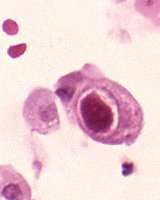
This photo shows an HCMV-infected cell.
(Medical Xpress) -- Tilting the scales in an ongoing debate, University of Wisconsin-Madison researchers have found new evidence that human cytomegalovirus (HCMV) is associated with glioblastoma multiforme (GBM), the brain cancer that killed Sen. Edward Kennedy.
The findings confirm what only a handful of scientists have found, but in a manner that University of Wisconsin School of Medicine and Public Health researchers believe enhances the scientific rigor of earlier studies.
The study, published in the advanced online edition (Nov. 16, 2011) of the Journal of Virology, hints for the first time that HCMV may work differently than other cancer-related viruses - possibly by affecting only tumor stem cells, self-renewing cells that keep the tumor growing.
The new research may place HCMV in an expanding group of viruses associated with cancer.
"As many as 15 to 20 percent of all human cancers are caused by viruses, and the number is growing," says HCMV expert Dr. Robert Kalejta, associate professor of oncology at the UW School of Medicine and Public Health (SMPH). "The viruses may not cause cancer on their own, but they play a critical role in the process."
Among others, human papilloma virus (HPV) causes cervical cancer, Epstein-Barr virus (EBV) causes lymphoma and hepatitis C virus (HCV) causes liver cancer.
HCMV's role in GBM has been debated, with many scientists and clinicians remaining skeptical. Oncologist Dr. Charles Cobbs of California Pacific Medical Center has been the main proponent of the theory that HCMV contributes to GBM.
Dr. John Kuo, assistant professor of neurological surgery and human oncology and a cancer stem cell scientist at the School of Medicine and Public Health, was one of the skeptical ones, but he says he's now convinced that HCMV is associated with human GBM specimens.
Still, the association does not prove a causal relationship between HCMV and the development of GBM, he says.
"This study may open up a new unexplored area of research for this incurable disease," says Kuo, who is director of the Comprehensive Brain Tumor Program at UW Hospital and Clinics. He also coordinates clinical trials as chair of the brain tumor group at the Carbone Cancer Center.
Kuo and colleagues on the UW brain tumor team currently treat GBM patients with the standard regimen of surgery, followed by radiation and chemotherapy. More research is needed before anti-viral drugs against HCMV could be considered for clinical trials, says Kuo, whose group contributed to the Journal of Virology paper.
Two years ago, Kalejta's team added support to Cobb's position when it showed that two HCMV proteins shut down a key protein that restricts tumor growth in general.
"HCMV can also do every one of the things that are generally considered the 10 hallmarks of cancer," says Kalejta, a member of the McArdle Laboratory for Cancer Research, Carbone Cancer Center, Stem Cell and Regenerative Medicine Center and Institute for Molecular Virology at UW-Madison.
The problem with studying HCMV is that the virus is present in a harmless way in almost everyone, so scientists can't ask if HCMV-positive people are more likely to get cancer than people without HCMV.
Kalejta's postdoctoral fellow Dr. Padhma Ranganatan used a standard laboratory test, rather than the ultra-sensitive test Cobb has used, to see if HCMV was present in 75 GBM samples. The UW-Madison researchers also looked to see if the entire virus genome - all of its DNA - rather than just a portion of it was present in the tissues. Finally, they wanted to learn if all cells within the tumor or just some of them were infected.
The analysis showed that HCMV is statistically more likely to be present in GBM sample tissues than in other brain tumor and epileptic brain tissues. The whole virus genome, not a portion of it, was present in GBM samples. And the data suggested that a minority of GBM cells were infected with HCMV.
"We hypothesize that HCMV may be infecting only tumor stem cells, unlike other viruses, which infect every single tumor cell," says Kalejta. "This leads us to predict that HCMV functions by a unique mechanism that no other virus uses."
Kalejta hopes to begin looking for the new mechanism soon. If there is such a mechanism, it could open a new door in cancer biology. It would also convert many more people to the idea that HCMV plays a key role in GBM.
"But I think the tide is now turning on the debate," Kalejta says.
Journal reference:
Journal of Virology
Provided by
University of Wisconsin-Madison
-
Could targeting a virus treat a common pediatric brain tumor?
Sep 26, 2011 |
not rated yet |
0
-
Common virus may help doctors treat deadly brain tumors
Oct 22, 2007 |
not rated yet |
0
-
Intriguing viral link to intestinal cancer in mice
Oct 11, 2010 |
not rated yet |
0
-
Welsh scientists 'clone' human virus
Sep 13, 2010 |
not rated yet |
0
-
Study in mice shows mechanisms behind immune responses to brain tumors
Jan 13, 2009 |
not rated yet |
0
-
Of mice and mental models: Neuroscientific implications of risk-optimized behavior in the mouse
May 25, 2012 |
not rated yet |
0
-
Limits to growth: Scientists identify key metastasis-enabling enzyme
May 22, 2012 |
5 / 5 (4) |
0
-
Seeing is as seeing does: Spatially-structured retinal input in early development of cortical maps
Apr 26, 2012 |
5 / 5 (4) |
1
-
Dreamless nights: Brain activity during nonrapid eye movement sleep
Apr 09, 2012 |
4.4 / 5 (12) |
0
-
Take your time: Neurobiology sheds light on the superiority of spaced vs. massed learning
Mar 28, 2012 |
4.5 / 5 (21) |
3
-
Potential Breakthrough in Seizure Control
10 hours ago
-
Popping/Cracked sternum.
15 hours ago
-
Which Mental Illness Encompasses This Problem?
15 hours ago
-
A question about drug tolerance
May 23, 2012
-
Poor nutrition leading to overeating?
May 23, 2012
-
Math and dyslexia?
May 21, 2012
- More from Physics Forums - Medical Sciences
More news stories
Skp2 activates cancer-promoting, glucose-processing Akt
HER2 and its epidermal growth factor receptor cousins mobilize a specialized protein to activate a major player in cancer development and sugar metabolism, scientists report in the May 25 issue of Cell.
Cancer
23 hours ago |
not rated yet |
0
|
Pancreatectomy OK without downstaging from therapy
(HealthDay) -- Pancreatectomy improves median survival in pancreatic cancer patients even when presurgical neoadjuvant therapy does not lead to radiographic downstaging of tumors, according to a study published ...
Cancer
May 25, 2012 |
not rated yet |
0
Common therapies for basal cell carcinoma offer similar survival
(HealthDay) -- For patients with superficial basal cell carcinoma (sBCC), treatment with imiquimod or photodynamic therapy (PDT) results in similar long-term tumor-free survival, according to a review published ...
Cancer
May 25, 2012 |
not rated yet |
0
Cancer may require simpler genetic mutations than previously thought
Chromosomal deletions in DNA often involve just one of two gene copies inherited from either parent. But scientists haven't known how a deletion in one gene from one parent, called a "hemizygous" deletion, can contribute ...
Cancer
May 25, 2012 |
not rated yet |
0
|
New prostate cancer screening guidelines face a tough sell, study suggests
(Medical Xpress) -- Recent recommendations from the U.S. Preventive Services Task Force (USPSTF) advising elimination of routine prostate-specific antigen (PSA) screening for prostate cancer in healthy men are likely to encounter ...
Cancer
May 25, 2012 |
not rated yet |
1
Travel to high altitudes tied to Crohn's, colitis flare-ups
(HealthDay) -- People with inflammatory bowel disease, which includes Crohn's disease and colitis, may be at increased risk for flare-ups when they fly or travel to high altitudes for skiing or mountain climbing, ...
Family history of Alzheimer's affects functional connectivity
(HealthDay) -- Cognitively normal individuals with a family history of late-onset Alzheimer's disease (AD) may display lower resting state functional connectivity in the default mode network (DMN) of the brain, ...
Transvaginal mesh op restores pelvic organ prolapse at price
(HealthDay) -- Transvaginal mesh (TVM) procedures are effective for anatomical restoration of pelvic organ prolapse (POP), but patients report a worsening of sexual function following surgery, according to ...
Tongue analysis software uses ancient Chinese medicine to warn of disease
For 5,000 years, the Chinese have used a system of medicine based on the flow and balance of positive and negative energies in the body. In this system, the appearance of the tongue is one of the measures used to classify ...
Early physical therapist treatment associated with reduced risk of healthcare utilization and reduced overall healthcare
A new study published in Spine shows that early treatment by a physical therapist for low back pain (LBP), as compared to delayed treatment, was associated with reduced risk of subsequent healthcare utilization and lower ...
Of mice and mental models: Neuroscientific implications of risk-optimized behavior in the mouse
(Medical Xpress) -- Regardless of an organism’s biological complexity, every encephalized animal continuously makes under-informed behavioral choices that can have serious consequences. Despite its ubiquity, ...