Researchers identify gene that causes rare dementing illness
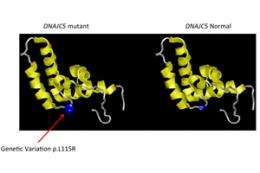
(Medical Xpress) -- By studying family members suspected of having Alzheimer’s disease, researchers at Washington University School of Medicine in St. Louis have identified a gene that causes a rare disorder highlighted by memory loss and motor impairments, and that leads to an early death.
The condition, known as Kufs disease, strikes middle-aged adults, but related forms also affect children and infants. Scientists say their discovery paves the way to development of a genetic test for Kufs and therapies to treat dementia, which is a hallmark of Kufs and of other neurodegenerative conditions, such as Alzheimer’s disease.
The research is reported online in the journal PLoS ONE.
The investigators found variations in the DNAJC5 gene were responsible for Kufs disease. The gene has not been associated with any human disease previously. It plays a role in transmitting signals in the brain between the nerve-cell junctions known as synapses.
“What caught our attention is that synaptic dysfunction underlies other forms of dementia,” says first author Bruno Benitez, MD. “We think this Kufs-causing gene may open up a new avenue of research for these kinds of disorders because it may provide new information about dementia in general. That’s why we think this discovery could have implications beyond this rare disease.”
Kufs disease is one of a group of disorders known as neuronal ceroid lipofuscinoses (NCLs), which affect two to four out of every 100,000 newborns worldwide. Kufs disease makes up fewer than 10 percent of those cases and affects mainly adults, but it can strike individuals from 6 to 60, and it is invariably fatal. Other related disorders, such as Batten disease and Jansky-Sielschowsky disease, affect children and infants, respectively. Most NCLs are inherited from parents as a recessive trait.
The most common symptoms of the adult forms of NCLs include dementia, mental retardation, movement disorders, seizures and lack of muscle coordination. Currently, there are no known treatments, but drugs often are prescribed to treat symptoms such as seizures.
The study involved two Kufs disease patients from the same family who originally came to Washington University’s Alzheimer’s Disease Research Center because their memory problems were thought to be Alzheimer’s-related.
The initial symptoms of the illnesses can be very similar, but the difference can be distinguished by measuring the accumulation of lipopigments inside the cells. Lipopigments are made up of fats and proteins. Their name comes from “lipo,” which is short for “lipid” or fat, and from pigment, because they appear to be a greenish-yellow color when viewed under an ultraviolet light microscope. In Kufs disease, there are abnormal lipopigment levels in most of the cells in the patient’s body.
Benitez is a postdoctoral research associate in the laboratory of Carlos Cruchaga, PhD, assistant professor of psychiatry. The two worked together to identify genetic mutations that contribute to the illness.
They sequenced DNA from the two related Kufs disease patients and from a first-degree relative who did not have the disease, and then they compared the results.
Using a technique called whole-exome sequencing to analyze only the regions of DNA that make proteins, which make up about 2 percent of a person’s genetic material, they began to home in on the genetic changes responsible for Kufs disease.
“It’s nearly impossible to tell when a single DNA variant causes a problem because there are about 3,000 unique variations in every person,” Cruchaga says. “But by comparing the DNA from the two related patients to the unaffected relative, we narrowed down the number of variants to 24.”
Then, the researchers studied the DNA of more family members and winnowed the number of variants to three. Finally, they looked at DNA from people without the disease and found that two of the variants occurred in some healthy people without Kufs disease. That left only one causal variant.
The researchers also sequenced the gene in other families affected by Kufs. That led the investigators to identify additional genetic variations, but each one was located on the same DNAJC5 gene and caused changes in a protein involved in nerve-cell signaling in the brain.
“That was when we really knew that we’d found what we were looking for,” Cruchaga says.
He says the discovery makes it possible to develop a genetic test to tell relatives of Kufs disease patients whether they also will develop the disease. The discovery also may help physicians diagnose related disorders that strike young children.
“Now that we know the gene that causes Kufs, we want to learn more about how changes in that gene cause the disease,” Cruchaga says. “Knowing what is going on in the biology of the disorder can help us look for therapies. And because there are several related forms of the disease, it may be possible to develop therapies for one form of the disease that also would be useful in another.”
More information: Benitez BA, Alvarado D, Cai Y, Mayo K, Chakravery S, Norton J, Morris JC, Sands M, Goate AM, Cruchaga C, Exome-sequencing confirms DNAJC5 mutations as cause of Adult Neuronal Ceroid-Lipofuscinosis. PLoS ONE, available online at: dx.plos.org/10.1371/journal.pone.0026741


