Giffords faces long road, wants to return to Hill
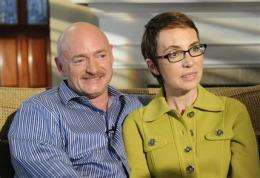
(AP) -- Debating opponents. Negotiating compromises. Raising money. The demands of Congress are great for anyone, much less someone recovering from a gunshot to the head like Rep. Gabrielle Giffords.
Giffords' first televised interview showed a lively woman making good progress in recovering from a devastating brain injury, yet still struggling mightily to pull out the words she wants. Only 10 months after her injury, brain specialists unconnected with Giffords' care say she'll almost certainly continue to improve. But no one can predict how much or how fast.
How the brain rewires itself after trauma - making new connections or recruiting an undamaged area to compensate for a damaged one - is largely a mystery. But most people with severe brain injuries never emerge as exactly the same person they were before, and lingering impairment could make a return to Congress a difficult decision for Giffords and her family.
The stress of the job should get consideration, said Dr. Jordan Grafman, director of the Traumatic Brain Injury Research Laboratory at the Kessler Foundation Research Center in West Orange, N.J.
"A little stress makes us sharp. A lot of stress kills neurons," said Grafman, who has long studied penetrating brain injuries but hasn't examined Giffords. After a severe brain injury, "I really don't think you'd want to be exposed to the level of stress that you'd be exposed to in Congress. I wouldn't want to."
Monday's interview on ABC was the first opportunity for the public to get a detailed look beyond the reassurances of Giffords' friends and physicians about how she's fared since being shot on Jan. 8. It was a chance to see what someone who's making a recovery often called miraculous or remarkable really looks like.
Giffords appeared determined and confident, but she struggled to form multiple-word sentences, much less string them together for a detailed conversation. With the help of her husband, Mark Kelly, she said she wouldn't return to Congress until she was "better." The filing deadline to run to for re-election to her House seat is May 30.
On Tuesday, Giffords' staff released on her Facebook page a more complex, minute-long recording made last week, two weeks after the ABC interview. In it, she says wants to get back to work.
"I'm getting stronger. I'm getting better," Giffords says still somewhat haltingly. She adds, "There is a lot to say. I will speak better."
Giffords read a script for the recording, which required multiple takes "until she was happy with it," said spokesman Mark Kimble.
To independent brain specialists, Giffords' speech thus far is good, considering the bullet passed right by an important speech region in the brain's left side.
"I think she's way ahead of the curve," said Dr. Ross Bullock, chief of neurotrauma at the University of Miami and Jackson Memorial Hospital. "Just as people's faces are different and personalities are different, just where those collections of really important cells are located varies from person to person," making it impossible to say how much her speech region was damaged.
Indeed, video taken by Kelly of his wife's hard slog through rehabilitation showed a hugely common frustration: People with all kinds of brain injuries recall, once they can speak again, that they knew what word they wanted but a completely unrelated one popped out from their brain's tangled wiring. "Spoon," Giffords kept saying to a therapist early on, instead of "chair."
Recovery from a brain injury is most dramatic in the first year, especially in the first three to six months. Much of that early improvement is spontaneous as the brain's networks reorganize themselves, said Dr. Robert Laureno, neurology chairman at Washington Hospital Center.
The recovery can continue for two years although more slowly, the kinds of changes more noticeable to people you don't see often, Grafman said. Rehab helps to spur the brain's continued rewiring, what scientists call plasticity. Giffords' adaptable personality and motivation give her an obvious advantage, he added.
People can return successfully to high-profile jobs after serious brain injuries. Sen. Tim Johnson, D-S.D., suffered a brain hemorrhage in December 2006 and returned to the Senate the following fall. His speech was a bit slurred, and sometimes he used a scooter to get around. He later won re-election and chairs the Banking Committee.
Grafman says patients must adapt to lingering impairments, with the help of families who are best able to tell if they're making good judgments. For Giffords, a supportive congressional staff can do a lot of the work. But at some point, he noted, "people are going to ask hard questions. How is she going to handle them?"
©2011 The Associated Press. All rights reserved. This material may not be published, broadcast, rewritten or redistributed.


