Grant funds feasibility study of microneedle patches for polio vaccination
November 7, 2011 in Medical research
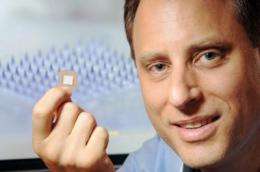
Georgia Tech Regents’ professor Mark Prausnitz holds a prototype microneedle patch with a microscope image of the microneedles shown in the background. Researchers from Georgia Tech and the CDC have received funding to study the use of such patches for polio vaccination. Credit: Georgia Tech Photo: Gary Meek
The Georgia Institute of Technology will receive funding through Grand Challenges Explorations, an initiative created by the Bill & Melinda Gates Foundation that enables researchers worldwide to test unorthodox ideas that address persistent health and development challenges. Mark Prausnitz, Regents' professor in Georgia Tech's School of Chemical and Biomolecular Engineering, will pursue an innovative global health research project focused on using microneedle patches for the low-cost administration of polio vaccine through the skin in collaboration with researchers Steve Oberste and Mark Pallansch of the US Centers for Disease Control and Prevention (CDC).
Grand Challenges Explorations funds scientists and researchers worldwide to explore ideas that can break the mold in how we solve persistent global health and development challenges. The Georgia Tech/CDC project is one of 110 Grand Challenges Explorations grants announced November 7th.
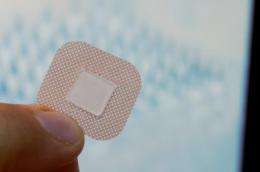
Patches containing tiny microneedles could one day replace conventional hypodermic needles for drug and vaccine delivery. Researchers from Georgia Tech and the CDC have received funding to study the use of such patches for polio vaccination. Credit: Georgia Tech Photo: Gary Meek
"We believe in the power of innovation -- that a single bold idea can pioneer solutions to our greatest health and development challenges," said Chris Wilson, director of global health discovery for the Bill & Melinda Gates Foundation. "Grand Challenges Explorations seeks to identify and fund these new ideas wherever they come from, allowing scientists, innovators and entrepreneurs to pursue the kinds of creative ideas and novel approaches that could help to accelerate the end of polio, cure HIV infection or improve sanitation."Projects that are receiving funding show promise in tackling priority global health issues where solutions do not yet exist. This includes finding effective methods to eliminate or control infectious diseases such as polio and HIV as well as discovering new sanitation technologies.
The goal of the Georgia Tech/CDC project is to demonstrate the scientific and economic feasibility for using microneedle patches in vaccination programs aimed at eradicating the polio virus. Current vaccination programs use an oral polio vaccine that contains a modified live virus. This vaccine is inexpensive and can be administered in door-to-door immunization campaigns, but in rare cases the vaccine can cause polio. There is an alternative injected vaccine that uses killed virus, which carries no risk of polio transmission, but is considerably more expensive than the oral vaccine, requires refrigeration for storage and must be administered by trained personnel. To eradicate polio from the world, health officials will have to discontinue use of the oral vaccine with its live virus, replacing it with the more expensive and logistically-complicated injected vaccine.
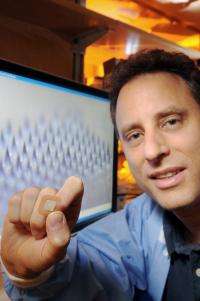
Georgia Tech Regents’ professor Mark Prausnitz holds a prototype microneedle patch with a microscope image of the microneedles shown in the background. Researchers from Georgia Tech and the CDC have received funding to study the use of such patches for polio vaccination. Credit: Georgia Tech Photo: Gary Meek
Prausnitz and his CDC collaborators believe the use of microneedle patches could reduce the cost and simplify administration of the injected vaccine. Use of the patches, which carry vaccine into the body by dissolving into the skin, could eliminate the need for administration by highly-trained personnel and the "sharps" disposal problems of traditional hypodermic needles. Because skin administration produces an immune response with smaller doses of vaccine than traditional deep intramuscular injection, the researchers expect to reduce the per-person cost of vaccine. And by incorporating dried vaccine into the microneedles, they hope to eliminate the need for vaccine refrigeration a challenge in remote areas of the world."We envision vaccination campaigns in which minimally-trained personnel go door-to-door administering microneedle patches rather than oral polio vaccine," Prausnitz explained. "Our goal for this study will be to provide the data to scientifically justify moving the microneedle patch for polio vaccination into a human trial."
In research that will complement the Grand Challenges Exploration grant, Prausnitz and his team have also received funding from the World Health Organization (WHO) to support development of the polio vaccine application for microneedle patches. And in a project sponsored by the U.S. National Institutes of Health (NIH), Prausnitz and other Georgia Tech researchers are collaborating with Emory University scientists on development of a microneedle patch for administering flu vaccine.
Provided by
Georgia Institute of Technology
-
Vaccine-delivery patch with dissolving microneedles eliminates 'sharps,' boosts protection
Jul 18, 2010 |
not rated yet |
0
-
Study shows H1N1 microneedle vaccine protects better than injection
Jul 12, 2011 |
not rated yet |
0
-
Flu vaccine given in microneedle skin patches proves effective in mice
Apr 27, 2009 |
not rated yet |
0
-
Polio eradication hinges on four countries
Oct 13, 2006 |
not rated yet |
0
-
New polio vaccine raises hope for eradication: study
Oct 26, 2010 |
not rated yet |
0
-
Motion perception revisited: High Phi effect challenges established motion perception assumptions
Apr 23, 2013 |
3 / 5 (2) |
2
-
Anything you can do I can do better: Neuromolecular foundations of the superiority illusion (Update)
Apr 02, 2013 |
4.5 / 5 (11) |
5
-
The visual system as economist: Neural resource allocation in visual adaptation
Mar 30, 2013 |
5 / 5 (2) |
9
-
Separate lives: Neuronal and organismal lifespans decoupled
Mar 27, 2013 |
4.9 / 5 (8) |
0
-
Sizing things up: The evolutionary neurobiology of scale invariance
Feb 28, 2013 |
4.8 / 5 (10) |
14
-
Why is zone 1 in liver more prone to ischemic injury?
May 23, 2013
-
How can there be villous adenoma in colon, if there are no villi there
May 22, 2013
-
How can there be a term called "intestinal metaplasia" of stomach
May 21, 2013
-
Pressure-volume curve: Elastic Recoil Pressure don't make sense
May 18, 2013
-
If you became brain-dead, would you want them to pull the plug?
May 17, 2013
-
MRI bill question
May 15, 2013
- More from Physics Forums - Medical Sciences
More news stories
Study reveals new mechanism for estrogen suppression of liver lipid synthesis
By discovering the new mechanism by which estrogen suppresses lipid synthesis in the liver, UC Irvine endocrinologists have revealed a potential new approach toward treating certain liver diseases.
Medical research
May 23, 2013 |
5 / 5 (1) |
0
|
MRI-based measurement helps predict vascular disease in the brain
Aortic arch pulse wave velocity, a measure of arterial stiffness, is a strong independent predictor of disease of the vessels that supply blood to the brain, according to a new study published in the June issue the journal ...
Medical research
May 23, 2013 |
not rated yet |
0
Antibiotics: A new understanding of sulfonamide nervous system side effects
Since the discovery of Prontosil in 1932, sulfonamide antibiotics have been used to combat a wide spectrum of bacterial infections, from acne to chlamydia and pneumonia. However, their side effects can include serious neurological ...
Medical research
May 23, 2013 |
3 / 5 (1) |
0
|
Scientists discover molecule triggers sensation of itch
Scientists at the National Institutes of Health report they have discovered in mouse studies that a small molecule released in the spinal cord triggers a process that is later experienced in the brain as ...
Medical research
May 23, 2013 |
5 / 5 (3) |
0
|
Discarded immune cells induce the relocation of stem cells
Spanish researchers have discovered that the daily clearance of neutrophils from the body stimulates the release of hematopoietic stem cells from the bone marrow into the bloodstream, according to a report published today ...
Medical research
May 23, 2013 |
5 / 5 (2) |
0
First drug to improve heart failure mortality in over a decade
Coenzyme Q10 decreases all cause mortality by half, according to the results of a multicentre randomised double blind trial presented today at Heart Failure 2013 congress. It is the first drug to improve heart failure mortality ...
Heart failure accelerates male 'menopause'
Heart failure accelerates the aging process and brings on early andropausal syndrome (AS), according to research presented today at the Heart Failure Congress 2013. AS, also referred to as male 'menopause', was four times ...
Seniors more likely to crash when driving with pet, study finds
(HealthDay)—Animals make great companions for senior citizens, but elderly people who always drive with a pet in the car are far more likely to crash than those who never drive with a pet, researchers have ...
New immune system discovered
(Medical Xpress)—A research team, led by Jeremy Barr, a biology post-doctoral fellow, unveils a new immune system that protects humans and animals from infection.
Death highest in heart failure patients admitted in January, on Friday, and overnight
Mortality and length of stay are highest in heart failure patients admitted in January, on Friday, and overnight, according to research presented today at the Heart Failure Congress 2013. The analysis of nearly 1 million ...
Feds fight morning-after pill age ruling in NY
(AP)—Department of Justice lawyers have again asked a federal appeals court in New York to delay lifting age restrictions and prescription requirements on an emergency contraceptive popularly known as the morning-after ...

