Molecule serves as a key in some protein interactions
November 4, 2011 in Medical research
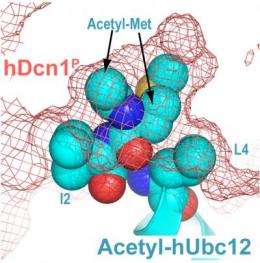
Work led by St. Jude Children's Research Hospital scientists has identified a new function for the acetyl group attached to N-terminal end of protein. This modification occurs on between 30 and 80 percent of proteins, although its function has been generally unknown. The research focused on the interaction of the Ubc12 and Dcn1 proteins but investigators said the same mechanism might also be at work in thousands of other protein interactions. This image shows a portion of the crystal structure of the Ubc12-Dcn1 complex. The spheres represent the acetyl group and the methionine amino acid at the N-terminus of Ubc12 to which it is attached, and two other surrounding amino acids. The mesh represents the pocket on Dcn1 where the acetyl-methionine fits like a key in a key-hole. Researchers showed this connection served to accelerate the work of the Ubc12-Dcn1 complex, which helps regulate cell division. Notably, Dcn1 has been linked to cancer. Credit: Image courtesy of Science/AAAS
Research led by St. Jude Children's Research Hospital scientists has identified an unexpected mechanism facilitating some protein interactions that are the workhorses of cells and, in the process, identified a potential new cancer drug development target.
The discovery involves a chemical known as an acetyl group. An estimated 85 percent of human proteins have this chemical added to the amino acid at one end of the protein. The addition comes in a process known as N-terminal acetylation. N-terminal acetylation occurs shortly after proteins are assembled. Although it has long been known that proteins are N-terminally acetylated, until now it was unknown how such acetylation could serve specific functions.
The findings came from scientists studying a system cells use to regulate the fate and function of proteins. The researchers showed that much like a key must fit precisely to work a lock, the acetylated end of one enzyme fits perfectly into a deep pocket on the surface of another protein. The connection helps accelerate the activity of a protein complex that is involved in regulating cell division and that has been linked to cancer. The research appears in the November 4 print edition of the journal Science.
The findings have potential implications for drug discovery and for understanding basic mechanisms governing the interaction of possibly thousands of proteins, said the study's senior author, Brenda Schulman, Ph.D., a member of the St. Jude Department of Structural Biology and a Howard Hughes Medical Institute investigator.
"The work presents a major new concept in protein-protein interactions," she said. "This raises the question of whether similar 'keys' on thousands of different proteins also unlock doors to allow them to function."
The research offers the first view of how N-terminal acetylation mediates protein interactions, bringing proteins together to do the work of cells. "These findings raise the possibility that N-terminal acetylation plays an important role in the function of a large number of proteins in the cell," said first author, Daniel Scott, Ph.D. a scientist in Schulman's laboratory.
The pocket where N-terminally acetylated proteins bind may also be a good target for small molecules designed to block protein interactions that lead to many diseases, including cancers, Schulman said.
Schulman and her colleagues discovered the pivotal role N-terminal acetylation plays while studying interactions between the proteins Ubc12 and Dcn1. Other researchers have identified human Dcn1 as an oncogene that promotes some squamous cell head, neck and lung cancers.
The focus of the current study was the role the enzymes played in regulating activity of another complex, known as cullin-RING. The cullin-RING complex is the command center of a tagging system that cells use to modify a protein's function or to mark a protein for degradation. The cullin-RING targeted proteins include those that control such important biological processes as cell division and the immune response.
Dcn1 is bound to the cullin protein. In previous studies, Schulman and her colleagues showed that in yeast the Ubc12 and Dcn1 interaction led Ubc12 to transfer its cargo, a protein called NEDD8, to cullin. That step dramatically accelerated the activity of cullin-RING.
But a major question was how human Dcn1 and Ubc12 interact. The breakthrough came when the researchers realized that Ubc12 is among the 35 to 50 percent of proteins in which methionine is the amino acid involved in N-terminal acetylation. The investigators used a variety of laboratory techniques to demonstrate that the acetylated methionine of Ubc12 was essential to the Ubc12-Dcn1 interaction. Evidence included an X-ray image that shows Ubc12's acetyl-methionine buried in a pocket on the surface of Dcn1.
"The size and shape of the pocket indicate it might be a completely new route to generating small- molecule inhibitors," Schulman said. Pharmaceutical companies are already targeting other parts of the same NEDD8 pathway, and one experimental drug has entered clinical trials.
Not only does Ubc12's acetylated tail fit perfectly into the pocket, but acetylation solved another problem that would have made the interaction of Ubc12 and Dcn1 difficult. Without acetylation, Ubc12 and the Dcn1 pocket would repel each other much like oil and water. Acetylation neutralizes the charge on Ubc12, allowing the interaction to occur, Schulman said.
Provided by St. Jude Children's Research Hospital
-
New insights into how cells accessorize their proteins
Sep 18, 2008 |
not rated yet |
0
-
Modification of mutant huntingtin protein increases its clearance from brain cells
Apr 02, 2009 |
not rated yet |
0
-
Scientists locate disease switches
Jul 17, 2009 |
not rated yet |
0
-
Chemical tags likely to affect metabolism, cancer development
Feb 18, 2010 |
not rated yet |
0
-
Study suggests another avenue for detecting Alzheimer's disease
Apr 01, 2011 |
not rated yet |
0
-
Of mice and mental models: Neuroscientific implications of risk-optimized behavior in the mouse
May 25, 2012 |
not rated yet |
0
-
Limits to growth: Scientists identify key metastasis-enabling enzyme
May 22, 2012 |
5 / 5 (4) |
0
-
Seeing is as seeing does: Spatially-structured retinal input in early development of cortical maps
Apr 26, 2012 |
5 / 5 (4) |
1
-
Dreamless nights: Brain activity during nonrapid eye movement sleep
Apr 09, 2012 |
4.4 / 5 (12) |
0
-
Take your time: Neurobiology sheds light on the superiority of spaced vs. massed learning
Mar 28, 2012 |
4.5 / 5 (21) |
3
-
Potential Breakthrough in Seizure Control
10 hours ago
-
Popping/Cracked sternum.
15 hours ago
-
Which Mental Illness Encompasses This Problem?
15 hours ago
-
A question about drug tolerance
May 23, 2012
-
Poor nutrition leading to overeating?
May 23, 2012
-
Math and dyslexia?
May 21, 2012
- More from Physics Forums - Medical Sciences
More news stories
Implantable pain disk may help those with cancer
An estimated 3.5 million cancer patients around the globe are in severe pain from their disease, but many get no relief.
Medical research
May 25, 2012 |
not rated yet |
0
|
Energy levels link sleep control mechanisms
Sleep, or lack of it, can determine level of cognitive performance which is linked with accidents as well as increased risk of serious health problems. Links between cell energy levels, gene transcription ...
Medical research
May 25, 2012 |
not rated yet |
0
Researchers identify key brain cell in antidepressant action
(Medical Xpress) -- Antidepressant medications such as Prozac have helped improve mood and lessen anxiety in millions of people with major depression. But scientists know surprisingly little about how these drugs work.
Medical research
May 25, 2012 |
4.7 / 5 (3) |
0
|
Rockefeller scientists pioneer new method to determine mechanisms of drug action
(Medical Xpress) -- Knowing that a drug works is great. Knowing how it works is a luxury. And until now, determining a drugs mechanism of action has been a tedious and difficult process for scientists.
Medical research
May 25, 2012 |
not rated yet |
0
|
Like curry? New biological role identified for compound used in ancient medicine
Scientists have just identified a new reason why some curry dishes, made with spices humans have used for thousands of years, might be good for you.
Medical research
May 25, 2012 |
4.5 / 5 (12) |
2
|
Travel to high altitudes tied to Crohn's, colitis flare-ups
(HealthDay) -- People with inflammatory bowel disease, which includes Crohn's disease and colitis, may be at increased risk for flare-ups when they fly or travel to high altitudes for skiing or mountain climbing, ...
Family history of Alzheimer's affects functional connectivity
(HealthDay) -- Cognitively normal individuals with a family history of late-onset Alzheimer's disease (AD) may display lower resting state functional connectivity in the default mode network (DMN) of the brain, ...
Transvaginal mesh op restores pelvic organ prolapse at price
(HealthDay) -- Transvaginal mesh (TVM) procedures are effective for anatomical restoration of pelvic organ prolapse (POP), but patients report a worsening of sexual function following surgery, according to ...
Tongue analysis software uses ancient Chinese medicine to warn of disease
For 5,000 years, the Chinese have used a system of medicine based on the flow and balance of positive and negative energies in the body. In this system, the appearance of the tongue is one of the measures used to classify ...
Skp2 activates cancer-promoting, glucose-processing Akt
HER2 and its epidermal growth factor receptor cousins mobilize a specialized protein to activate a major player in cancer development and sugar metabolism, scientists report in the May 25 issue of Cell.
Early physical therapist treatment associated with reduced risk of healthcare utilization and reduced overall healthcare
A new study published in Spine shows that early treatment by a physical therapist for low back pain (LBP), as compared to delayed treatment, was associated with reduced risk of subsequent healthcare utilization and lower ...