Scientists design experimental treatment for iron-overload diseases
November 1, 2011 in Medical research
Scientists design experimental treatment for iron-overload diseases

Enlarge

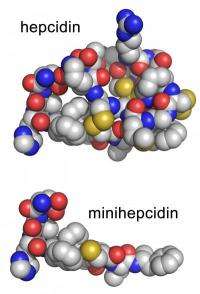
Structure of the human hormone hepcidin (top panel) and the portion used for the minihepcidin design (bottom panel). Credit: UCLA

Iron overload is a common condition affecting millions of people worldwide. Excess iron in the body is toxic, and deposits can cause damage to the liver, heart and other organs. Current treatments, researchers say, are not ideal and have significant side effects.

Iron in the body is regulated by a hormone called , and a deficiency in this hormone can cause the seen in genetic disorders like hereditary hemochromatosis and Cooley's .

In the hopes of finding a treatment for iron overload, UCLA researchers have developed a new type of therapy based on small that mimic the effects of hepcidin in mice. Published online Nov. 1 in the peer-reviewed , their findings could lead to to help prevent the condition.

Hepcidin works by fitting into a receptor protein known as ferroportin, which causes a change in iron flow in the body. The UCLA team systematically worked with the hormone–receptor interface to learn how the two pieces fit together and which part of hepcidin is the most important for binding to ferroportin.

"Like with jigsaw puzzle pieces, we tried to find the best fit," said Dr. Elizabeta Nemeth, the study's senior author and an associate professor of medicine at the David Geffen School of Medicine at UCLA.

Nemeth, co-director of the UCLA Center for Iron Disorders, noted that this is the first attempt to develop medications that mimic hepcidin. Because hepcidin contains 25 amino acids and numerous disulfide bonds, it would be expensive and difficult to reproduce the hormone as a medication.

The UCLA team zeroed in on the areas of hepcidin and ferroportin that provided the best fit to generate iron-regulating activity. Surprisingly, they found that the first third of the

hepcidin molecule had an effect similar to that of the whole molecule. They then re-engineered this portion of the molecule to make it even more effective and named the resulting new molecules "minihepcidins."
Scientists design experimental treatment for iron-overload diseases
Enlarge

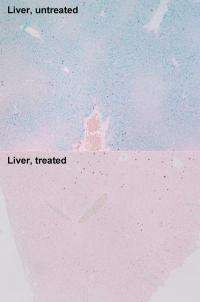
Minihepcidin treatment prevents liver iron loading in mice with hereditary hemochromatosis. The top panel shows a liver section from a mouse treated with placebo only, and the bottom panel shows a liver section from a mouse treated with minihepcidin. Blue color reveals iron deposits, pink color identifies cells with low iron content. Treatment with minihepcidin for two weeks prevented harmful accumulation of iron in the liver. Credit: UCLA

"We found that just a few amino acids were enough to provide an effective scaffold for the minihepcidin design," said Piotr Ruchala, a visiting assistant professor of medicine at the Geffen School of Medicine.

The team confirmed that the minihepcidins were effective in healthy and demonstrated that they could prevent iron overload in mouse models of hereditary hemochromatosis.

"Using this structure and function analysis, we were able to develop minihepcidins that were even more effective than the naturally occurring hormone," said study author Dr. Tomas Ganz, a professor of medicine and pathology and co-director of the Center for Iron Disorders at the Geffen School of Medicine.

Ganz added that the UCLA findings built on previous research by the team and collaborators around the world that originally helped identify the role of hepcidin and ferroportin in iron regulation.

The next step is to identify the optimal form of minihepcidin for human trials. According to UCLA researchers, if the molecules' safety and efficacy is confirmed, minihepcidins could be used alone or together with current treatments for iron-overload diseases.

The study was funded by the National Institute of Diabetes, Digestive and Kidney Diseases, which is part of the National Institutes of Health, and the Will Rogers Fund.

UCLA is currently negotiating a license to this technology with a biotechnology company that will take the minihepcidins through pre-clinical development and into clinical trials.

Provided by University of California - Los Angeles

not rated yet  

Rank not rated yet
Relevant PhysicsForums posts
  • Potential Breakthrough in Seizure Control
    created12 hours ago
  • Popping/Cracked sternum.
    created17 hours ago
  • Which Mental Illness Encompasses This Problem?
    created17 hours ago
  • A question about drug tolerance
    createdMay 23, 2012
  • Poor nutrition leading to overeating?
    createdMay 23, 2012
  • Math and dyslexia?
    createdMay 21, 2012
  • More from Physics Forums - Medical Sciences

More news stories

Implantable pain disk may help those with cancer

An estimated 3.5 million cancer patients around the globe are in severe pain from their disease, but many get no relief.

Medical research created May 25, 2012 | popularity not rated yet | comments 0 | with audio podcast

Energy levels link sleep control mechanisms

Sleep, or lack of it, can determine level of cognitive performance which is linked with accidents as well as increased risk of serious health problems. Links between cell energy levels, gene transcription ...

Medical research created May 25, 2012 | popularity not rated yet | comments 0

Researchers identify key brain cell in antidepressant action

(Medical Xpress) -- Antidepressant medications such as Prozac have helped improve mood and lessen anxiety in millions of people with major depression. But scientists know surprisingly little about how these drugs work.

Medical research created May 25, 2012 | popularity 4.7 / 5 (3) | comments 0 | with audio podcast

Rockefeller scientists pioneer new method to determine mechanisms of drug action

(Medical Xpress) -- Knowing that a drug works is great. Knowing how it works is a luxury. And until now, determining a drug’s mechanism of action has been a tedious and difficult process for scientists.

Medical research created May 25, 2012 | popularity not rated yet | comments 0 | with audio podcast

Like curry? New biological role identified for compound used in ancient medicine

Scientists have just identified a new reason why some curry dishes, made with spices humans have used for thousands of years, might be good for you.

Medical research created May 25, 2012 | popularity 4.5 / 5 (12) | comments 2 | with audio podcast


Travel to high altitudes tied to Crohn's, colitis flare-ups

(HealthDay) -- People with inflammatory bowel disease, which includes Crohn's disease and colitis, may be at increased risk for flare-ups when they fly or travel to high altitudes for skiing or mountain climbing, ...

Family history of Alzheimer's affects functional connectivity

(HealthDay) -- Cognitively normal individuals with a family history of late-onset Alzheimer's disease (AD) may display lower resting state functional connectivity in the default mode network (DMN) of the brain, ...

Transvaginal mesh op restores pelvic organ prolapse at price

(HealthDay) -- Transvaginal mesh (TVM) procedures are effective for anatomical restoration of pelvic organ prolapse (POP), but patients report a worsening of sexual function following surgery, according to ...

Tongue analysis software uses ancient Chinese medicine to warn of disease

For 5,000 years, the Chinese have used a system of medicine based on the flow and balance of positive and negative energies in the body. In this system, the appearance of the tongue is one of the measures used to classify ...

Of mice and mental models: Neuroscientific implications of risk-optimized behavior in the mouse

(Medical Xpress) -- Regardless of an organism’s biological complexity, every encephalized animal continuously makes under-informed behavioral choices that can have serious consequences. Despite its ubiquity, ...

Weight struggles? Blame new neurons in your hypothalamus

New nerve cells formed in a select part of the brain could hold considerable sway over how much you eat and consequently weigh, new animal research by Johns Hopkins scientists suggests in a study published in the May issue ...