Ultrathin flexible brain implant offers unique look at seizures
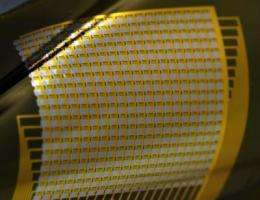
Researchers funded by the National Institutes of Health have developed a flexible brain implant that could one day be used to treat epileptic seizures. In animal studies, the researchers used the device – a type of electrode array that conforms to the brain's surface – to take an unprecedented look at the brain activity underlying seizures.
"Someday, these flexible arrays could be used to pinpoint where seizures start in the brain and perhaps to shut them down," said Brian Litt, M.D., the principal investigator and an associate professor of neurology at the University of Pennsylvania School of Medicine in Philadelphia. The findings appear in this month's Nature Neuroscience. The team will also discuss their findings at the 2011 Society for Neuroscience meeting, Nov. 12-16 in Washington, D.C.
"This group's work reflects a confluence of skills and advances in electrical engineering, materials science and neurosurgery," said Story Landis, Ph.D., director of NIH's National Institute of Neurological Disorders and Stroke (NINDS), which helped fund the work. "These flexible electrode arrays could significantly expand surgical options for patients with drug-resistant epilepsy."
In an animal model, the researchers saw spiral waves of brain activity not previously observed during a seizure. Similar waves are known to ripple through cardiac muscle during a type of life-threatening heart rhythm called ventricular fibrillation.
"If our findings are borne out in human studies, they open up the possibility of treating seizures with therapies like those used for cardiac arrhythmias," said Dr. Litt. Epilepsy surgery could become more analogous to ablation procedures for cardiac arrhythmias. In these procedures electrodes are used to detect aberrant electrical circuits in the heart muscle, which are then interrupted by making tiny lesions in the muscle. A stimulating electrode array might one day be designed to suppress seizure activity, working like a pacemaker for the brain, Dr. Litt said.
The brain contains billions of interconnected neurons that normally transmit electrical pulses. During a seizure, these pulses occur in abnormal, synchronized, rapid-fire bursts that can cause convulsions, loss of consciousness and other symptoms.
More than 20 drugs are on the market for epilepsy, but they do not always provide adequate seizure control. Surgery can be an effective treatment option for people with drug-resistant epilepsy and commonly involves removing, or resecting, an area of the brain where the seizures originate. Electrode arrays are used to map the seizures and guide resection surgery.
The arrays currently used to record seizure activity in patients being considered for surgery consist of electrodes attached to a rubbery base about the thickness of a credit card. These arrays are placed on the surface of the brain, but they are not flexible enough to mold to the brain's many folds. The electrodes are widely spaced and allow for only limited brain coverage.
The array developed by Dr. Viventi and his colleagues is made of a pliable material that is only about one quarter the thickness of a human hair. It contains 720 silicon nanomembrane transistors in a multiplexed 360-channel array, which allow for minimal wiring and dense packing of the electrodes. "This technology allows us to see patterns of activity before and during a seizure at a very fine scale, with broad coverage of the brain," said Jonathan Viventi, Ph.D., the study's lead author and an assistant professor at the Polytechnic Institute of New York University and New York University.
The flexibility of the array allows it to conform to the brain's complex shape, even reaching into grooves that are inaccessible to conventional arrays. With further engineering, the array could be rolled into a tube and delivered into the brain through a small hole rather than by opening the skull, the researchers said.
The researchers tested the flexible array on cats. Although mice and rats are used for most neuroscience research, cats have larger brains that are anatomically more like the human brain, with simplified folds and grooves.
The team evaluated the array in multiple contexts and brain areas. They found that it could record brain responses as the cats viewed simple objects, and sleep rhythms while the cats were under anesthesia. In one set of experiments, the researchers recorded brain activity during seizures that were induced with a drug.
"We were able to watch as spiral waves began and became self-sustaining," said Dr. Litt.
Using their flexible array technology, the researchers hope to identify these spiral brainwaves in people with epilepsy, to monitor seizures, and perhaps to control them. "We should be able to model the spirals and determine what kind of waveform can stop them. Or we can watch the spirals terminate spontaneously and try to reproduce what we see by stimulating the brain electrically," Dr. Litt said.
More information: Viventi J et al. Flexible, foldable, actively multiplexed, high-density electrode array for mapping brain activity in vivo. Nature Neuroscience, published online November 13, 2011.


