Discovery of a new reprogramming mechanism for tumor cells
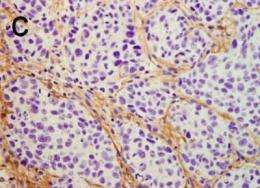
The image shows the formation of new blood vessels in tumorous tissue do to the presence of CEPB-4. Credit: IRB Barcelona / IMIM
Barcelona, 1st December, 2011.- A study by researchers Raúl Méndez, ICREA Research Professor at the Institute for Research in Biomedicine (IRB Barcelona) and Pilar Navarro at the IMIM (Institut de Recerca Hospital del Mar, Barcelona) describes a new reprogramming mechanism for the expression of genes responsible for turning a healthy cell into a tumor cell. In the study, published in this week's edition of Nature Medicine, the scientists have identified the protein CPEB4 as a "cellular orchestra conductor" that "activates" hundreds of genes associated with tumor growth.
"The peculiarity is that it would not only be the mutation of a specific gene that promotes tumor growth but the expression of a protein in an incorrect site that "triggers" hundreds of messenger molecules (mRNAs), which transmit gene information for the synthesis of proteins, without these genes being mutated. This process leads to the expression of many "normal" genes but in unsuitable amounts and times that more greatly resemble early embryonic developmental stages rather than the stages of adult organ development", explains Raúl Méndez, an expert in the CPEB protein family. "This would be the case of tPA (tissue plasminogen activator), a protein that is not normally found in the healthy pancreas but that shows high expression in pancreatic tumors", clarifies Elena Ortiz-Zapater, the first author of the article, and Pilar Navarro.
Tumors are 80% smaller when CEPB4 is absent
One of the conclusions highlighted in the study is that in the tissues examined, pancreas and brain, CPEB4 is not detected in healthy cells but only in tumor ones. Thus inhibition of this protein would provide a highly specific anti-tumor treatment and with few adverse effects, "one of the main drawbacks of many cancer therapies", says Pilar Navarro, a researcher specialized in pancreatic cancer.
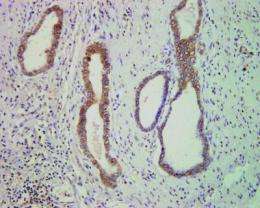
The image shows human pancreas tissue with tumors (in brown). The color brown indicates the localization of CEPB-4. Credit: IRB Barcelona/IMIM
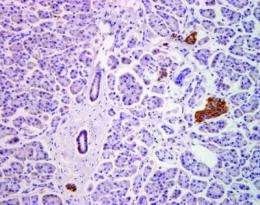
Using experiments involving human cancer cells in mice, these researchers have demonstrated that the decrease in CPEB4 levels in cancer cells reduces the size of tumors by up to 80%. Although the study is limited to two kinds of tumor, according to the co-authors, "given the effects observed in the tumors examined and the type of genes regulated by this mechanism, it is expected to be involved in many other types of cancer".The image shows a healthy pancreas tissue, with no tumors and absence of CEPB-4. Credit: IRB Barcelona/IMIM
This study opens up avenues for new treatments for cancer, for which the researchers are designing and analyzing CPEB4 inhibitors of potential therapeutic interest. "The clinical applications are very promising, although intensive research is needed to identify inhibitory molecules and to test them in various models before determining their clinical potential and, in this case, their use in patients", warn Navarro and Méndez.More information: Nature Medicine (2011) doi:10.1038/nm.2540
Journal reference:
Nature Medicine
Provided by Institute for Research in Biomedicine (IRB Barcelona)
-
Targeted Immune Cells Shrink Tumors in Mice
Feb 10, 2009 |
not rated yet |
0
-
Researchers find key gene in childhood cancer
May 05, 2011 |
not rated yet |
0
-
Tumor vessels identified by unique molecular markers
Jun 11, 2007 |
not rated yet |
0
-
Researchers unravel biochemical factor important in tumor metastasis
Nov 09, 2011 |
not rated yet |
0
-
New approach to gene therapy may shrink brain tumors, prevent their spread
Sep 25, 2008 |
not rated yet |
0
-
Motion perception revisited: High Phi effect challenges established motion perception assumptions
Apr 23, 2013 |
3 / 5 (2) |
2
-
Anything you can do I can do better: Neuromolecular foundations of the superiority illusion (Update)
Apr 02, 2013 |
4.5 / 5 (11) |
5
-
The visual system as economist: Neural resource allocation in visual adaptation
Mar 30, 2013 |
5 / 5 (2) |
9
-
Separate lives: Neuronal and organismal lifespans decoupled
Mar 27, 2013 |
4.9 / 5 (8) |
0
-
Sizing things up: The evolutionary neurobiology of scale invariance
Feb 28, 2013 |
4.8 / 5 (10) |
14
-
Why is zone 1 in liver more prone to ischemic injury?
May 23, 2013
-
How can there be villous adenoma in colon, if there are no villi there
May 22, 2013
-
How can there be a term called "intestinal metaplasia" of stomach
May 21, 2013
-
Pressure-volume curve: Elastic Recoil Pressure don't make sense
May 18, 2013
-
If you became brain-dead, would you want them to pull the plug?
May 17, 2013
-
MRI bill question
May 15, 2013
- More from Physics Forums - Medical Sciences
More news stories
New fluorescent tools for cancer diagnosis
In recent years, microRNAs (miRNAs) and other non-coding RNAs are small molecules that help control the expression of specific proteins. In recent years they have emerged as disease biomarkers. miRNA profiles have been used ...
Cancer
18 hours ago |
not rated yet |
0
Modulating the immune system to combat metastatic cancer
Cancer cells spread and grow by avoiding detection and destruction by the immune system. Stimulation of the immune system can help to eliminate cancer cells; however, there are many factors that cause the immune system to ...
Cancer
18 hours ago |
5 / 5 (1) |
0
Scientists put bowel cancer under the microscope
Researchers from London's Kingston University have begun a two-year study which could help prolong the lives of people with colorectal tumours.
Cancer
21 hours ago |
5 / 5 (1) |
0
Researcher identifies breast cancer fighting hormone
Transformative research from Western University has identified new hormones in the body which may suppress breast cancer and stimulate the regression of breast tumors.
Cancer
22 hours ago |
5 / 5 (2) |
0
Ground breaking cancer research finds immune system link
(Medical Xpress)—Curtin University researchers have found evidence that targeting specific cells in the body can reverse the effects of cancer on the immune system.
Cancer
22 hours ago |
5 / 5 (4) |
0
Heart failure accelerates male 'menopause'
Heart failure accelerates the aging process and brings on early andropausal syndrome (AS), according to research presented today at the Heart Failure Congress 2013. AS, also referred to as male 'menopause', was four times ...
First drug to improve heart failure mortality in over a decade
Coenzyme Q10 decreases all cause mortality by half, according to the results of a multicentre randomised double blind trial presented today at Heart Failure 2013 congress. It is the first drug to improve heart failure mortality ...
Death highest in heart failure patients admitted in January, on Friday, and overnight
Mortality and length of stay are highest in heart failure patients admitted in January, on Friday, and overnight, according to research presented today at the Heart Failure Congress 2013. The analysis of nearly 1 million ...
Engineered cytomegalovirus protects monkeys from HIV equivalent
(Medical Xpress)—A new study by researchers in the US has shown that an ancient virus can be modified to help in the fight against the simian immunodeficiency virus SIV, which is the equivalent in monkeys ...
Researchers identify first drug targets in childhood genetic tumor disorder
Two mutations central to the development of infantile myofibromatosis (IM)—a disorder characterized by multiple tumors involving the skin, bone, and soft tissue—may provide new therapeutic targets, according to researchers ...
Hormone levels may provide key to understanding psychological disorders in women
Women at a particular stage in their monthly menstrual cycle may be more vulnerable to some of the psychological side-effects associated with stressful experiences, according to a study from UCL.