New discovery could lead to treatment for Angelman syndrome
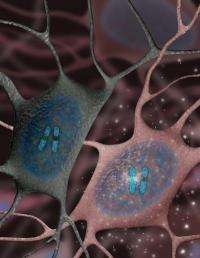
Results of a new study from the University of North Carolina at Chapel Hill may help pave the way to a treatment for a neurogenetic disorder often misdiagnosed as cerebral palsy or autism.
Known as Angelman syndrome, or AS, its most characteristic feature is the absence or near absence of speech throughout the person's life. Occurring in one in 15,000 live births, other AS characteristics include intellectual and developmental delay, severe intellectual disability, seizures, sleep disturbance, motor and balance disorders. Individuals with the syndrome typically have a happy, excitable demeanor with frequent smiling, laughter, and hand flapping.
No effective therapies exist for AS, which arises from mutations or deletions of the gene Ube3a on chromosome 15. The Ube3a protein produced by the gene is a key component of a molecular pathway that is very important to all cells, especially brain neurons by helping them pass electrical or chemical signals to other neurons via the synapse.
Angelman syndrome is linked to mutations or deletions in the Ube3a gene inherited from the mother; thus, the maternal allele. In most tissues of the body, both the maternal and paternal alleles are expressed. But in rodents and humans, the paternal Ube3a allele is intact but silent, or dormant.
What apparently accounts for the dormancy of that allele is a strand of ribonucleic acid known as antisense RNA, which in terms of gene expression keeps paternal Ube3a silenced, or off. Once referred to as the genome's "dark matter," antisense RNA makes no functioning gene product, but works to repress expression of another gene by binding to its RNA.
"We wanted to determine if there could be a way to "awaken" the dormant allele and restore Ube3a expression in neurons," said neuroscientist Benjamin D. Philpot, PhD, associate professor of cell and molecular physiology, one of three senior investigators in the study and a member of the UNC Neuroscience Center.
In a report of the research published online Dec. 21,2011 in the journal Nature, the interdisciplinary team of UNC scientists say they have found a way to "awaken" the paternal allele of Ube3a, which could lead to a potential treatment strategy for AS.
"We have taken advantage of a tool that allows us to distinguish between active and inactive alleles," Philpot said. "That tool is a modified mouse that's engineered so that the Ube3a gene has a fluorescent 'reporter' gene attached to it, which tells you when the gene is on or when it's off. When the gene is on, neurons will fluoresce in yellow, but won't when the gene is off."
Other 'tools' available on the UNC campus come from study senior author Bryan L. Roth, MD, PhD, Michael Hooker Distinguished Professor of Pharmacology and Translational Proteomics and director of the National Institute of Mental Health Psychoactive Drug Screening Program. These include highly automated robotics of the sort normally found in major pharmaceutical companies: fluid handling robotics and automated high-content imaging that combine the molecular tools of modern cell biology with automated high resolution microscopy and robotic handling.
Using a library of FDA-approved drugs obtained from the National Institute of Health (the NIH Clinical Collection) the UNC team discovered that irinotecan, a topoisomerase (TOPO-EYE-SOM-ERASE) inhibitor known to be active in the central nervous system -- robustly 'awakened' Ube3a. Subsequently, the team identified the FDA approved medication topotecan and several other topoisomerase inhibitors as drugs which can 'awaken' Ube3a.
"When we gave topotecan to these neurons they would now glow, indicating that the paternal allele was now on," Philpot said. Topotecan apparently awakened the dormant Ube3a allele by down-regulating, or reducing, antisense RNA in the paternal copy of Ube3a, the researchers determined.
When topotecan was given to the genetically engineered mice, "it unsilenced the paternal Ube3a allele in several regions of the nervous system, including neurons in several areas of the brain and in the spinal cord," the authors state. These findings also held true for irinotecan.
Importantly, the protein from the unsilenced paternal Ube3a was functional and was expressed by the gene in amounts comparable to that of normal maternal Ube3a in 'control' animals.
The study's third senior co-author, neuroscientist Mark J, Zylka, PhD, assistant professor of cell and molecular physiology and a UNC Neuroscience Center member says the study is "the first example of a drug that regulates antisense RNA and, as a result, regulates [protein] levels of a coding gene."
According to Philpot, the increased scientific interest in Ube3a is because certain DNA copies, or duplications, in maternal chromosome 15 are associated with classic forms of autism. "If you have too little Ube3a you have Angelman syndrome. If the maternal allele is duplicated, it might be a contributing factor to autism."
Zylka and Philpot caution against using topoisomerase inhibitors now to treat Angelman syndrome, given the limits of current knowledge.
"We'd like to stress that these compounds are not ready to be used clinically for Angelman syndrome," Zylka said. "We don't know what the off-target effects might be on a gene or genes with similar DNA sequences. We need to figure out optimal concentrations and dosing before we move to clinical trials. And we need to determine which drug is best."
For people to use these drugs now for Angelman syndrome, without further preclinical studies, might be a health risk, Philpot adds, "one that could jeopardize successfully bringing these compounds to clinical trials."


