Novel use of drug saves children from deadly E. coli bacteria disease
December 20, 2011 in Diseases, Conditions, Syndromes
Novel use of drug saves children from deadly E. coli bacteria disease

Enlarge

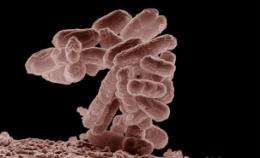
E.Coli bacteria

A physician and researcher at the Sainte Justine University Hospital Center (Sainte-Justine UHC), a University of Montreal affiliate, saved the life of a child and, by doing so, became the first to find a new use for a drug in the fight against deadly E. coli bacteria. In fact, after a little girl was admitted to the Sainte Justine UHC to treat severe complications, her physician, running out of options, thought about using the drug eculizumab, which is usually prescribed for another disorder with similar symptoms. Her intuition paid off and the little girl survived. The dramatic improvement experienced by the young patient and two others is explained in an article published last summer in the New England Journal of Medicine.

“At the time, there was no recognized treatment to cure the hemolytic and uremic syndrome, a severe complications associated with E. coli infections,” says Dr. Anne-Laure Lapeyraque, a nephrologist in the Department of Pediatrics at the Sainte Justine UHC as well as a professor at the University of Montreal. “Successful use of this medication in these children has opened our eyes to a promising new treatment.”

Dr. Anne-Laure Lapeyraque and her international colleagues relate how eculizumab was used to treat three 3-year-olds with E. coli-related neurological complications. Within a few days to weeks, their blood counts returned to normal and their kidneys recovered. Eculizumab, a drug known as a monoclonal antibody, acts by blocking a substance in the immune system known as complement protein C5.

Once this new drug application had been discovered, intravenous eculizumab therapy was used to save the lives of a large number of people. “Our report was published during the massive E. coli outbreak in May and June in Germany, which allowed us to break the news and alert physicians,” explains Dr. Lapeyraque. During the outbreak, about 4,000 people in Europe fell ill by eating contaminated sprouts.

E. coli infection with a Shiga toxin-producing strain (“hamburger disease”) has been the subject of several recalls of contaminated beef in Canada and the United States over the past few years. E. coli can be found in undercooked ground beef, unpasteurized (raw) dairy products and contaminated fruits and vegetables, particularly alfalfa sprouts. Symptoms include cramps and vomiting, with or without bloody diarrhea, and can lead to kidney failure and be life threatening. This is why it is important to cook hamburger meat thoroughly, wash fruits and vegetables, avoid unpasteurized dairy products, especially for children, and wash one's hands after handling raw meat. According to Dr. Lapeyraque, these precautions have greatly reduced the incidence of E. coli infection in Quebec.

The investigators on this international clinical team are very excited about their discovery. For one thing, it helps explain how and why hamburger disease can develop with such devastating consequences. “Further research studies are needed to determine which patients will benefit from it the most,” adds Dr. Lapeyraque. In any event, “eculizumab” is now a hot buzzword at kidney disease meetings around the world.

More information: “Eculizumab in severe Shiga-toxin-associated HUS” was published in the New England Journal of Medicine online on May 25 and in print in the June 30, 2011 issue. The authors are Anne-Laure Lapeyraque, Michal Malina, Véronique Fremeaux-Bacchi, Tobias Boppel, Michael Kirschfink, Mehdi Oualha, François Proulx, Marie-José Clermont, Françoise Le Deist, Patrick Niaudet, and Franz Schaefer.

Journal reference: New England Journal of Medicine search and more info website

Provided by University of Montreal search and more info website

4 /5 (1 vote)  

Rank 4 /5 (1 vote)
Relevant PhysicsForums posts

More news stories

Flesh-Eating bacteria no cause for panic, experts say

(HealthDay) -- Despite scary headlines by the score, most people don't have to fear that they'll be the next victim of the so-called flesh-eating bacteria disease, experts say.

Diseases, Conditions, Syndromes created May 25, 2012 | popularity not rated yet | comments 0

World Health Assembly endorses new plan to increase global access to vaccines

Ministers of Health from 194 countries at the Sixty-fifth World Health Assembly today endorsed a landmark Global Vaccine Action Plan (GVAP), a roadmap to prevent millions of deaths by 2020 through more equitable access to ...

Diseases, Conditions, Syndromes created May 25, 2012 | popularity not rated yet | comments 0

Physicians definitively links irritable bowel syndrome and bacteria in gut

An overgrowth of bacteria in the gut has been definitively linked to Irritable Bowel Syndrome in the results of a new Cedars-Sinai study which used cultures from the small intestine. This is the first study to use this "gold ...

Diseases, Conditions, Syndromes created May 25, 2012 | popularity not rated yet | comments 0 | with audio podcast

Study provides compelling evidence for an effective new treatment for tinnitus

According to new research, a multidisciplinary approach to treating tinnitus that combines cognitive behaviour therapy with sound-based tinnitus retraining therapy is significantly more effective than currently available ...

Diseases, Conditions, Syndromes created May 24, 2012 | popularity not rated yet | comments 0

Infections may be deadly for many dialysis patients

An infection called peritonitis commonly arises in the weeks before many dialysis patients die, according to a study appearing in an upcoming issue of the Journal of the American Society of Nephrology (JASN). The findings sugges ...

Diseases, Conditions, Syndromes created May 24, 2012 | popularity not rated yet | comments 0


Keep food safety in mind this memorial day weekend

(HealthDay) -- Picnics, parades and cookouts are as much a part of Memorial Day weekend as tributes to the United States' war veterans.

Travel to high altitudes tied to Crohn's, colitis flare-ups

(HealthDay) -- People with inflammatory bowel disease, which includes Crohn's disease and colitis, may be at increased risk for flare-ups when they fly or travel to high altitudes for skiing or mountain climbing, ...

Family history of Alzheimer's affects functional connectivity

(HealthDay) -- Cognitively normal individuals with a family history of late-onset Alzheimer's disease (AD) may display lower resting state functional connectivity in the default mode network (DMN) of the brain, ...

Transvaginal mesh op restores pelvic organ prolapse at price

(HealthDay) -- Transvaginal mesh (TVM) procedures are effective for anatomical restoration of pelvic organ prolapse (POP), but patients report a worsening of sexual function following surgery, according to ...

Of mice and mental models: Neuroscientific implications of risk-optimized behavior in the mouse

(Medical Xpress) -- Regardless of an organism’s biological complexity, every encephalized animal continuously makes under-informed behavioral choices that can have serious consequences. Despite its ubiquity, ...

Weight struggles? Blame new neurons in your hypothalamus

New nerve cells formed in a select part of the brain could hold considerable sway over how much you eat and consequently weigh, new animal research by Johns Hopkins scientists suggests in a study published in the May issue ...