Learning high-performance tasks with no conscious effort may soon be possible (w/ video)
December 8, 2011 in Neuroscience
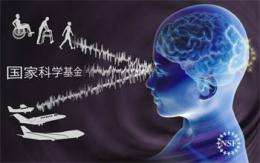
In the future, a person may be able to watch a computer screen and have his or her brain patterns modified to improve physical or mental performance. Researchers say an innovative learning method that uses decoded functional magnetic resonance imaging could modify brain activities to help people recuperate from an accident or disease, learn a new language or even fly a plane. Credit: Nicolle Rager Fuller, National Science Foundation
(Medical Xpress) -- New research published today in the journal Science suggests it may be possible to use brain technology to learn to play a piano, reduce mental stress or hit a curve ball with little or no conscious effort. It's the kind of thing seen in Hollywood's "Matrix" franchise.
Experiments conducted at Boston University (BU) and ATR Computational Neuroscience Laboratories in Kyoto, Japan, recently demonstrated that through a person's visual cortex, researchers could use decoded functional magnetic resonance imaging (fMRI) to induce brain activity patterns to match a previously known target state and thereby improve performance on visual tasks.
Think of a person watching a computer screen and having his or her brain patterns modified to match those of a high-performing athlete or modified to recuperate from an accident or disease. Though preliminary, researchers say such possibilities may exist in the future.
"Adult early visual areas are sufficiently plastic to cause visual perceptual learning," said lead author and BU neuroscientist Takeo Watanabe of the part of the brain analyzed in the study.
Neuroscientists have found that pictures gradually build up inside a person's brain, appearing first as lines, edges, shapes, colors and motion in early visual areas. The brain then fills in greater detail to make a red ball appear as a red ball, for example.
Researchers studied the early visual areas for their ability to cause improvements in visual performance and learning.
"Some previous research confirmed a correlation between improving visual performance and changes in early visual areas, while other researchers found correlations in higher visual and decision areas," said Watanabe, director of BU's Visual Science Laboratory. "However, none of these studies directly addressed the question of whether early visual areas are sufficiently plastic to cause visual perceptual learning." Until now.
Boston University post-doctoral fellow Kazuhisa Shibata designed and implemented a method using decoded fMRI neurofeedback to induce a particular activation pattern in targeted early visual areas that corresponded to a pattern evoked by a specific visual feature in a brain region of interest. The researchers then tested whether repetitions of the activation pattern caused visual performance improvement on that visual feature.
The result, say researchers, is a novel learning approach sufficient to cause long-lasting improvement in tasks that require visual performance.
What's more, the approached worked even when test subjects were not aware of what they were learning.
"The most surprising thing in this study is that mere inductions of neural activation patterns corresponding to a specific visual feature led to visual performance improvement on the visual feature, without presenting the feature or subjects' awareness of what was to be learned," said Watanabe, who developed the idea for the research project along with Mitsuo Kawato, director of ATR lab and Yuka Sasaki, an assistant in neuroscience at Massachusetts General Hospital.
"We found that subjects were not aware of what was to be learned while behavioral data obtained before and after the neurofeedback training showed that subjects' visual performance improved specifically for the target orientation, which was used in the neurofeedback training," he said.
The finding brings up an inevitable question. Is hypnosis or a type of automated learning a potential outcome of the research?
"In theory, hypnosis or a type of automated learning is a potential outcome," said Kawato. "However, in this study we confirmed the validity of our method only in visual perceptual learning. So we have to test if the method works in other types of learning in the future. At the same time, we have to be careful so that this method is not used in an unethical way."
At present, the decoded neurofeedback method might be used for various types of learning, including memory, motor and rehabilitation.
Provided by
National Science Foundation
-
Echoes discovered in early visual brain areas play role in working memory
Feb 18, 2009 |
not rated yet |
0
-
Perceptual training improves vision of the elderly
Nov 22, 2010 |
not rated yet |
0
-
Researchers find learning in the visual brain
Nov 10, 2010 |
not rated yet |
0
-
New study examines brain processes behind facial recognition
Apr 18, 2011 |
not rated yet |
0
-
Reward elicits unconscious learning in humans
Mar 11, 2009 |
not rated yet |
0
-
Motion perception revisited: High Phi effect challenges established motion perception assumptions
Apr 23, 2013 |
3 / 5 (2) |
2
-
Anything you can do I can do better: Neuromolecular foundations of the superiority illusion (Update)
Apr 02, 2013 |
4.5 / 5 (11) |
5
-
The visual system as economist: Neural resource allocation in visual adaptation
Mar 30, 2013 |
5 / 5 (2) |
9
-
Separate lives: Neuronal and organismal lifespans decoupled
Mar 27, 2013 |
4.9 / 5 (8) |
0
-
Sizing things up: The evolutionary neurobiology of scale invariance
Feb 28, 2013 |
4.8 / 5 (10) |
14
-
Why is zone 1 in liver more prone to ischemic injury?
May 23, 2013
-
How can there be villous adenoma in colon, if there are no villi there
May 22, 2013
-
How can there be a term called "intestinal metaplasia" of stomach
May 21, 2013
-
Pressure-volume curve: Elastic Recoil Pressure don't make sense
May 18, 2013
-
If you became brain-dead, would you want them to pull the plug?
May 17, 2013
-
MRI bill question
May 15, 2013
- More from Physics Forums - Medical Sciences
More news stories
New neuron formation could increase capacity for new learning, at the expense of old memories
New research presented today shows that formation of new neurons in the hippocampus - a brain region known for its importance in learning and remembering - could cause forgetting of old memories by causing a reorganization ...
Neuroscience
11 hours ago |
3.7 / 5 (3) |
0
Help at hand for people with schizophrenia
How can healthy people who hear voices help schizophrenics? Finding the answer for this is at the centre of research conducted at the University of Bergen.
Neuroscience
11 hours ago |
4 / 5 (2) |
2
Japanese research organizations contribute to Human Brain Project
One of the major frontiers of modern science is a comprehensive understanding of the human brain and its functions to guide the development of new technologies in information and communication. In a major announcement for ...
Neuroscience
11 hours ago |
3 / 5 (2) |
0
Controlling mood through the motions of mitochondria
(Medical Xpress)—Regulating the distribution of power in neurons is done by a system that makes the national electric grid look simple by comparison. Each neuron has several thousand mitochondria confined ...
Neuroscience
May 23, 2013 |
4.9 / 5 (9) |
0
|
Brain uses internal 'average voice' prototype to identify who is talking
(Medical Xpress)—The human brain is able to identify individuals' voices by comparing them against an internal 'average voice' prototype, according to neuroscientists.
Neuroscience
May 23, 2013 |
3 / 5 (2) |
3
|
Researchers identify first drug targets in childhood genetic tumor disorder
Two mutations central to the development of infantile myofibromatosis (IM)—a disorder characterized by multiple tumors involving the skin, bone, and soft tissue—may provide new therapeutic targets, according to researchers ...
Engineered cytomegalovirus protects monkeys from HIV equivalent
(Medical Xpress)—A new study by researchers in the US has shown that an ancient virus can be modified to help in the fight against the simian immunodeficiency virus SIV, which is the equivalent in monkeys ...
Hormone levels may provide key to understanding psychological disorders in women
Women at a particular stage in their monthly menstrual cycle may be more vulnerable to some of the psychological side-effects associated with stressful experiences, according to a study from UCL.
Going live: Immune cell activation in multiple sclerosis
Biological processes are generally based on events at the molecular and cellular level. To understand what happens in the course of infections, diseases or normal bodily functions, scientists would need to ...
Driving and hands-free talking lead to spike in errors, study shows
Talking on a hands-free device while behind the wheel can lead to a sharp increase in errors that could imperil other drivers on the road, according to new research from the University of Alberta.
Pollen count apps for smartphones are nothing to sneeze at
Kate O'Reilly's spring allergy survival kit includes the usual stuff - nasal sprays, allergy pills and a box of tissues. This season, she's added a new weapon to her line of defense: an app on her smartphone.
Dec 08, 2011
Rank: 3.4 / 5 (5)
Dec 08, 2011
Rank: not rated yet
Dec 08, 2011
Rank: 5 / 5 (8)
Dec 08, 2011
Rank: 5 / 5 (4)
So...I supposed it's unethical to use this to 'encourage' the hotter students to have crushes on their teacher?
Dec 08, 2011
Rank: 5 / 5 (12)
Dec 08, 2011
Rank: 5 / 5 (6)
Dec 08, 2011
Rank: 5 / 5 (7)
...YOU!
The Sixth Day anyone?
Now imagine if instead of programing the "blanks" to have the original person's memory, they just program YOU.
Boss: "you don't want a raise. You want to get back to work."
You: "Mmmmm...ok. I'm happy here!"
It woould be reeeeeally easy, the naive fool goes in for a "skill upgrade" and the "corporation" slips some nasssssty programming into the update: submission.
"Work hard! BE happy! Be content! You love your boss and your job! You love paying taxes!"
"They Live" on steroids.
Dec 08, 2011
Rank: 1.2 / 5 (5)
You really live in a paranoid cacotopia.
Dec 08, 2011
Rank: 1.6 / 5 (9)
"The Paranoid Style in American Politics"
http://karws.gso....yle.html
In fact you're probably just jealous you couldn't wage his argument against communists/socialists/Lex Luthor before he got the chance to use it.
Dec 08, 2011
Rank: 4.8 / 5 (8)
Dec 08, 2011
Rank: 5 / 5 (6)
What does it not do? It does not force you to believe other opinions or change your way of thinking.
It is more like the difference between sleeping or fooling around in class and paying attention and taking notes.
If you believe that this will feed propoganda, whatever, you would be too late. There's already something called "public schools." It's just a slower lower tech venue that does the same thing as this device, if you really want to subscribe to extreme conspiracy like that.
Dec 08, 2011
Rank: 5 / 5 (2)
Dec 08, 2011
Rank: 5 / 5 (2)
Dec 08, 2011
Rank: 2 / 5 (4)
-Or an assassin of a high-ranking public official. This sounds like 50 year old sirhan sirhan MKULTRA stuff to me. OK I'll try it.
Dec 08, 2011
Rank: 3 / 5 (1)
Dec 08, 2011
Rank: 5 / 5 (3)
In any case advertisers (and spammers) would likely want to use the technology for their own gain.
Dec 08, 2011
Rank: 3 / 5 (2)
Similar to adding, for example, a sense of fear in my dreams, but not adding a complex pattern like inception of me breaking up the business emporium.
Dec 09, 2011
Rank: 5 / 5 (1)
Dec 09, 2011
Rank: 1 / 5 (2)
Visually, someone figured scribbles carried the potential to have more meaning - like the tracks of an hunted animal.
Of course sound was just as abundant as were the visuals. So eventually the voice box extended beyond crying and the voice was discovery to have a potential to carry more meaning than a hunger signal.
Nature's input/output mutual feedback (for the senses) is impressive.
fMRI's induced patterns fall short of this. Actually this:
http://www.physor...ail.html
is where all 'blueprints' come true. Unfortunately signaling a cell to become a cell, the cell has already become - (differentiation completed)is a repeated message ignored once the differentiation stage is superseded.
The visual cortex first signals (from eyes ready or not) is darkness. What is the signal representation in the visual cortex for black?
Dec 09, 2011
Rank: 5 / 5 (1)
Dec 09, 2011
Rank: 5 / 5 (1)
Dec 09, 2011
Rank: 2.3 / 5 (3)
Dec 09, 2011
Rank: 2.4 / 5 (5)
Not much benefit in knowing more than 3 or 4 basic martial arts disciplines: Maybe two grapling schools and 2 striking schools: Jujitsu, Judo, Taekwondo, Ishinryu.
Only so many ways someone can tell you to throat jab, eye gouge, groin kick, neck break, or arm bar before it's just repetitive.
50 digits of pi is useless.
And when you can remember most things you read, then you have to deal with idiots like Ghost of Otto accusing you of not knowing what you're talking about, just because THEY can't remember it...
Go figure.
Knowing everything will probably make life more miserable, because then you know how big an idiot everyone really is...
Dec 09, 2011
Rank: 4.2 / 5 (5)
Humans rely on those poorly understood abilities. If we understood those learning abilities, then learning is effortless like a child's first step or language. All taking place without teaching and teachers.
I can mimic the innate learning abilities of humans. I have to know how those abilities work to teach anything. I rely on those abilities already subjected to experience before I am even to allowed to consider teaching. AI has a 'clean slate' start. Life forms don't have that disadvantage.
Dec 11, 2011
Rank: not rated yet
Dec 11, 2011
Rank: 1 / 5 (1)