Italy seeking women with French breast implants
December 22, 2011 in Other
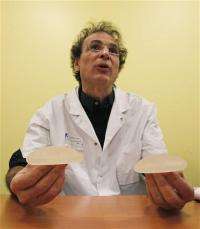
Dr. Maurice Mimoun, a plastic surgeon at the St Louis hospital, holds silicone gel breast implants made by French company Poly Implant Prothese, or PIP, that he removed from a patient because of concerns that they are unsafe, Paris, Wednesday, Dec. 21, 2011. French health authorities are considering whether to suggest that an estimated 30,000 women in France get their breast implants removed, amid warnings by leading doctors about risks of rupture and possible cancer risks. (AP Photo/Michel Euler)
(AP) -- Italy's health ministry on Thursday asked hospitals to track down women who received silicone breast implants made by a suspect French company due to concerns the implants may be unsafe.
The ministry's health council also said the national health system would pay to have the Poly Implant Prothese, or PIP, implants removed if medical conditions required it, such as if they ruptured.
While saying there was no proof of any greater cancer risk among women with PIP implants, the council suggested that women with the implants contact their surgeons because there's a "greater probability of rupture and inflammatory reaction."
The council met Thursday in an emergency session on the eve of an expected decision by French health authorities over whether to recommend mass surgery for thousands of women who received PIP implants.
French investigators say the implants were made with cheap industrial silicone, not medical grade silicone, and that more than 1,000 women in France have had one or two implants burst. In addition, there have been eight cases of cancer among women with the implants, including one who died in November.
Italy's health ministry estimates that about 4,000-4,300 PIP devices have been implanted in women in Italy. From 2005 to today, some 24 ruptures have been reported.
Italy recalled the implants April 1, 2010, a day after French health authorities reported that they had suspended the sale, distribution and exportation of PIP implants after discovering that the vast majority were made with industrial silicone.
©2011 The Associated Press. All rights reserved. This material may not be published, broadcast, rewritten or redistributed.
-
France may order 30,000 women to remove implants
Dec 20, 2011 |
not rated yet |
0
-
Women urged not to panic over breast implant scare
Dec 21, 2011 |
not rated yet |
0
-
Canada OK's silicone gel implants
Oct 23, 2006 |
not rated yet |
0
-
New proteins detected on silicone breast implants
Dec 19, 2006 |
not rated yet |
0
-
Breast cancer patients prefer silicone over saline implants after mastectomy
Nov 08, 2010 |
not rated yet |
0
-
Of mice and mental models: Neuroscientific implications of risk-optimized behavior in the mouse
May 25, 2012 |
not rated yet |
0
-
Limits to growth: Scientists identify key metastasis-enabling enzyme
May 22, 2012 |
5 / 5 (4) |
0
-
Seeing is as seeing does: Spatially-structured retinal input in early development of cortical maps
Apr 26, 2012 |
5 / 5 (4) |
1
-
Dreamless nights: Brain activity during nonrapid eye movement sleep
Apr 09, 2012 |
4.4 / 5 (12) |
0
-
Take your time: Neurobiology sheds light on the superiority of spaced vs. massed learning
Mar 28, 2012 |
4.5 / 5 (21) |
3
-
Classical and Quantum Mechanics via Lie algebras
Apr 15, 2011
- More from Physics Forums - Independent Research
More news stories
Transvaginal mesh op restores pelvic organ prolapse at price
(HealthDay) -- Transvaginal mesh (TVM) procedures are effective for anatomical restoration of pelvic organ prolapse (POP), but patients report a worsening of sexual function following surgery, according to ...
Other
8 hours ago |
not rated yet |
0
Tongue analysis software uses ancient Chinese medicine to warn of disease
For 5,000 years, the Chinese have used a system of medicine based on the flow and balance of positive and negative energies in the body. In this system, the appearance of the tongue is one of the measures used to classify ...
Other
23 hours ago |
1 / 5 (1) |
0
|
Neck strength, cervical spine mobility don't predict pain
(HealthDay) -- Neither isometric neck muscle strength nor passive mobility of the cervical spine, two physical capacity parameters found to be associated with neck pain in other studies, predicts later neck ...
Other
May 25, 2012 |
not rated yet |
0
Pool access for the disabled sparks controversy
(AP) -- The Obama administration is sidestepping an election-year confrontation with the hotel industry and other pool owners to give them more time to comply with access rules for the disabled.
Other
May 25, 2012 |
not rated yet |
0
Chile to cover sex change operations
Chile will soon cover sex change surgeries under its public health plan in order to allow citizens of limited means to "recover their true sexual identity," Health Minister Jaime Manalich said.
Other
May 25, 2012 |
not rated yet |
0
Travel to high altitudes tied to Crohn's, colitis flare-ups
(HealthDay) -- People with inflammatory bowel disease, which includes Crohn's disease and colitis, may be at increased risk for flare-ups when they fly or travel to high altitudes for skiing or mountain climbing, ...
Family history of Alzheimer's affects functional connectivity
(HealthDay) -- Cognitively normal individuals with a family history of late-onset Alzheimer's disease (AD) may display lower resting state functional connectivity in the default mode network (DMN) of the brain, ...
Of mice and mental models: Neuroscientific implications of risk-optimized behavior in the mouse
(Medical Xpress) -- Regardless of an organism’s biological complexity, every encephalized animal continuously makes under-informed behavioral choices that can have serious consequences. Despite its ubiquity, ...
Weight struggles? Blame new neurons in your hypothalamus
New nerve cells formed in a select part of the brain could hold considerable sway over how much you eat and consequently weigh, new animal research by Johns Hopkins scientists suggests in a study published in the May issue ...
Thioridazine kills cancer stem cells in human while avoiding toxic side-effects of conventional cancer treatments
A team of scientists at McMaster University has discovered a drug, thioridazine, successfully kills cancer stem cells in the human while avoiding the toxic side-effects of conventional cancer treatments.
Most occupational injury and illness costs are paid by the government and private payers
UC Davis researchers have found that workers' compensation insurance is not used nearly as much as it should be to cover the nation's multi-billion dollar price tag for workplace illnesses and injuries. Instead, almost 80 ...