When the ladybug has to count her spots
December 1, 2011 in Psychology & Psychiatry
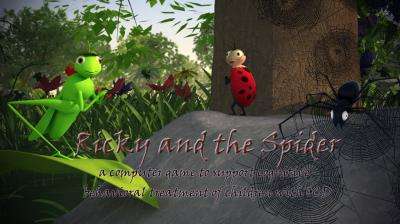
This is a screenshot cover of "Ricky and the Spider." Credit: picture: Huber Nathalie
About two percent of all children suffer from Obsessive Compulsive Disorder (OCD), which consists of obsessive thoughts and acts. Obsessive thoughts are intrusive thoughts such as fear or contamination, injury or violent notions that are perceived to be pointless or distressing. Obsessive acts are ritualized acts that have to be repeated frequently, such as washing one's hands, asking questions, counting, touching, checking or collecting. Without treatment, OCD often has serious consequences, such as children no longer being able to go to school on account of their symptoms.
Game supports psychotherapists
Nowadays, cognitive behavior therapy, possibly supplemented with medication, is considered to be the most reliable method of treating OCD in children. To help psychotherapists with evidence-based OCD treatment, the Center of Child and Adolescent Psychiatry at the University of Zurich has developed the computer game "Ricky and the Spider". The game incorporates the key treatment elements of the cognitive-behavioral approach and makes it easier for children to understand the disorder, its consequences and the treatment.
Ladybug has to count dots
In the game, a spider forces Ricky the Grasshopper and Lisa the Ladybug to do things they do not really want to do. For instance, Ricky is only allowed to hop across the meadow in a particular pattern and Lisa has to count the spots on her wings every evening before she goes to sleep. Fearing the spider, they become entangled deeper and deeper in OCD's web. In the end, Ricky asks Dr. Owl for help.
Distribution of treatment
Veronika Brezinka, who devised the game, hopes that it will help evidence-based treatments to spread beyond the university. "The game is designed to encourage affected children to confront their OCD and help psychotherapists to treat the disorder," explains Brezinka. Much like the computer game "Treasure Hunt", which was developed at the Center of Child and Adolescent Psychiatry three years ago, "Ricky and the Spider" is not a self-help game, but rather a professional tool and should only be used for the purposes of psychotherapeutic treatment.
Provided by University of Zurich
-
New research helps clinicians predict treatment outcomes for children with OCD
Oct 14, 2010 |
not rated yet |
0
-
Study finds young children can develop full-blown OCD
Sep 30, 2008 |
not rated yet |
0
-
Young children with OCD benefit from family-based treatment
May 15, 2008 |
not rated yet |
0
-
Wrong type of help from parents could worsen child's OCD
Jun 17, 2009 |
not rated yet |
0
-
Researchers find new way to examine major depressive disorder in children
May 10, 2011 |
not rated yet |
0
-
Of mice and mental models: Neuroscientific implications of risk-optimized behavior in the mouse
May 25, 2012 |
not rated yet |
0
-
Limits to growth: Scientists identify key metastasis-enabling enzyme
May 22, 2012 |
5 / 5 (4) |
0
-
Seeing is as seeing does: Spatially-structured retinal input in early development of cortical maps
Apr 26, 2012 |
5 / 5 (4) |
1
-
Dreamless nights: Brain activity during nonrapid eye movement sleep
Apr 09, 2012 |
4.4 / 5 (12) |
0
-
Take your time: Neurobiology sheds light on the superiority of spaced vs. massed learning
Mar 28, 2012 |
4.5 / 5 (21) |
3
-
Potential Breakthrough in Seizure Control
13 hours ago
-
Popping/Cracked sternum.
18 hours ago
-
Which Mental Illness Encompasses This Problem?
18 hours ago
-
A question about drug tolerance
May 23, 2012
-
Poor nutrition leading to overeating?
May 23, 2012
-
Math and dyslexia?
May 21, 2012
- More from Physics Forums - Medical Sciences
More news stories
More mental health care urged for kids who self-harm
(HealthDay) -- Doctors have long known that some kids suffering severe emotional turmoil find relief in physical pain -- cutting or burning or sticking themselves with pins to achieve a form of release.
Psychology & Psychiatry
May 25, 2012 |
not rated yet |
0
Questionable research practices surprisingly common
(Medical Xpress) -- Not all scientific misconduct is flat-out fraud. Much falls into the murkier realm of questionable research practices. A new study finds that in one field, psychology, these practices are surprisingly ...
Psychology & Psychiatry
May 25, 2012 |
5 / 5 (1) |
0
|
Feeling strong emotions makes peoples' brains 'tick together'
Experiencing strong emotions synchronises brain activity across individuals, research team at Aalto University and Turku PET Centre in Finland has revealed.
Psychology & Psychiatry
May 24, 2012 |
5 / 5 (1) |
0
Formal recognition of PMDD will lift stigma for women
A decision to recognise premenstrual dysphoric disorder as a genuine psychiatric condition will finally provide validation for this awful and poorly understood syndrome and alleviate the stigma ...
Psychology & Psychiatry
May 24, 2012 |
2 / 5 (1) |
1
Long-term meditation leads to different brain organization
(Medical Xpress) -- People who practice mindfulness meditation learn to accept their feelings, emotions, and states of mind without judging or resisting them. They simply live in the moment.
Psychology & Psychiatry
May 24, 2012 |
5 / 5 (6) |
0
|
Travel to high altitudes tied to Crohn's, colitis flare-ups
(HealthDay) -- People with inflammatory bowel disease, which includes Crohn's disease and colitis, may be at increased risk for flare-ups when they fly or travel to high altitudes for skiing or mountain climbing, ...
Family history of Alzheimer's affects functional connectivity
(HealthDay) -- Cognitively normal individuals with a family history of late-onset Alzheimer's disease (AD) may display lower resting state functional connectivity in the default mode network (DMN) of the brain, ...
Transvaginal mesh op restores pelvic organ prolapse at price
(HealthDay) -- Transvaginal mesh (TVM) procedures are effective for anatomical restoration of pelvic organ prolapse (POP), but patients report a worsening of sexual function following surgery, according to ...
Tongue analysis software uses ancient Chinese medicine to warn of disease
For 5,000 years, the Chinese have used a system of medicine based on the flow and balance of positive and negative energies in the body. In this system, the appearance of the tongue is one of the measures used to classify ...
Of mice and mental models: Neuroscientific implications of risk-optimized behavior in the mouse
(Medical Xpress) -- Regardless of an organism’s biological complexity, every encephalized animal continuously makes under-informed behavioral choices that can have serious consequences. Despite its ubiquity, ...
Weight struggles? Blame new neurons in your hypothalamus
New nerve cells formed in a select part of the brain could hold considerable sway over how much you eat and consequently weigh, new animal research by Johns Hopkins scientists suggests in a study published in the May issue ...