Researchers trace origins of malaria parasite from African slave trade to South America
December 27, 2011 by Bob Yirka in Diseases, Conditions, Syndromes
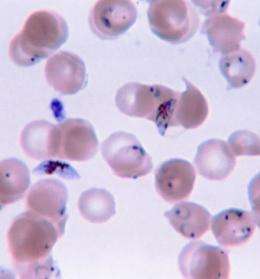
A thin-film Giemsa stained micrograph of ring-forms, and gametocytes of Plasmodium falciparum. Image: CDC
(PhysOrg.com) -- A new study done using DNA analysis and partly undertaken by the University of California, Irvine, has found evidence to support the premise that malaria was brought to South America via the African slave trade in the sixteenth century, rather than much earlier as some have suggested. The results of the study, led by evolutionary biologist Francisco Ayala, are to be published in the Proceedings of the National Academy of Sciences, show that the malaria parasite apparently had two sites of introduction, one in the northern part of South America and another in the south.
For many years there has been much debate about just how long ago malaria was introduced to South American populations. Were it to have been thousands of years ago, as some have theorized, the parasite would have had to travel over the Atlantic Ocean by bird or perhaps carried aloft, embedded in dust particles. With this new research however, such theories are likely to be put to rest.
To trace the roots of the malaria parasite in South America, Ayala and his colleagues collected samples of blood from people that had been infected with the protozoan from seventeen countries in South America, the Middle East, Africa and Southeast Asia. As each sample was gathered, DNA analysis was undertaken, comparing known stretches from each sample with all of the others collected. The team then performed mosquito generational estimates to come up with an approximation of how many years prior the malaria parasite must have first appeared in South American people.
Because of the inexactness of deriving estimates, the team calculated both high and low estimates based on either 12 or 6 mosquito generations per year. For the former, the team estimated that malaria arrived on the shores of South America some 217 to 495 years ago. For the later, it came to somewhere between 434 and 900 years ago.
In one area of first introduction, which appears to have occurred in a northern part of the continent; via Mexico perhaps, or in Columbia, the time estimates calculated overlap the time period during which Spanish slave traders were operating in those areas. Likewise, the second area of introduction appears to overlap with the time frame consistent with Portuguese slave traders operating in what is now Brazil.
Thus, the team concludes, it appears highly likely that the malaria parasite was introduced into South America by European slave traders bringing infected people from Africa to work as forced laborers in the precious metal mines and sugar cane fields.
More information: Multiple independent introductions of Plasmodium falciparum in South America, by Erhan Yalcindag et al. Proceedings of the National Academy of Sciences, Dec 26 2011.
Journal reference:
Proceedings of the National Academy of Sciences
© 2011 PhysOrg.com
-
Protein plays key role in transmitting deadly malaria parasite
May 28, 2008 |
not rated yet |
0
-
Monkeys provide reservoir for human malaria in South-east Asia
Apr 07, 2011 |
not rated yet |
0
-
Scientists report original source of malaria
Aug 03, 2009 |
not rated yet |
0
-
Researchers identify new way the malaria parasite and red blood cells interact
Mar 10, 2009 |
not rated yet |
0
-
Gorillas carry malignant malaria parasite, study reports
Jan 19, 2010 |
not rated yet |
0
-
Of mice and mental models: Neuroscientific implications of risk-optimized behavior in the mouse
May 25, 2012 |
not rated yet |
0
-
Limits to growth: Scientists identify key metastasis-enabling enzyme
May 22, 2012 |
5 / 5 (4) |
0
-
Seeing is as seeing does: Spatially-structured retinal input in early development of cortical maps
Apr 26, 2012 |
5 / 5 (4) |
1
-
Dreamless nights: Brain activity during nonrapid eye movement sleep
Apr 09, 2012 |
4.4 / 5 (12) |
0
-
Take your time: Neurobiology sheds light on the superiority of spaced vs. massed learning
Mar 28, 2012 |
4.5 / 5 (21) |
3
-
Classical and Quantum Mechanics via Lie algebras
Apr 15, 2011
- More from Physics Forums - Independent Research
More news stories
Flesh-Eating bacteria no cause for panic, experts say
(HealthDay) -- Despite scary headlines by the score, most people don't have to fear that they'll be the next victim of the so-called flesh-eating bacteria disease, experts say.
Diseases, Conditions, Syndromes
May 25, 2012 |
not rated yet |
0
World Health Assembly endorses new plan to increase global access to vaccines
Ministers of Health from 194 countries at the Sixty-fifth World Health Assembly today endorsed a landmark Global Vaccine Action Plan (GVAP), a roadmap to prevent millions of deaths by 2020 through more equitable access to ...
Diseases, Conditions, Syndromes
May 25, 2012 |
not rated yet |
0
Physicians definitively links irritable bowel syndrome and bacteria in gut
An overgrowth of bacteria in the gut has been definitively linked to Irritable Bowel Syndrome in the results of a new Cedars-Sinai study which used cultures from the small intestine. This is the first study to use this "gold ...
Diseases, Conditions, Syndromes
May 25, 2012 |
not rated yet |
0
|
Study provides compelling evidence for an effective new treatment for tinnitus
According to new research, a multidisciplinary approach to treating tinnitus that combines cognitive behaviour therapy with sound-based tinnitus retraining therapy is significantly more effective than currently available ...
Diseases, Conditions, Syndromes
May 24, 2012 |
not rated yet |
0
Infections may be deadly for many dialysis patients
An infection called peritonitis commonly arises in the weeks before many dialysis patients die, according to a study appearing in an upcoming issue of the Journal of the American Society of Nephrology (JASN). The findings sugges ...
Diseases, Conditions, Syndromes
May 24, 2012 |
not rated yet |
0
Travel to high altitudes tied to Crohn's, colitis flare-ups
(HealthDay) -- People with inflammatory bowel disease, which includes Crohn's disease and colitis, may be at increased risk for flare-ups when they fly or travel to high altitudes for skiing or mountain climbing, ...
Family history of Alzheimer's affects functional connectivity
(HealthDay) -- Cognitively normal individuals with a family history of late-onset Alzheimer's disease (AD) may display lower resting state functional connectivity in the default mode network (DMN) of the brain, ...
Transvaginal mesh op restores pelvic organ prolapse at price
(HealthDay) -- Transvaginal mesh (TVM) procedures are effective for anatomical restoration of pelvic organ prolapse (POP), but patients report a worsening of sexual function following surgery, according to ...
Tongue analysis software uses ancient Chinese medicine to warn of disease
For 5,000 years, the Chinese have used a system of medicine based on the flow and balance of positive and negative energies in the body. In this system, the appearance of the tongue is one of the measures used to classify ...
Of mice and mental models: Neuroscientific implications of risk-optimized behavior in the mouse
(Medical Xpress) -- Regardless of an organism’s biological complexity, every encephalized animal continuously makes under-informed behavioral choices that can have serious consequences. Despite its ubiquity, ...
Weight struggles? Blame new neurons in your hypothalamus
New nerve cells formed in a select part of the brain could hold considerable sway over how much you eat and consequently weigh, new animal research by Johns Hopkins scientists suggests in a study published in the May issue ...