Neuroscientists find genetic trigger that makes stem cells differentiate in nose epithelia
December 7, 2011 in Neuroscience
Neuroscientists find genetic trigger that makes stem cells differentiate in nose epithelia

Enlarge

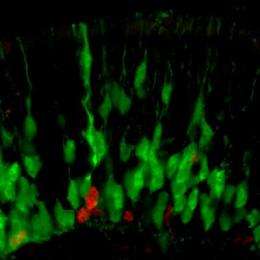
Elongated green cells are sensory neurons -- which sense smells and relay that information to the brain -- that originated from olfactory stem cells in the nose. Cells labeled in red are immature cells in the process of differentiating into neurons and other mature cell types. Credit: Photomicrograph by Russell Fletcher, UC Berkeley

University of California, Berkeley, neuroscientists have discovered a genetic trigger that makes the nose renew its smell sensors, providing hope for new therapies for people who have lost their sense of smell due to trauma or old age.

The gene tells olfactory the adult tissue stem cells in the nose to mature into the sensory neurons that detect odors and relay that information to the brain.

"Anosmia the absence of smell is a vastly underappreciated public health problem in our . Many people lose the will to eat, which can lead to , because the ability to taste depends on our , which often declines with age," said lead researcher and campus neuroscientist John Ngai.

"One reason may be that as a person ages, the olfactory stem cells age and are less able to replace , or maybe they are just depleted," he said. "So, if we had a way to promote active stem cell self-renewal, we might be better able to replace these lost cells and maintain sensory function."

Gary K. Beauchamp, director of the Monell Chemical Senses Center in Philadelphia, who was not a member of the research team, noted that the stands out for its ability to regenerate following injury or certain diseases

"This new paper … presents an elegant analysis of some of the underlying genetic mechanisms regulating this regeneration," Beauchamp said. "It also provides important insights that should eventually allow clinicians to enhance regeneration, induce it in cases where, for currently unknown reasons, olfactory loss appears permanent, or even prevent functional loss as a person ages."

The discovery may also help scientists harness olfactory stem cells and stem cells found in other sensory systems more generally, to recover sensory function following injury or degenerative disease, said Ngai, the Coates Family Professor of Neuroscience in UC Berkeley's Department of Molecular and Cell Biology and director of the Helen Wills Neuroscience Institute and the QB3 Functional Genomics Laboratory.

Ngai, post-doctoral fellow Russell B. Fletcher and their UC Berkeley colleagues report their findings in the Dec. 8 issue of the journal Neuron.

Self-renewal or differentiation

In the nose, smell sensory neurons live only about 30 days, then are replaced by new cells. The new cells are generated by adult stem cells in the olfactory epithelium. A key question, Ngai said, is what tells the stem cells to divide into new ones a process called self-renewal or to mature, or differentiate, into fully functional sensory nerve cells and other cells critical to maintaining olfactory function.

"These stem cells are capable of reconstituting the entire sensory epithelium of the nose following injury," Ngai said, "so understanding how these stem cells work is important for understanding the regeneration process that goes on in the nose."

Fletcher and Ngai screened nose epithelial cells for regulatory genes and discovered one, called p63, that was a previously known transcription factor that acts by controlling the transcription of other regulatory genes in epithelial stem cells, such as those in the skin, the lining of the airways and the prostate. By knocking out the p63 gene in mice, they showed that nasal olfactory stem cells rapidly differentiated into at the expense of the stem cells themselves.

"This gene produces a molecule that is like a brake on the stem cell," Fletcher said. "When the brake is on, stem cells self-renew. If you remove the brake, the stem cells go into differentiation."

A drug that regulates p63, or modulates one of the genes that p63, in turn, regulates, might be able to boost the number of nasal stem cells as well as the number that mature into smell neurons.

Because p63 is found in many epithelial tissues, Ngai noted, these findings could be applied to other adult tissue stem cells including stem cells in the skin and possibly lead to future therapeutic "cell replacement" strategies to take the place of damaged or dead cells not only in the nervous system but in other epihelial tissues in the body.

Provided by University of California - Berkeley search and more info website

not rated yet  

Rank not rated yet
Relevant PhysicsForums posts
  • Potential Breakthrough in Seizure Control
    created18 hours ago
  • Popping/Cracked sternum.
    created22 hours ago
  • Which Mental Illness Encompasses This Problem?
    created23 hours ago
  • A question about drug tolerance
    createdMay 23, 2012
  • Poor nutrition leading to overeating?
    createdMay 23, 2012
  • Math and dyslexia?
    createdMay 21, 2012
  • More from Physics Forums - Medical Sciences

More news stories

Of mice and mental models: Neuroscientific implications of risk-optimized behavior in the mouse

(Medical Xpress) -- Regardless of an organism’s biological complexity, every encephalized animal continuously makes under-informed behavioral choices that can have serious consequences. Despite its ubiquity, ...

Neuroscience created May 25, 2012 | popularity not rated yet | comments 0 | with audio podcast feature

Persistent sensory experience is good for aging brain

Despite a long-held scientific belief that much of the wiring of the brain is fixed by the time of adolescence, a new study shows that changes in sensory experience can cause massive rewiring of the brain, even as one ages. ...

Neuroscience created May 24, 2012 | popularity not rated yet | comments 0

Boundary stops molecule right where it needs to be

A molecule responsible for the proper formation of a key portion of the nervous system finds its way to the proper place not because it is actively recruited, but instead because it can't go anywhere else.

Neuroscience created May 24, 2012 | popularity not rated yet | comments 0 | with audio podcast

Locating ground zero: How the brain's emergency workers find the disaster area

Like emergency workers rushing to a disaster scene, cells called microglia speed to places where the brain has been injured, to contain the damage by 'eating up' any cellular debris and dead or dying neurons. ...

Neuroscience created May 24, 2012 | popularity 5 / 5 (2) | comments 0 | with audio podcast

Genetic 'reset switch' enables signaling pathway to induce multiple developmental outcomes for olfactory neurons

Within the nervous system, a handful of signaling pathways modulate development of a cornucopia of different neuronal subtypes. “Even small alterations in neuron differentiation pathways can disrupt subsequent ...

Neuroscience created May 24, 2012 | popularity not rated yet | comments 0


Keep food safety in mind this memorial day weekend

(HealthDay) -- Picnics, parades and cookouts are as much a part of Memorial Day weekend as tributes to the United States' war veterans.

Travel to high altitudes tied to Crohn's, colitis flare-ups

(HealthDay) -- People with inflammatory bowel disease, which includes Crohn's disease and colitis, may be at increased risk for flare-ups when they fly or travel to high altitudes for skiing or mountain climbing, ...

Family history of Alzheimer's affects functional connectivity

(HealthDay) -- Cognitively normal individuals with a family history of late-onset Alzheimer's disease (AD) may display lower resting state functional connectivity in the default mode network (DMN) of the brain, ...

Transvaginal mesh op restores pelvic organ prolapse at price

(HealthDay) -- Transvaginal mesh (TVM) procedures are effective for anatomical restoration of pelvic organ prolapse (POP), but patients report a worsening of sexual function following surgery, according to ...

Weight struggles? Blame new neurons in your hypothalamus

New nerve cells formed in a select part of the brain could hold considerable sway over how much you eat and consequently weigh, new animal research by Johns Hopkins scientists suggests in a study published in the May issue ...

Thioridazine kills cancer stem cells in human while avoiding toxic side-effects of conventional cancer treatments

A team of scientists at McMaster University has discovered a drug, thioridazine, successfully kills cancer stem cells in the human while avoiding the toxic side-effects of conventional cancer treatments.