From stimulus to emotion: A role for cortex in emotional learning
December 8, 2011 in Neuroscience
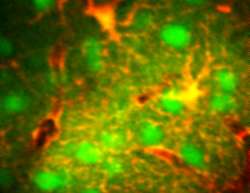
Nerve cells (green) and glia cells (orange) in the cortex.
(Medical Xpress) -- A team of neurobiologists around Andreas Lüthi at the Friedrich Miescher Institute of Biomedical Research has shown for the first time that cortex, the largest area of the brain that is typically associated with higher functions such as perception and cognition, is also a prominent site of emotional learning. Letzkus and colleagues used a set of recently developed methods to observe through which neuronal circuits activity is conveyed during learning. This study, published in Nature, demonstrates a causal link between neuronal activity patterns and animal behavior, and provides pioneering work exploring emotions in the brain.
Anxiety disorders are a family of complex diseases, which affect around 10% of adults. One of the hallmarks of these disorders is that patients have "learned" to fear situations or objects to a degree that is not proportional to the real danger. The amygdala, a structure deep in the brain, is central to the processing of fear and anxiety, and its function may be disrupted in anxiety disorders.
But, there is no fear without a sensory input: We hear, see, smell, taste or feel something that then triggers fear. These sensory signals are processed in the cortex, the region of the brain typically associated with higher functions such as perception and cognition. However, how this brain region is involved in emotional learning has hardly ever been addressed.
For the first time, scientists in the team of Andreas Lüthi, group leader at the FMI and professor at the University of Basel, have been able to follow a sensory stimulus during learning on its cellular path through the brain. Their results, describing a circuit in cortex critical for associative fear learning, have been published today in the distinguished scientific journal Nature.
Looking inside a learning brain
In Lüthi's experiments, mice learned to associate a tone with an unpleasant stimulus so that the tone itself becomes unpleasant to the animal. During this learning process the researchers visualized the activity of the neurons in the brain using 2-photon calcium imaging.
Under normal conditions, activity in neuronal networks is tightly controlled by a fine-tuned balance of synaptic excitation (which promotes firing) and synaptic inhibition (which prevents firing). Thus, any incoming signal is rapidly quenched by inhibition, allowing firing only for a very brief time after stimulus onset. In contrast, the authors found that learning opens a prolonged time window of reduced inhibition, termed 'dis-inhibition'. Thus, when the animal perceives a tone during learning, it is processed much more intensely than under normal conditions. This increased activity likely induces synaptic plasticity which underlies memory formation.
Neuronal circuit in cortex necessary for learning
Lüthi then went on to show that this dis-inhibitory microcircuit is also present in other areas of cortex, like the one processing visual input. "A really interesting aspect of our observations is that dis-inhibition appears to be necessary for learning, but does not cause learning on its own. Rather, what we perceive during a state of heightened arousal will determine what we actually learn" explains Lüthi.
To strengthen their findings further, Johannes Letzkus and Steffen Wolff, both in Lüthi's group, made use of optogenetics. They used this recently developed technique to interfere selectively with dis-inhibition during learning. When they tested the memory of these mice the next day, they found a severe impairment, which directly demonstrates that dis-inhibition is indispensable for learning.
"For the first time, thanks to the recent technological developments in modern neurobiology, we can look into the black box and actually show what happens in these neuronal circuits during associative learning on a cellular level and thereby elucidate the psychological concepts of arousal and attention in learning," said Lüthi.
More information: Letzkus JJ, Wolff SBE, Meyer EMM, Tovote P, Courtin J, Herry C, Lüthi A. (2011) A disinhibitory microcircuit for associative fear learning in auditory cortex. Nature, DOI: 10.1038/nature10674
Journal reference:
Nature
Provided by Friedrich Miescher Institute for Biomedical Research
-
At the forefront of optogenetics
May 24, 2011 |
not rated yet |
0
-
Be afraid, be very afraid, if you learned to
Jan 24, 2007 |
not rated yet |
0
-
Scientists discover brain structures associated with learning
May 02, 2011 |
not rated yet |
0
-
Deeper insight in the activity of cortical cells
Jul 12, 2011 |
not rated yet |
0
-
Picower research finds unexpected activity in visual cortex
Mar 16, 2006 |
not rated yet |
0
-
Of mice and mental models: Neuroscientific implications of risk-optimized behavior in the mouse
May 25, 2012 |
not rated yet |
0
-
Limits to growth: Scientists identify key metastasis-enabling enzyme
May 22, 2012 |
5 / 5 (4) |
0
-
Seeing is as seeing does: Spatially-structured retinal input in early development of cortical maps
Apr 26, 2012 |
5 / 5 (4) |
1
-
Dreamless nights: Brain activity during nonrapid eye movement sleep
Apr 09, 2012 |
4.4 / 5 (12) |
0
-
Take your time: Neurobiology sheds light on the superiority of spaced vs. massed learning
Mar 28, 2012 |
4.5 / 5 (21) |
3
-
Potential Breakthrough in Seizure Control
16 hours ago
-
Popping/Cracked sternum.
20 hours ago
-
Which Mental Illness Encompasses This Problem?
21 hours ago
-
A question about drug tolerance
May 23, 2012
-
Poor nutrition leading to overeating?
May 23, 2012
-
Math and dyslexia?
May 21, 2012
- More from Physics Forums - Medical Sciences
More news stories
Of mice and mental models: Neuroscientific implications of risk-optimized behavior in the mouse
(Medical Xpress) -- Regardless of an organism’s biological complexity, every encephalized animal continuously makes under-informed behavioral choices that can have serious consequences. Despite its ubiquity, ...
Neuroscience
May 25, 2012 |
not rated yet |
0
|
Persistent sensory experience is good for aging brain
Despite a long-held scientific belief that much of the wiring of the brain is fixed by the time of adolescence, a new study shows that changes in sensory experience can cause massive rewiring of the brain, even as one ages. ...
Neuroscience
May 24, 2012 |
not rated yet |
0
Boundary stops molecule right where it needs to be
A molecule responsible for the proper formation of a key portion of the nervous system finds its way to the proper place not because it is actively recruited, but instead because it can't go anywhere else.
Neuroscience
May 24, 2012 |
not rated yet |
0
|
Locating ground zero: How the brain's emergency workers find the disaster area
Like emergency workers rushing to a disaster scene, cells called microglia speed to places where the brain has been injured, to contain the damage by 'eating up' any cellular debris and dead or dying neurons. ...
Neuroscience
May 24, 2012 |
5 / 5 (2) |
0
|
Genetic 'reset switch' enables signaling pathway to induce multiple developmental outcomes for olfactory neurons
Within the nervous system, a handful of signaling pathways modulate development of a cornucopia of different neuronal subtypes. Even small alterations in neuron differentiation pathways can disrupt subsequent ...
Neuroscience
May 24, 2012 |
not rated yet |
0
Keep food safety in mind this memorial day weekend
(HealthDay) -- Picnics, parades and cookouts are as much a part of Memorial Day weekend as tributes to the United States' war veterans.
Travel to high altitudes tied to Crohn's, colitis flare-ups
(HealthDay) -- People with inflammatory bowel disease, which includes Crohn's disease and colitis, may be at increased risk for flare-ups when they fly or travel to high altitudes for skiing or mountain climbing, ...
Family history of Alzheimer's affects functional connectivity
(HealthDay) -- Cognitively normal individuals with a family history of late-onset Alzheimer's disease (AD) may display lower resting state functional connectivity in the default mode network (DMN) of the brain, ...
Transvaginal mesh op restores pelvic organ prolapse at price
(HealthDay) -- Transvaginal mesh (TVM) procedures are effective for anatomical restoration of pelvic organ prolapse (POP), but patients report a worsening of sexual function following surgery, according to ...
Weight struggles? Blame new neurons in your hypothalamus
New nerve cells formed in a select part of the brain could hold considerable sway over how much you eat and consequently weigh, new animal research by Johns Hopkins scientists suggests in a study published in the May issue ...
Thioridazine kills cancer stem cells in human while avoiding toxic side-effects of conventional cancer treatments
A team of scientists at McMaster University has discovered a drug, thioridazine, successfully kills cancer stem cells in the human while avoiding the toxic side-effects of conventional cancer treatments.
Dec 08, 2011
Rank: not rated yet