It takes a sugar to catch a sugar
December 2, 2011 in Medical research
It takes a sugar to catch a sugar

Enlarge

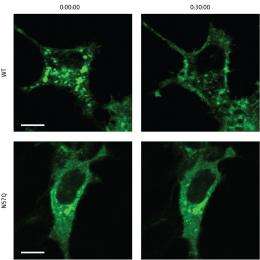
Figure 1: GLUT4 is normally retained within storage vesicles in the cytoplasm (top left), but is redistributed to the cell membrane within 30 minutes of insulin treatment (top right). However, the non-glycosylated N57Q mutant (bottom left) fails to respond to insulin and remains within cytoplasmic vesicles even after 30 minutes (bottom right) (scale bars, 10 μm). Credit: Reproduced from Ref. 1 © 2011 American Society for Biochemistry and Molecular Biology

After every meal, the hormone insulin is released into the bloodstream, issuing instructions to target cells to begin taking up excess sugar. In some situations, however, cells stop responding to these signals; and this insulin-resistant state is associated with onset of type 2 diabetes. Unexpected findings from Tadashi Suzuki’s group at the RIKEN Advanced Science Institute in Wako have now revealed how a cellular malfunction may contribute to this insulin resistance. 

Suzuki and postdoctoral fellow Yoshimi Haga had originally sought to develop imaging strategies to track localization of proteins modified with carbohydrate groups in a process known as glycosylation. They tested their method with the glucose-transporter GLUT4 and developed a mutant version of the protein that lacks a glycosylation site, but the results led their study in a new direction. “We accidentally found that behavior of our N57Q mutant and the wild-type protein was quite different,” says Suzuki. “It was a completely serendipitous finding.” 

Insulin-responsive typically maintain reservoirs of GLUT4 in bubble-like vesicles within the cytoplasm; insulin signals induce the transport of GLUT 4 to the cell surface, where it begins pumping glucose into the cell. The N57Q mutant, on the other hand, was largely unresponsive to insulin (Fig. 1). Suzuki and colleagues determined that, instead of gathering within storage vesicles, this protein tended to accumulate either at the cell surface or within ‘recycling vesicles’ that continually shuttle to and away from the plasma membrane.

The N57Q mutant retains normal glucose-transporting capabilities, suggesting that this modification acts primarily as a trafficking signal rather than influencing protein function. Accordingly, the researchers observed the same insulin-insensitive behavior when they used a chemical treatment to alter the glycosylation of normal GLUT4. “These results clearly suggest that there must be a mechanism that detects subtle differences in glycan structure on this protein to sort it into specific GLUT4 vesicles,” says Suzuki.

Several studies have found evidence that GLUT4 may be subject to altered glycosylation in a subset of patients with ; and, these new findings provide a potential explanation for how malfunctions in this protein modification process could contribute to pathology. As a next step, Suzuki hopes to uncover more details about how this transport pathway intersects with the insulin response. “We believe that glycan-recognition molecules known as lectins should be involved in this process,” he says, “and we will try to identify these lectins and other players involved in the fine-tuning of intracellular trafficking of GLUT4.”

More information: Haga, Y., Ishii, K. & Suzuki, T. N-glycosylation is critical for the stability and intracellular trafficking of GLUT4 glucose transporter. The Journal of Biological Chemistry published online 14 July 2011. doi: 10.1074/jbc.M111.253955

Provided by RIKEN search and more info website

5 /5 (1 vote)  

Filter


Move the slider to adjust rank threshold, so that you can hide some of the comments.


Display comments: newest first

DanielHaszard
Dec 03, 2011

Rank: not rated yet
Be aware of drugs that potentiate diabetes.
Eli Lilly Zyprexa Olanzapine issues linger.
The use of powerful antipsychotic drugs has increased in children as young as three years old. Weight gain, increases in triglyceride levels and associated risks for diabetes and cardiovascular disease. The average weight gain (adults) over the 12 week study period was the highest for Zyprexa17 pounds. Youd be hard pressed to gain that kind of weight sport-eating your way through the holidays.One in 145 adults died in clinical trials of those taking the antipsychotic drug Zyprexa.
This was Lilly's #1 product $5 billion per year sales,moreover Lilly also make billions more on drugs that treat diabetes.
--- Daniel Haszard Zyprexa activist and patient.
Rank 5 /5 (1 vote)
Relevant PhysicsForums posts
  • Potential Breakthrough in Seizure Control
    created15 hours ago
  • Popping/Cracked sternum.
    created20 hours ago
  • Which Mental Illness Encompasses This Problem?
    created20 hours ago
  • A question about drug tolerance
    createdMay 23, 2012
  • Poor nutrition leading to overeating?
    createdMay 23, 2012
  • Math and dyslexia?
    createdMay 21, 2012
  • More from Physics Forums - Medical Sciences

More news stories

Implantable pain disk may help those with cancer

An estimated 3.5 million cancer patients around the globe are in severe pain from their disease, but many get no relief.

Medical research created May 25, 2012 | popularity 5 / 5 (1) | comments 0 | with audio podcast

Energy levels link sleep control mechanisms

Sleep, or lack of it, can determine level of cognitive performance which is linked with accidents as well as increased risk of serious health problems. Links between cell energy levels, gene transcription ...

Medical research created May 25, 2012 | popularity not rated yet | comments 0

Researchers identify key brain cell in antidepressant action

(Medical Xpress) -- Antidepressant medications such as Prozac have helped improve mood and lessen anxiety in millions of people with major depression. But scientists know surprisingly little about how these drugs work.

Medical research created May 25, 2012 | popularity 4.7 / 5 (3) | comments 0 | with audio podcast

Rockefeller scientists pioneer new method to determine mechanisms of drug action

(Medical Xpress) -- Knowing that a drug works is great. Knowing how it works is a luxury. And until now, determining a drug’s mechanism of action has been a tedious and difficult process for scientists.

Medical research created May 25, 2012 | popularity not rated yet | comments 0 | with audio podcast

Like curry? New biological role identified for compound used in ancient medicine

Scientists have just identified a new reason why some curry dishes, made with spices humans have used for thousands of years, might be good for you.

Medical research created May 25, 2012 | popularity 4.5 / 5 (12) | comments 2 | with audio podcast


Keep food safety in mind this memorial day weekend

(HealthDay) -- Picnics, parades and cookouts are as much a part of Memorial Day weekend as tributes to the United States' war veterans.

Travel to high altitudes tied to Crohn's, colitis flare-ups

(HealthDay) -- People with inflammatory bowel disease, which includes Crohn's disease and colitis, may be at increased risk for flare-ups when they fly or travel to high altitudes for skiing or mountain climbing, ...

Family history of Alzheimer's affects functional connectivity

(HealthDay) -- Cognitively normal individuals with a family history of late-onset Alzheimer's disease (AD) may display lower resting state functional connectivity in the default mode network (DMN) of the brain, ...

Transvaginal mesh op restores pelvic organ prolapse at price

(HealthDay) -- Transvaginal mesh (TVM) procedures are effective for anatomical restoration of pelvic organ prolapse (POP), but patients report a worsening of sexual function following surgery, according to ...

Of mice and mental models: Neuroscientific implications of risk-optimized behavior in the mouse

(Medical Xpress) -- Regardless of an organism’s biological complexity, every encephalized animal continuously makes under-informed behavioral choices that can have serious consequences. Despite its ubiquity, ...

Weight struggles? Blame new neurons in your hypothalamus

New nerve cells formed in a select part of the brain could hold considerable sway over how much you eat and consequently weigh, new animal research by Johns Hopkins scientists suggests in a study published in the May issue ...