Toward a vaccine for Ebola
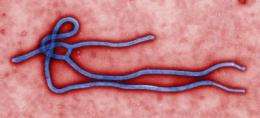
On August 26, 1976, a time bomb exploded in Yambuku, a remote village in Zaire, (now the Democratic Republic of the Congo). A threadlike virus known as Ebola had emerged, soon earning a grim distinction as one of the most lethal, naturally occurring pathogens on earth, killing up to 90 percent of its victims, and producing a terrifying constellation of symptoms known as hemorrhagic fever.
Now, Charles Arntzen, a researcher at the Biodesign Institute at Arizona State University, along with colleagues from ASU, the University of Arizona College of Medicine-Phoenix, and the United States Army Medical Research Institute of Infectious Diseases, Fort Detrick, MD, have made progress toward a vaccine against the deadly virus.
The group's research results appear in today's issue of the Proceedings of the National Academy of Science, along with a companion paper by their collaborators at Mapp Pharmaceuticals in San Diego, CA, led by Larry Zeitlin. Arntzen's group demonstrated that a plant-derived vaccine for Ebola provided strong immunological protection in a mouse model.
If early efforts bear fruit, an Ebola vaccine could be stockpiled for use in the United States, should the country fall victim to a natural outbreak or a bioterrorism event in which a weaponized strain of the virus were unleashed on soldiers or the public.
To date, Ebola outbreaks have been mercifully rare. For researchers like Arntzen however, this presents a challenge: "With other lethal viruses like HIV there is a common pattern of occurrence, allowing for vaccine testing. For example, an AIDS vaccine study is now underway at two locations in Thailand, which were chosen because of a current high incidence of the disease."
By contrast, Ebola events are fleeting, episodic and largely unpredictable. For this reason, Arntzen stresses that an Ebola vaccine would most likely not be used prophylactically—that is, as a means of protecting large populations, as in the case of common vaccines against diseases like influenza or polio. Instead, the idea is to have a sizeable store of the vaccine on hand in the event of a sudden outbreak, either natural or nefarious.
A killer up close
Ebola belongs to a family of viruses known as filoviridae, which take their name from their serpentine, filamentous structure (see Figure 1). Filoviridae fall into two broad categories known as Ebola-like and Marburg-like viruses. In the original Ebola outbreak in Yambuku, situated along the Ebola River, 280 of the 318 identified cases died. Soon thereafter, an additional 284 cases and 151 deaths occurred in nearby Sudan. In Yambuku, the small local hospital was shut down, after 11 of its 17 staff members died.
The likely reservoir for the disease is bats. Primates including monkeys can become infected from eating bats or from fruit the bats may have dropped. Infected animals can then spread the disease to humans through bites, or when the primates are consumed for food—a practice prevalent in some regions of Africa.
The course of the disease is pitiless, sometimes producing hemorrhagic fever, which causes severe bleeding from mucous membranes, including the gastroinestinal tract, eyes, nose, vagina and gingiva. The very high mortality and gruesome symptoms of the disease have riveted public attention and have been the focus of numerous films and books, notably Richard Preston's The Hot Zone.
Arntzen notes that while no human vaccine against Ebola currently exists, a number of strong candidates have emerged. While some have yielded good results in animal models, in terms of protection against the virus, they have practical shortcomings. "All of these existing vaccine candidates are genetically modified live viruses," he says. Vaccines of this sort require very careful conditions of storage and have a tendency to lose potency over a period of months. "If you've got something that you're going to have to keep at liquid nitrogen temperatures for years at a time, in hopes that there will never be an outbreak, it makes it impractical. "
Fighting pathogens with plants
Of the vaccines available to doctors today, some (like influenza) are produced in eggs, some in cultured animal cells, and others in yeast. Arntzen's team has taken a different approach to vaccine production by converting tobacco plants into living pharmaceutical factories. They created a DNA blueprint for their Ebola vaccine, and used a specialized bacterium to infuse it into the leaves of tobacco. "The blueprint converts each leaf cell into a miniature manufacturing unit," Arntzen says.
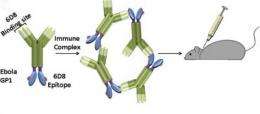
In the current study, the vaccine blueprint was designed by fusing a key surface protein (known as GP1) from the Ebola virus with a monoclonal antibody customized to bind to GP1. The resulting molecules' opposite ends attract each other, like a group of rod-shaped magnets. When the vaccine molecules bind to each other, they form an aggregate called an Ebola Immune Complex (EIC). "In immunology, that means you've got something that is much easier for our immune system to recognize," Arntzen says. "Because it has many copies of an identical molecule, it's called a repeating array." (See Figure 2)
Within two weeks after the vaccine "blueprint" is delivered to tobacco leaves, enough of the EIC accumulates to allow its purification from other leaf cell components. The researchers then vaccinated mice with the purified sample, and showed that their immune system gave a strong response.
For the ultimate validation of the vaccine however, it was necessary to show that the vaccinated mice could withstand an Ebola virus infection. Because of the dangers in handling the virus, these experiments were conducted by skilled researchers at a high containment facility operated by the US Army Medical Research Institute in Maryland. It was found that the level of protection of the vaccinated mice was equivalent to that seen in prior experiments with the best, previously available experimental vaccine.
The advantages of using tobacco to manufacture a vaccine are significant. The initial costs for plant growth are much cheaper than design of traditional pharmaceutical facilities. In addition, the material extracted from tobacco leaves can be easily purified, and then might be spray dried or freeze-dried, yielding a highly stable compound, storable at ambient temperatures for extended periods. This will be essential for an Ebola vaccine, since it will primarily be stockpiled to use only if there is a disease outbreak.
Vaccines typically contain adjuvants—immune modulating factors that improve a vaccine's protective qualities. Most vaccines contain alum (or aluminum hydroxide), which is an FDA approved adjuvant. In the case of the plant-derived Ebola vaccine, alum did not improve the survival rates in mice when it was co-administered with EIC. Instead, the group found that a Toll-like receptor (TLR) agonist known as PIC, when delivered in tandem with EIC, dramatically improved survival.
Toll-like receptors are part of the body's innate immune system—involved in processes of inflammation, where defensive cells like macrophages and dendritic cells are attracted to the site of infection. Arntzen explains that the TLR agonist PIC acts to mimic a site of inflammation, amplifying the immune response, without causing tissue damage. In experiments using a combination of PIC and EIC, mice achieved an 80 percent survival rate against a lethal challenge of Ebola—commensurate with the best existing vaccine candidates.
The road ahead
In their companion PNAS paper, Arnzen's collaborators at Mapp Biopharmaceuticals outline the process for creating the monoclonal antibodies used for this research. Treatment for an Ebola infection, Arntzen says, would likely involve the injection of fast acting antibodies to attack the virus directly—a process known as passive immunization, combined with a vaccine to stimulate the protective immune response (active immunization). This approach is commonly used in the case of other viral infections, particularly rabies. "Our two papers offer a nice back to back picture," Arntzen says. "We can manufacture both of these post-Ebola exposure reagents for a defensive stockpile, using tobacco."
The next steps for a plant-derived filovirus vaccine will involve using the EIC platform to design protection against the full range of these threadlike viruses. The method, with its straightforward purification protocol might also be used in the case of other pathogens including hepatitis C or dengue fever, where the extraction of glycoproteins has thus far been difficult.
Should efforts succeed in producing a post-exposure therapeutic that could be stockpiled by the U.S. military, the vaccine could also be made available to the Center for Disease Control for immediate use in the event of a remote outbreak.
More information: A nonreplicating subunit vaccine protects mice against lethal Ebola virus challenge, by Waranyoo Phoolcharoen, John M. Dye, Jacquelyn Kilbourne, Khanrat Piensook, William D. Pratt, Charles J. Arntzen, Qiang Chen, Hugh S. Mason, and Melissa M. Herbst-Kralovetz, PNAS.
Design and testing of an Ebola virus post-exposure immunoprotectant: enhanced potency of a fucose free monoclonal antibody, Larry Zeitlin, James Pettitt, Corinne Scully, Natasha Bohorova, Do Kim, MichaelyPauly, Andrew Hiatt, Long Ngo, Herta Steinkellner, Kevin Whaley, Gene Olinger, PNAS.


