Brain region can signal early-stage Alzheimer's and other dementias
January 12, 2012 in Alzheimer's disease & dementia
Brain region can signal early-stage Alzheimer's and other dementias

Enlarge

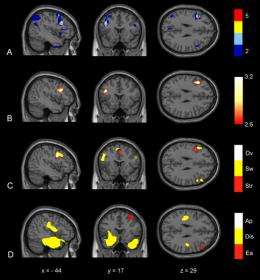
A and B show the correlation of cognitive impairment in early dementia with sugar metabolism in the inferior frontal junction (IFJ; red). In healthy subjects, the control functions are located in the same region (C). Personality changes such as those that may occur in dementia are associated with other regions of the brain (D). Credit: MPI for Human Cognitive and Brain Sciences

(Medical Xpress) -- A key misplaced yet again? Unable to recall a name? Forgetfulness frequently leads to anxiety: is it just a sign of age, or are these the first symptoms of the onset of Alzheimer’s disease? It has never been easy to answer this question in the early stages - however, that might be about to change. Using modern imaging techniques, scientists from Leipzig’s Max Planck Institute for Human Cognitive and Brain Sciences and Leipzig University have identified a brain hub that is associated with thought functions often affected by dementias. This could facilitate improved predictions of the progress of dementia.

Dementia disorders are one of the major problems faced by societies with aging populations. The most common form of is Alzheimer’s disease, which generally makes its appearance after the age of 60. As a rule, it is preceded by a phase of mild cognitive impairment that does not diminish quality of life. Forgetting the keys or checking twice for the post – these slight impairments of memory are easy enough to live with. Experience shows that only about half of those affected by such go on to develop Alzheimer’s or other forms of dementia in the following years.

“In dementias, other thought processes are often affected as well as memory, such as those known as the executive or control functions”, explains Matthias Schroeter of the Max Planck Institute for Human Cognitive and Sciences. Using brain scans and modern imaging techniques, his team in Leipzig are working to make early diagnosis possible. “These control functions come into play when we face new and unexpected situations, for example, enabling us to react in flexible and appropriate ways. If they are affected in addition to memory, patients can no longer compensate for their handicap by, say, writing reminders for themselves.” Deficiencies in these control functions actually indicate that dementia is imminent.

In a current study, the researchers use measurements of brain metabolism to show that impairments to the control functions are reflected in a specific part of the frontal lobe of the brain, the inferior frontal junction. The data suggests that this junction, where two depressions or sulci meet, is of major importance in the development of dementia and its symptoms.

For the purposes of this study, the scientists examined 54 patients with different early-stage dementias, including Alzheimer’s disease. The patients completed typical dementia tests used to evaluate cognitive impairment. One example is the classic Stroop test, in which the subject must read words that represent specific colours (yellow, red, blue, etc.) but that are printed in different colours. The idea is to name the colour in which the word is printed as fast as possible: a task that requires quick rethinking in the brain. Another test, this time used to assess language competence, is the supermarket test. Within a given time, patients have to name as many items as possible that can be bought in a supermarket. A third test is used to test problem-solving ability. Together, these and other tests give a good overall picture of the cognitive deficiencies that may occur in dementia and that affect the functions most likely to impinge on daily activities. Over and above the dementia tests, all patients were subjected to a PET scan (positron emission tomography) to assess their cerebral metabolism. The resulting images showed that problems detected by the dementia tests were associated with reduced sugar metabolism in the neurons of the inferior frontal junction.

If this correlation is confirmed in further studies, it could be that scans of the frontal lobe of the brain will provide the answer to that pressing, fearful question: just forgetfulness or the onset of dementia?

More information: Matthias L. Schroeter, et al. Executive deficits are related to the inferior frontal junction – An FDG-PET study in early dementia. Brain (2011) doi: 10.1093/brain/awr311 First published online: December 19, 2011

Journal reference: Brain search and more info website

Provided by Max-Planck-Gesellschaft search and more info website

3.4 /5 (13 votes)  

Rank 3.4 /5 (13 votes)
Relevant PhysicsForums posts
  • magnetic field from stream of protons
    created1 hour ago
  • Force on a particle constrained to move on the surface of a sphere
    created1 hour ago
  • Force in a magnetic coupling
    created11 hours ago
  • Sign of scalar product in electric potential integral?
    created18 hours ago
  • Heat engines: how can we yield work?
    created19 hours ago
  • Work done by us on the spring
    createdMay 25, 2012
  • More from Physics Forums - Classical Physics

More news stories

Family history of Alzheimer's affects functional connectivity

(HealthDay) -- Cognitively normal individuals with a family history of late-onset Alzheimer's disease (AD) may display lower resting state functional connectivity in the default mode network (DMN) of the brain, ...

Alzheimer's disease & dementia created 10 hours ago | popularity not rated yet | comments 0

First study to suggest that the immune system may protect against Alzheimer's changes in humans

Recent work in mice suggested that the immune system is involved in removing beta-amyloid, the main Alzheimer's-causing substance in the brain. Researchers have now shown for the first time that this may apply in humans.

Alzheimer's disease & dementia created May 25, 2012 | popularity 4.8 / 5 (4) | comments 0 | with audio podcast

The search for the earliest signs of Alzheimer's

(Medical Xpress) -- For the past five years, volunteers from the City of Berkeley and surrounding areas have come to Lawrence Berkeley National Laboratory to participate in an ongoing study that’s changing ...

Alzheimer's disease & dementia created May 24, 2012 | popularity 5 / 5 (1) | comments 0 | with audio podcast

New estimates up dementia rates in mid-income countries

(HealthDay) -- Use of 10/66 dementia diagnosis criteria (10/66) results in an increase in the estimated incidence of dementia in middle-income countries, according to a study published online May 23 in The La ...

Alzheimer's disease & dementia created May 24, 2012 | popularity 5 / 5 (1) | comments 0

Pathological aging brains contain the same amyloid plaques as Alzheimer's disease

Pathological aging (PA) is used to describe the brains of people which have Alzheimer's disease (AD)-like pathology but where the person showed no signs of cognitive impairment whilst they were alive. New research, published ...

Alzheimer's disease & dementia created May 23, 2012 | popularity not rated yet | comments 0


Keep food safety in mind this memorial day weekend

(HealthDay) -- Picnics, parades and cookouts are as much a part of Memorial Day weekend as tributes to the United States' war veterans.

Travel to high altitudes tied to Crohn's, colitis flare-ups

(HealthDay) -- People with inflammatory bowel disease, which includes Crohn's disease and colitis, may be at increased risk for flare-ups when they fly or travel to high altitudes for skiing or mountain climbing, ...

Transvaginal mesh op restores pelvic organ prolapse at price

(HealthDay) -- Transvaginal mesh (TVM) procedures are effective for anatomical restoration of pelvic organ prolapse (POP), but patients report a worsening of sexual function following surgery, according to ...

Of mice and mental models: Neuroscientific implications of risk-optimized behavior in the mouse

(Medical Xpress) -- Regardless of an organism’s biological complexity, every encephalized animal continuously makes under-informed behavioral choices that can have serious consequences. Despite its ubiquity, ...

Weight struggles? Blame new neurons in your hypothalamus

New nerve cells formed in a select part of the brain could hold considerable sway over how much you eat and consequently weigh, new animal research by Johns Hopkins scientists suggests in a study published in the May issue ...

Thioridazine kills cancer stem cells in human while avoiding toxic side-effects of conventional cancer treatments

A team of scientists at McMaster University has discovered a drug, thioridazine, successfully kills cancer stem cells in the human while avoiding the toxic side-effects of conventional cancer treatments.