Emergency medicine physicians develop device to stop lethal bleeding in soldiers
January 11, 2012 in Other

Emergency medicine physicians develop device to stop lethal bleeding in soldiers

Enlarge

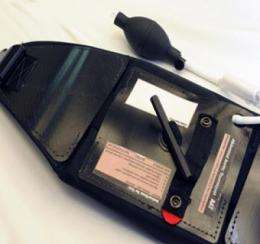
Dr. Richard Schwartz, Chairman of the Department of Emergency Medicine in the Medical College of Georgia at Georgia Health Sciences University and Dr. John Croushorn, Chairman of the Department of Emergency Medicine at Trinity Medical Center in Birmingham, Ala., hope their inflatable wedge-shaped bladder will make a lifesaving difference. Credit: Phil Jones, GHSU photographer

Two emergency medicine physicians with wartime experience have developed a weapon against one rapidly lethal war injury.

Insurgents commonly aim just below a soldier's , where the trunk and legs join, to injure the body's largest blood vessels, causing soldiers to bleed to death within minutes.

"There is no way to put a tourniquet around it, so soldiers are getting shot in this area and dying within several minutes," said Dr. Richard Schwartz, Chairman of the Department of Emergency Medicine in the Medical College of Georgia at Georgia Health Sciences University. Police officers wearing chest protection as well as victims can sustain similar injuries.

Efforts to externally compress the injury have been largely ineffective; the inch-round aorta runs parallel to the spine, so it can't be approached from the back, and is several inches inside the abdomen even in a fit soldier.

Schwartz and Dr. John Croushorn, Chairman of the Department of at Trinity Medical Center in Birmingham, Ala., hope their inflatable wedge-shaped bladder will make a lifesaving difference.

It's called an abdominal aortic tourniquet and it's placed around the body at the navel level, tightened then, much like a blood pressure cuff, inflated into the abdomen until it occludes the aorta and stops the . The goal is to restore the golden hour so soldiers survive long enough to get definitive care for their injury.

"By effectively cross-clamping the aorta with the abdominal aortic tourniquet, you are essentially turning the faucet off," Croushorn said. "You are stopping the loss of blood from the broken and damaged blood vessels. You are buying the patient an additional hour of survival time based on blood loss."

It was known that the knee pressed into the mid-abdomen could slow bleeding and block blood flow to the legs. The idea for the device came from studies conducted at GHSU in 2006 that quantified pressure needed to occlude the abdominal aorta. Schwartz and Croushorn started talking about turning that concept into a lifesaving device at an American College of Emergency Physicians meeting.

They first put the device on pigs, inflated it to the point there was no blood flow from the aorta to the femoral arteries and left it that way for an hour. There saw no potentially deadly increase in potassium levels in the blood and the pigs' leg and gut tissue remained healthy. Next they used it on healthy humans for a shorter duration to ensure that the aorta could be completed occluded.

Croushorn and Schwartz have premarket clearance for the abdominal aortic tourniquet from the Food and Drug Administration and have identified a manufacturer. They already have orders for the device from the U.S. military and will teach courses on how to use it to the military and law enforcement. Device development was funded by the U.S. Department of Defense.

The physicians still want to explore their device's potential for also helping CPR recipients. The chest compression that is the hallmark of CPR actually pushes blood all the way out to the extremities when the focus is keeping vital organs alive.

"With this device, you could, in theory, double the flow to the kidneys, heart and brain," Schwartz said. They also believe it will help concentrate drugs given during CPR where they are needed. "Now when a medic pushes a cardiac drug during cardiac arrest, the drug is circulated through the toes before it reaches steady state concentrations in the heart," Croushorn said.

Schwartz was a member of the 5th Special Forces Group (Airborne) during Operation Desert Shield and Desert Storm. He works with the Federal and Georgia Bureaus of Investigation and helped develop courses that bridge the gap between military and civilian groups that may work together during major disasters. Croushorn served as Command Surgeon, Task Force 185 Aviation in the U.S. Army in Iraq in 2004. He also works with the FBI.

Provided by Georgia Health Sciences University

4.8 /5 (6 votes)  

Filter


Move the slider to adjust rank threshold, so that you can hide some of the comments.


Display comments: newest first

Duude
Jan 11, 2012

Rank: 5 / 5 (2)
Why don't they just extend the body armor a few inches lower?
tadchem
Jan 11, 2012

Rank: 1 / 5 (1)
Inserting and inflating a 'balloon' should accomplish the same goal, and many people carry suitable items on their person - in a wallet or a purse. The could add another dimension to the definition of 'prophylactic.' These could be easily incorporated into most First Aid kits.
Rank 4.8 /5 (6 votes)
Relevant PhysicsForums posts

More news stories

Survey points out deficiencies in addictions training for medical residents

A 2012 survey of internal medicine residents at Massachusetts General Hospital (MGH) – one of the nation's leading teaching hospitals – found that more than half rated the training they had received in addiction and other ...

Other created 4 hours ago | popularity not rated yet | comments 0

Early use of tracheostomy for mechanically ventilated patients not associated with improved survival

For critically ill patients receiving mechanical ventilation, early tracheostomy (within the first 4 days after admission) was not associated with an improvement in the risk of death within 30 days compared to patients who ...

Other created May 21, 2013 | popularity not rated yet | comments 0

Decisions to forgo life support may depend heavily on the ICU where patients are treated

The decision to limit life support in patients in the intensive care unit (ICU) appears to be significantly influenced by physician practices and/or the culture of the hospital, suggests new findings from researchers at the ...

Other created May 21, 2013 | popularity not rated yet | comments 0

People on higher incomes are happier with new knees

Knee replacement surgery is a very common procedure. However, it does not always resolve function or pain in all the recipients of new knees. A study by Robert Barrack, MD and his colleagues from the Washington University ...

Other created May 21, 2013 | popularity not rated yet | comments 0

New search engine finds rare diagnoses

Doctors are trained to think "common disease" when they meet patients in their practices, and as they rarely or never meet a rare disease, it often takes many years to reach the right diagnosis. A new search tool called FindZebra ...

Other created May 21, 2013 | popularity not rated yet | comments 0


Slowing the aging process—only with antibiotics

Swiss scientists reveal the mechanism responsible for aging hidden deep within mitochondria—and dramatically slow it down in worms by administering antibiotics to the young.

Having both migraines, depression may mean smaller brain

(HealthDay)—Migraines and depression can each cause a great deal of suffering, but new research indicates the combination of the two may be linked to something else entirely—a smaller brain.

Brain can be trained in compassion, study shows

Until now, little was scientifically known about the human potential to cultivate compassion—the emotional state of caring for people who are suffering in a way that motivates altruistic behavior.

Researchers complete largest genetic sequencing study of human disease

Researchers from Queen Mary, University of London have led the largest sequencing study of human disease to date, investigating the genetic basis of six autoimmune diseases.

Calorie information in fast food restaurants used by 40 percent of 9-18 year olds when making food choices

A new study published online today (Thursday) in the Journal of Public Health has found that of young people who visited fast food or chain restaurants in the U.S. in 2010, girls and youth who were obese were more likely ...

Novel approach for influenza vaccination shows promise in early animal testing

A new approach for immunizing against influenza elicited a more potent immune response and broader protection than the currently licensed seasonal influenza vaccines when tested in mice and ferrets. The vaccine ...