New fluorescent dyes highlight neuronal activity
January 25, 2012 in Medical research
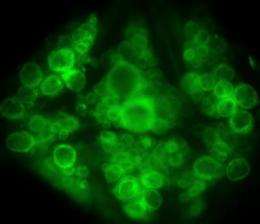
These are leech neurons stained with voltage-sensitive dye. Credit: UC San Diego School of Medicine
Researchers at the University of California, San Diego School of Medicine have created a new generation of fast-acting fluorescent dyes that optically highlight electrical activity in neuronal membranes. The work is published in this week's online Early Edition of the Proceedings of the National Academy of Sciences.
The ability to visualize these small, fast-changing voltage differences between the interior and exterior of neurons known as transmembrane potential is considered a powerful method for deciphering how brain cells function and interact.
However, current monitoring methods fall short, said the study's first author Evan W. Miller, a post-doctoral researcher in the lab of Roger Tsien, PhD, Howard Hughes Medical Institute investigator, UC San Diego professor of pharmacology, chemistry and biochemistry and 2008 Nobel Prize co-winner in chemistry for his work on green fluorescent protein.
"The most common method right now monitors the movement of calcium ions into the cell," said Miller. "It provides some broad indication, but it's an indirect measurement that misses activity we see when directly measuring voltage changes."
The new method employs dyes that penetrate only the membrane of neurons, either in in vitro cells cultured with the dye or, for this study, taken up by neurons in a living leech model. When the dyed cells are exposed to light, neuronal firing causes the dye momentarily to glow more brightly, a flash that can be captured with a high-speed camera.
"One of the tradeoffs with using voltage-sensing dyes in the past is that when they were reasonably sensitive to voltage changes, they were slow compared to the actual physiological events," said Miller. "The new dye gives big signals but is much faster and doesn't perturb the neurons. We essentially see no lag time between the optical signal and electrodes (used to double-check neuronal activity)."
The new method provides a wider view of neuronal activity, said Miller. More importantly, it makes it possible for neuroscientists to do accurate, single trial experiments. "Right now, you have to repeat experiments with cells, and then average the results, which is physiologically less relevant and meaningful."
For Tsien, the new dyes address a career-long challenge.
"These results are the first demonstration of a new mechanism to sense membrane voltage, which is particularly satisfying to me because this was the first problem I started working on as a graduate student in 1972, with little success back then," said Tsien. "Later, we devised indirect solutions such as calcium imaging or dyes that gave big but slow responses to voltage. These techniques have been very useful in other areas of biology or in drug screening, but didn't properly solve the original problem. I think we are finally on the right track, four decades later."
Funding for this research came, in part, from the Howard Hughes Medical Institute, the National Institutes of Health, including the National Institute of Neurological Disorders and Stroke and the National Institute of Biomedical Imaging and Bioengineering.
Co-authors are John Y. Lin, Department of Pharmacology, UC San Diego; E. Paxon Frady, Neurosciences Graduate Group, UC San Diego; Paul A. Steinbach, Department of Pharmacology, UC San Diego and Howard Hughes Medical Institute; William B. Kristan, Jr., Division of Biological Sciences, UC San Diego.
###
Journal reference:
Proceedings of the National Academy of Sciences
Provided by
University of California - San Diego
-
Expression of infrared fluorescence engineered in mammals
May 07, 2009 |
not rated yet |
0
-
New powerful tool can visualize dynamic activity of electrical signals in neuronal populations
Sep 27, 2010 |
not rated yet |
0
-
Scientists chart rapid advances of fluorescent tools for life-science research
Apr 13, 2006 |
not rated yet |
0
-
Rejuvenating electron microscopy: Scientists modify plant protein to provide way to see previously unseen
Apr 05, 2011 |
not rated yet |
0
-
Stem cell derived neurons for research relevant to Alzheimer's and Niemann-Pick type C diseases
Dec 09, 2009 |
not rated yet |
0
-
Motion perception revisited: High Phi effect challenges established motion perception assumptions
Apr 23, 2013 |
3 / 5 (2) |
2
-
Anything you can do I can do better: Neuromolecular foundations of the superiority illusion (Update)
Apr 02, 2013 |
4.5 / 5 (11) |
5
-
The visual system as economist: Neural resource allocation in visual adaptation
Mar 30, 2013 |
5 / 5 (2) |
9
-
Separate lives: Neuronal and organismal lifespans decoupled
Mar 27, 2013 |
4.9 / 5 (8) |
0
-
Sizing things up: The evolutionary neurobiology of scale invariance
Feb 28, 2013 |
4.8 / 5 (10) |
14
-
How can there be a term called "intestinal metaplasia" of stomach
17 hours ago
-
Pressure-volume curve: Elastic Recoil Pressure don't make sense
May 18, 2013
-
If you became brain-dead, would you want them to pull the plug?
May 17, 2013
-
MRI bill question
May 15, 2013
-
Ratio of Hydrogen of Oxygen in Dessicated Animal Protein
May 13, 2013
-
Alcohol and acetaminophen
May 13, 2013
- More from Physics Forums - Medical Sciences
More news stories
H. pylori, smoking trends, and gastric cancer in US men
Trends in Helicobacter pylori (H. pylori) and smoking explain a significant proportion of the decline of intestinal-type noncardia gastric adenocarcinoma (NCGA) incidence in US men between 1978 and 2008, and are estimated ...
Medical research
7 hours ago |
not rated yet |
0
Common food supplement fights degenerative brain disorders
Widely available in pharmacies and health stores, phosphatidylserine is a natural food supplement produced from beef, oysters, and soy. Proven to improve cognition and slow memory loss, it's a popular treatment for older ...
Medical research
11 hours ago |
5 / 5 (2) |
0
|
Finding a family for a pair of orphan receptors in the brain
Researchers at Emory University have identified a protein that stimulates a pair of "orphan receptors" found in the brain, solving a long-standing biological puzzle and possibly leading to future treatments for neurological ...
Medical research
12 hours ago |
5 / 5 (1) |
0
|
Insight into the dazzling impact of insulin in cells
Australian scientists have charted the path of insulin action in cells in precise detail like never before. This provides a comprehensive blueprint for understanding what goes wrong in diabetes.
Medical research
12 hours ago |
4.5 / 5 (6) |
0
|
Do men's and women's hearts burn fuel differently?
Researchers at the University of Illinois at Chicago College of Medicine will study gender differences in how the heart uses and stores fat—its main energy source—and how changes in fat metabolism play ...
Medical research
15 hours ago |
not rated yet |
0
If you can remember it, you can remember it wrong
(Medical Xpress)—Native peoples in regions where cameras are uncommon sometimes react with caution when their picture is taken. The fear that something must have been stolen from them to create the photo ...
B vitamins could delay dementia
(Medical Xpress)—Despite spending billions of dollars on research and development, drug companies have been unable to come up with effective treatments for dementia and Alzheimer's Disease (AD). Now, A. ...
Reducing caloric intake delays nerve cell loss
Activating an enzyme known to play a role in the anti-aging benefits of calorie restriction delays the loss of brain cells and preserves cognitive function in mice, according to a study published in the May ...
New sleeping pill poised to hit US markets
An experimental sleeping pill from US drug company Merck is effective at helping people fall and stay asleep, according to reviewers at the US Food and Drug Administration, which could soon approve the new drug.
Antidepressant reduces stress-induced heart condition
A drug commonly used to treat depression and anxiety may improve a stress-related heart condition in people with stable coronary heart disease, according to researchers at Duke Medicine.
Drugs found to both prevent and treat Alzheimer's disease in mice
Researchers at USC have found that a class of pharmaceuticals can both prevent and treat Alzheimer's Disease in mice.