We may be less happy, but our language isn't
"If it bleeds, it leads," goes the cynical saying with television and newspaper editors. In other words, most news is bad news and the worst news gets the big story on the front page.
So one might expect the New York Times to contain, on average, more negative and unhappy types of words — like "war," " funeral," "cancer," "murder" — than positive, happy ones — like "love," "peace" and "hero."
Or take Twitter. A popular image of what people tweet about may contain a lot of complaints about bad days, worse coffee, busted relationships and lousy sitcoms. Again, it might be reasonable to guess that a giant bag containing all the words from the world's tweets — on average — would be more negative and unhappy than positive and happy.
But new research shows just the opposite.
"English, it turns out, is strongly biased toward being positive," said Peter Dodds, an applied mathematician at the University of Vermont.
The UVM team's study "Positivity of the English Language," is presented in the Jan. 11 issue of the journal PLoS ONE.
This new study complements another study the same Vermont scientists presented in the Dec. 7 issue of PLoS ONE, "Temporal Patterns of Happiness and Information in a Global Social Network."
That work attracted wide media attention showing that average global happiness, based on Twitter data, has been dropping for the past two years.
Combined, the two studies show that short-term average happiness has dropped — against the backdrop of the long-term fundamental positivity of the English language.
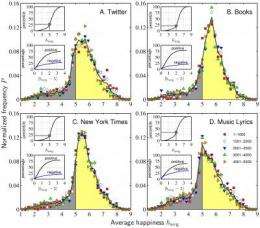
In the new study, Dodds and his colleagues gathered billions of words from four sources: twenty years of the New York Times, the Google Books Project (with millions of titles going back to 1520), Twitter and a half-century of music lyrics.
"The big surprise is that in each of these four sources it's the same," says Dodds. "We looked at the top 5,000 words in each, in terms of frequency, and in all of those words you see a preponderance of happier words."
Or, as they write in their study, "a positivity bias is universal," both for very common words and less common ones and across sources as diverse as tweets, lyrics and British literature.
Why is this? "It's not to say that everything is fine and happy," Dodds says. "It's just that language is social."
In contrast to traditional economic theory, which suggests people are inherently and rationally selfish, a wave of new social science and neuroscience data shows something quite different: that we are a pro-social storytelling species. As language emerged and evolved over the last million years, positive words, it seems, have been more widely and deeply engrained into our communications than negative ones.
"If you want to remain in a social contract with other people, you can't be a…," well, Dodds here used a word that is rather too negative to be fit to print — which makes the point.
This new work adds depth to the Twitter study that the Vermont scientists published in December that attracted attention from NPR, Time magazine and other media outlets.
"After that mild downer story, we can say, 'But wait — there's still happiness in the bank," Dodds notes. "On average, there's always a net happiness to language."
Both studies drew on a service from Amazon called Mechanical Turk. On this website, the UVM researchers paid a group of volunteers to rate, from one to nine, their sense of the "happiness" — the emotional temperature — of the 10,222 most common words gathered from the four sources. Averaging their scores, the volunteers rated, for example, "laughter" at 8.50, "food" 7.44, "truck" 5.48, "greed" 3.06 and "terrorist" 1.30.
The Vermont team — including Dodds, Isabel Kloumann, Chris Danforth, Kameron Harris, and Catherine Bliss — then took these scores and applied them to the huge pools of words they collected. Unlike some other studies — with smaller samples or that elicited strong emotional words from volunteers — the new UVM study, based solely on frequency of use, found that "positive words strongly outnumber negative words overall."
This seems to lend support to the so-called Pollyanna Principle, put forth in 1969, that argues for a universal human tendency to use positive words more often, easily and in more ways than negative words.
Of course, most people would rank some words, like "the," with the same score: a neutral 5. Other words, like "pregnancy," have a wide spread, with some people ranking it high and others low. At the top of this list of words that elicited strongly divergent feelings: "profanities, alcohol and tobacco, religion, both capitalism and socialism, sex, marriage, fast foods, climate, and cultural phenomena such as the Beatles, the iPhone, and zombies," the researchers write.
"A lot of these words — the neutral words or ones that have big standard deviations — get washed out when we use them as a measure," Dodds notes. Instead, the trends he and his team have observed are driven by the bulk of English words tending to be happy.
If we think of words as atoms and sentences as molecules that combine to form a whole text, "we're looking at atoms," says Dodds. "A lot of news is bad," he says, and short-term happiness may rise and and fall like the cycles of the economy, "but the atoms of the story — of language — are, overall, on the positive side."


