Researchers quantify muscle soreness
January 23, 2012 in Medical research
Researchers quantify muscle soreness

Enlarge

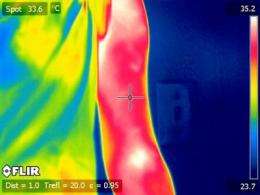
This is a typical infrared image of a subject's arm before exercising. Credit: (c) Journal of Visualized Experiments

Quantifying how sore a person is after a long workout is a challenge for doctors and researchers, but scientists from Loma Linda and Asuza Pacific Universities think they may have figured it out. Their research article describing a new technique to measure muscle soreness will be published in the Journal of Visualized Experiments (JoVE).

Delayed onset (DOMS) or exercise-induced (EIMD) is one of the most common sports injuries, but without a reliable method of quantifying muscle soreness, assessing treatments is difficult.

Traditionally, muscle soreness has been measured using the visual analogue scale (VAS). Participants mark their level of agreement to a statement along a continuous line. Rather than measuring soreness subjectively, the researchers used to detect subtle changes in the temperature of the skin above exercised muscles.

"The main advantage of this technique," said paper author Dr. Jerrold Petrofsky, "is that unlike visual scales, which are kind of a subjective measure of whether someone is sore or not, this technique gives you quantifiable, absolute data."

"There is no gold standard for measuring DOMS and other techniques, such as , are invasive and painful for patients," said JoVE Editor, Leiam Colbert. "The technique presented here allows for earlier diagnosis and quicker treatment of soreness."

Journal reference: Journal of Visualized Experiments search and more info website

Provided by The Journal of Visualized Experiments

4 /5 (1 vote)  

Rank 4 /5 (1 vote)
Relevant PhysicsForums posts
  • Potential Breakthrough in Seizure Control
    created17 hours ago
  • Popping/Cracked sternum.
    created22 hours ago
  • Which Mental Illness Encompasses This Problem?
    created22 hours ago
  • A question about drug tolerance
    createdMay 23, 2012
  • Poor nutrition leading to overeating?
    createdMay 23, 2012
  • Math and dyslexia?
    createdMay 21, 2012
  • More from Physics Forums - Medical Sciences

More news stories

Implantable pain disk may help those with cancer

An estimated 3.5 million cancer patients around the globe are in severe pain from their disease, but many get no relief.

Medical research created May 25, 2012 | popularity 5 / 5 (1) | comments 0 | with audio podcast

Energy levels link sleep control mechanisms

Sleep, or lack of it, can determine level of cognitive performance which is linked with accidents as well as increased risk of serious health problems. Links between cell energy levels, gene transcription ...

Medical research created May 25, 2012 | popularity not rated yet | comments 0

Researchers identify key brain cell in antidepressant action

(Medical Xpress) -- Antidepressant medications such as Prozac have helped improve mood and lessen anxiety in millions of people with major depression. But scientists know surprisingly little about how these drugs work.

Medical research created May 25, 2012 | popularity 4.7 / 5 (3) | comments 0 | with audio podcast

Rockefeller scientists pioneer new method to determine mechanisms of drug action

(Medical Xpress) -- Knowing that a drug works is great. Knowing how it works is a luxury. And until now, determining a drug’s mechanism of action has been a tedious and difficult process for scientists.

Medical research created May 25, 2012 | popularity not rated yet | comments 0 | with audio podcast

Like curry? New biological role identified for compound used in ancient medicine

Scientists have just identified a new reason why some curry dishes, made with spices humans have used for thousands of years, might be good for you.

Medical research created May 25, 2012 | popularity 4.5 / 5 (12) | comments 2 | with audio podcast


Keep food safety in mind this memorial day weekend

(HealthDay) -- Picnics, parades and cookouts are as much a part of Memorial Day weekend as tributes to the United States' war veterans.

Travel to high altitudes tied to Crohn's, colitis flare-ups

(HealthDay) -- People with inflammatory bowel disease, which includes Crohn's disease and colitis, may be at increased risk for flare-ups when they fly or travel to high altitudes for skiing or mountain climbing, ...

Family history of Alzheimer's affects functional connectivity

(HealthDay) -- Cognitively normal individuals with a family history of late-onset Alzheimer's disease (AD) may display lower resting state functional connectivity in the default mode network (DMN) of the brain, ...

Transvaginal mesh op restores pelvic organ prolapse at price

(HealthDay) -- Transvaginal mesh (TVM) procedures are effective for anatomical restoration of pelvic organ prolapse (POP), but patients report a worsening of sexual function following surgery, according to ...

Of mice and mental models: Neuroscientific implications of risk-optimized behavior in the mouse

(Medical Xpress) -- Regardless of an organism’s biological complexity, every encephalized animal continuously makes under-informed behavioral choices that can have serious consequences. Despite its ubiquity, ...

Weight struggles? Blame new neurons in your hypothalamus

New nerve cells formed in a select part of the brain could hold considerable sway over how much you eat and consequently weigh, new animal research by Johns Hopkins scientists suggests in a study published in the May issue ...