Rigged to explode? Inherited mutation links exploding chromosomes to cancer
January 19, 2012 in Cancer
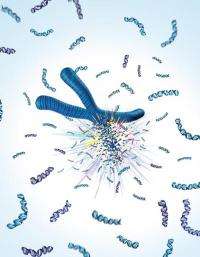
An inherited mutation in the TP53 gene likely causes chromosome "explosions" linked to cancer. Credit: EMBL/P. Riedinger
An inherited mutation in a gene known as the guardian of the genome is likely the link between exploding chromosomes and some particularly aggressive types of cancer, scientists at the European Molecular Biology Laboratory (EMBL), the German Cancer Research Centre (DKFZ) and the University Hospital, all in Heidelberg, Germany, have discovered. Their study, published online today in Cell, also presents the first whole genome sequence of a paediatric tumour: medulloblastoma, a brain cancer which is the second most common cause of childhood mortality in developed countries, where only car accidents cause more deaths in children.
Looking at the complete genome sequence of these tumours, the scientists found one or two chromosomes in each cell had countless parts in the wrong order, were missing some genes, and had extra copies of others. Such extensive rearrangements suggested that those chromosomes had been shattered, like a bead necklace that is pulled too hard, and then wrongly reassembled. But the scientists only found these telltale signs of chromosome explosion, or chromothripsis, in samples from a specific group of patients.
"All patients who had inherited a mutation in the TP53 gene showed signs of chromothripsis in their tumour cells, but none of the patients with normal TP53 did" says Jan Korbel, who led the genomics research at EMBL, "so this mutation must be involved either in shattering chromosomes, or in preventing the cell from reacting when a chromosome shatters."
This strong link between the hereditary TP53 mutation and chromothripsis has implications for diagnosis and treatment.
"As clinicians, if we find evidence of chromothripsis in a medulloblastoma sample, we can now look for an inherited mutation in the TP53 gene" says Stefan Pfister, who led the work at the DKFZ, "and we know that any family members who also have the mutation should be screened regularly, as they'll have a very high risk of developing particular types of cancer, including brain tumours."
Cancer treatments often involve killing the tumour cells by damaging their DNA with chemo- or radiotherapy, but these treatments also affect healthy cells in the surrounding tissue. If those cells have healthy copies of p53 the protein encoded by TP53 this gene will monitor the genome, and if it finds too much damage it will instruct the cells to stop dividing, sending them into the cellular equivalent of old age (senescence) or suicide (apoptosis). But if a patient has inherited the TP53 mutation from their parents, all their cells will have faulty copies of this gene, including the cells surrounding the tumour. Thus, those healthy cells will have trouble dealing with the DNA damage caused by such treatments, and could become cancerous themselves. So the findings have immediate clinical implications in that such patients should not be given DNA-damaging chemotherapy or high-dose radiotherapy, since both would greatly increase the likelihood of secondary cancers.
The scientists believe that the TP53 mutation may also play a role in causing chromosomes to shatter in the first place, by shortening telomeres, the caps that keep chromosome ends from fraying. This could make arms from different chromosomes more likely to get stuck to each other and shatter if they're pulled in different directions. Since telomeres naturally shorten with age, this could explain why, when the German scientists expanded their study to another cancer an aggressive form of leukaemia in adults they found that patients who had both a non-inherited TP53 mutation and evidence of chromothripsis were typically of an advanced age.
"Chromothripsis is thought to cause two to three percent of all human cancers," says Korbel, "so if we can really prove how the TP53 mutation affects this process, it could have a big impact on our understanding of how healthy cells in the body turn into tumours."
The study was undertaken as part of the International Cancer Genome Consortium (ICGC), an effort to study 50 different types of cancer worldwide.
"This study shows the power of combining genome sequencing and clinical expertise," says Peter Lichter from DKFZ, and member of the ICGC scientific steering committee: "cancer genome sequencing can help to understand why patients can react so differently to cancer treatments, and may also lead to the development of new anti-cancer drugs."
Provided by
European Molecular Biology Laboratory
-
U of T discovery may help children with brain cancer avoid radiation
Mar 22, 2010 |
not rated yet |
0
-
Decoding cancer patients' genomes is powerful diagnostic tool
Apr 19, 2011 |
not rated yet |
0
-
Researchers discover genetic risk factor for skin, prostate and brain cancers
Sep 25, 2011 |
not rated yet |
0
-
Punctuated evolution in cancer genomes
Jan 06, 2011 |
not rated yet |
0
-
Preventing cancer without killing cells
Mar 30, 2007 |
not rated yet |
0
-
Of mice and mental models: Neuroscientific implications of risk-optimized behavior in the mouse
May 25, 2012 |
not rated yet |
0
-
Limits to growth: Scientists identify key metastasis-enabling enzyme
May 22, 2012 |
5 / 5 (4) |
0
-
Seeing is as seeing does: Spatially-structured retinal input in early development of cortical maps
Apr 26, 2012 |
5 / 5 (4) |
1
-
Dreamless nights: Brain activity during nonrapid eye movement sleep
Apr 09, 2012 |
4.4 / 5 (12) |
0
-
Take your time: Neurobiology sheds light on the superiority of spaced vs. massed learning
Mar 28, 2012 |
4.5 / 5 (21) |
3
-
Potential Breakthrough in Seizure Control
18 hours ago
-
Popping/Cracked sternum.
23 hours ago
-
Which Mental Illness Encompasses This Problem?
23 hours ago
-
A question about drug tolerance
May 23, 2012
-
Poor nutrition leading to overeating?
May 23, 2012
-
Math and dyslexia?
May 21, 2012
- More from Physics Forums - Medical Sciences
More news stories
Skp2 activates cancer-promoting, glucose-processing Akt
HER2 and its epidermal growth factor receptor cousins mobilize a specialized protein to activate a major player in cancer development and sugar metabolism, scientists report in the May 25 issue of Cell.
Cancer
May 25, 2012 |
not rated yet |
0
|
Pancreatectomy OK without downstaging from therapy
(HealthDay) -- Pancreatectomy improves median survival in pancreatic cancer patients even when presurgical neoadjuvant therapy does not lead to radiographic downstaging of tumors, according to a study published ...
Cancer
May 25, 2012 |
not rated yet |
0
Common therapies for basal cell carcinoma offer similar survival
(HealthDay) -- For patients with superficial basal cell carcinoma (sBCC), treatment with imiquimod or photodynamic therapy (PDT) results in similar long-term tumor-free survival, according to a review published ...
Cancer
May 25, 2012 |
not rated yet |
0
Cancer may require simpler genetic mutations than previously thought
Chromosomal deletions in DNA often involve just one of two gene copies inherited from either parent. But scientists haven't known how a deletion in one gene from one parent, called a "hemizygous" deletion, can contribute ...
Cancer
May 25, 2012 |
not rated yet |
0
|
New prostate cancer screening guidelines face a tough sell, study suggests
(Medical Xpress) -- Recent recommendations from the U.S. Preventive Services Task Force (USPSTF) advising elimination of routine prostate-specific antigen (PSA) screening for prostate cancer in healthy men are likely to encounter ...
Cancer
May 25, 2012 |
not rated yet |
1
Keep food safety in mind this memorial day weekend
(HealthDay) -- Picnics, parades and cookouts are as much a part of Memorial Day weekend as tributes to the United States' war veterans.
Travel to high altitudes tied to Crohn's, colitis flare-ups
(HealthDay) -- People with inflammatory bowel disease, which includes Crohn's disease and colitis, may be at increased risk for flare-ups when they fly or travel to high altitudes for skiing or mountain climbing, ...
Family history of Alzheimer's affects functional connectivity
(HealthDay) -- Cognitively normal individuals with a family history of late-onset Alzheimer's disease (AD) may display lower resting state functional connectivity in the default mode network (DMN) of the brain, ...
Transvaginal mesh op restores pelvic organ prolapse at price
(HealthDay) -- Transvaginal mesh (TVM) procedures are effective for anatomical restoration of pelvic organ prolapse (POP), but patients report a worsening of sexual function following surgery, according to ...
Of mice and mental models: Neuroscientific implications of risk-optimized behavior in the mouse
(Medical Xpress) -- Regardless of an organism’s biological complexity, every encephalized animal continuously makes under-informed behavioral choices that can have serious consequences. Despite its ubiquity, ...
Weight struggles? Blame new neurons in your hypothalamus
New nerve cells formed in a select part of the brain could hold considerable sway over how much you eat and consequently weigh, new animal research by Johns Hopkins scientists suggests in a study published in the May issue ...