Venezuelans line up to switch PIP breast implants
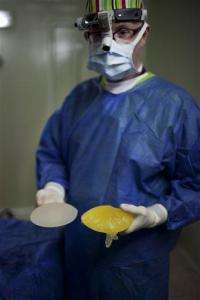
(AP) -- The office of plastic surgeon Ignacio Sousa is so packed that women are lined up outside the door. College students in their 20s, housewives in their 40s, middle-class office workers: nearly all are fearful that their breast implants may be leaking.
Thousands of women worldwide are consulting their doctors about health concerns that have sprung up since December due to faulty silicone breast implants made by the now-defunct French company Poly Implant Prothese, or PIP. In some cases, the implants filled with industrial-grade silicone have split open, prompting growing demand for their removal.
"It's like a snowball," said Sousa, who has been receiving dozens of patients every day since the news broke that French authorities recommended the implants be removed.
The scandal has hit beauty-obsessed Venezuela particularly hard. An estimated 16,000 Venezuelans have the implants, one of the highest figures among Latin American countries, along with much-larger Brazil, where about 20,000 women have either PIP or other defective implants sold by the Dutch company Rofil Medical Nederland BV.
Breast enlargement surgery is common in Venezuela and has grown in popularity in recent years among middle-class women, thanks in part to low-interest loans offered by private clinics for the operations.
The PIP brand was used frequently until the implants were pulled from the market in 2010.
Like many of those affected in Venezuela, Sania Arroyo has struggled with the mounting medical bills. The 33-year-old bank employee and single mother managed to save about 20,000 bolivars, or $4,600, for surgery to replace the implants in January, scraping together nearly four times what she paid to have them inserted in 2007.
She suspected a problem with the implants when she felt a tingling pain under her left breast, and an ultrasound exam confirmed one had ruptured and was leaking silicone into her body.
She said the replacement implants feel more comfortable, but she's still apprehensive about them.
"I feel so much better now, although I still have the fear something similar could happen again," Arroyo said, holding a plastic case containing the ruptured implant and the yellowish silicone that leaked out.
PIP's silicone gel is transparent, but doctors say the substance often turns yellow when it comes in contact with body tissues.
Arroyo is one of 495 Venezuelans who are suing companies that sold the implants, demanding payment of medical costs.
Venezuela's government offered to remove the implants for free, but many women say they won't take up the offer because they prefer to have new implants and the government won't pay for them.
French authorities say an estimated 300,000 women have the implants worldwide, including more than 42,000 in Britain, more than 30,000 in France, 9,000 in Australia and 4,000 in Italy.
The implants were never approved for sale in the United States, but tens of thousands of pairs were sold in Latin America. In Colombia, for instance, the association of plastic surgeons says about 14,000 pairs of PIP implants were sold.
On a per-capita basis, Venezuela appears to lead Latin America in the number of breast implants. That's no surprise to most people in the country, where beauty pageants are a source of national pride and where some teenagers receive implants as birthday presents. Middle-class women sometimes set aside large portions of their salaries for the surgery.
An estimated 35,000 to 40,000 women undergo breast enlargement surgeries in Venezuela each year, and doctors say the numbers have been rising.
"Terror has certainly gripped patients who have the implants, but I don't believe the desire for breast enlargement surgery is going to diminish," said Gabriel Obayi, a surgeon who has been answering many emails from women concerned about health risks.
Like most surgeons in Venezuela, Obayi recommends that PIP implants eventually be removed but advises that surgery is not urgent in most cases.
Regardless of the brand, breast implants are known to break down over time and rupture in some cases.
The U.S. Food and Drug Administration banned silicone-gel type implants in 1992 amid fears they might cause cancer, lupus and other diseases. But in 2006 the agency returned the implants to the U.S. market after most studies failed to find a link between silicone breast implants and disease.
The FDA began an investigation last year into a possible link between implants and a very rare form of cancer, known as anaplastic large cell lymphoma. The agency said it had learned of about 60 cases of the disease worldwide among women with implants.
France's Health Safety Agency has said the suspect PIP implants appear to be more rupture-prone than other types, but officials have not specified why.
French health authorities have said they don't know enough about the health effects of the industrial-grade silicone in the faulty implants, and have recommended that women get them removed after the implants ruptured in more than 1,000 cases. The government has agreed to pay for the procedure.
Investigators in France say PIP sought to save money by using industrial silicone rather than the medical-grade variety.
Last week, French authorities filed preliminary charges against PIP's founder, Jean-Claude Mas, who according to his lawyer is under investigation for "involuntary injury." His company went into bankruptcy proceedings shortly after the government in 2010 pulled the implants from the market.
The scandal has left many women asking about the risks they may face, and doctors so far have limited answers.
"We don't know, neither in Venezuela nor Latin America, what percentage of PIP implants rupture," said Dr. Carlos Nieto, a surgeon and board member of the Venezuelan Society of Plastic and Reconstructive Surgery.
It's also unclear how many women have had the implants removed so far.
In Argentina, about 300 women are negotiating with private clinics and a local distributor, Pro Estetica, demanding the defective implants be replaced for free, said attorney Virgina Luna, who represents the group.
Gabriela Febres, a 30-year-old financial analyst in Caracas, has joined the legal case against Venezuelan distributors. She suspects she needs to have surgery soon because her right breast has been hurting for weeks.
"This affects you in so many ways: your job, your finances and your psychological state," Febres said. "The uncertainty is the worst."
©2012 The Associated Press. All rights reserved. This material may not be published, broadcast, rewritten or redistributed.


