New ability to regrow blood vessels holds promise for treatment of heart disease
February 13, 2012 in Medical research

New ability to regrow blood vessels holds promise for treatment of heart disease

Enlarge

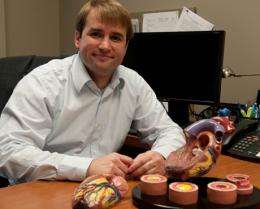
Aaron Baker is an assistant professor in the Department of Biomedical Engineering.

(Medical Xpress) -- University of Texas at Austin researchers have demonstrated a new and more effective method for regrowing blood vessels in the heart and limbs — a research advancement that could have major implications for how we treat heart disease, the leading cause of death in the Western world.

The treatment method developed by Cockrell School of Engineering Assistant Professor Aaron Baker could allow doctors to bypass surgery and instead repair damaged blood vessels simply by injecting a lipid-incased substance into a patient. Once inside the body, the substance stimulates cell growth and spurs the growth of new blood vessels from pre-existing ones.

The method has been tested successfully on rats, and findings of the study were published recently in the Proceedings of the National Academy of Sciences.

"Others have tried using growth factors to stimulate vessel growth in clinical trials and have not been successful," said Baker, a faculty member in the school’s Department of Biomedical Engineering. "We think that a major reason for this is that previous methods assumed that the diseased tissues retained the ability to respond to a growth stimulus. Our method basically delivers extra components that can restore responsiveness to the tissue of patients with long-standing clinical disease."

The ability to regrow blood vessels could prove crucial to treating chronic myocardial ischemia disease, which affects up to 27 million patients in the U.S. and leads to a reduction of blood flow in the heart and lower limbs — ultimately causing organ dysfunction and failure.
New ability to regrow blood vessels holds promise for treatment of heart disease
Enlarge

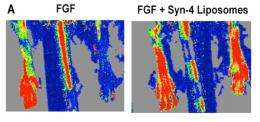
Hindlimb ischemia was created in rats and treatments were delivered over seven days with an osmotic pump. The laser doppler imaging above shows the rat's hind limb prior to treatment (on the left) and with increased blood flow (image on the right) just seven days after treatment.

Central ischemia, which affects the heart, occurs when the coronary vessels that feed blood to the heart become blocked or narrow because of a buildup of fatty deposits called plaques. Such plaques are typically the result of a prolonged unhealthy diet or smoking, and factors such as age, high blood pressure and diabetes increase the risks of the disease, Baker said.

Doctors have typically treated ischemia by physically opening the closed artery with a stent or surgically rerouting blood flow to the poorly perfused tissue. Both methods have limitations, however, and are not effective long-term.

The new method introduced by Baker and his research team builds on a promising revascularization approach that, up until now, has shown limited efficacy in clinical trials for treating human disease.

The method combines a growth factor — a substance capable of stimulating cellular growth, proliferation and cellular differentiation, as well as healing wounds — known as fibroblast growth factor 2 (FGF-2) with a lipid-embedded receptor to enhance its activity.

A challenge for scientists and engineers, however, has been getting FGF-2 to bind with cell receptors — the very molecules often found on the surface of the cell that receive chemical signals and direct activity in the cell from outside sources.

To overcome this, Baker's method embeds the growth factors in synthetic lipid-based nanoparticles containing a coreceptor known as syndecan-4. The nanoparticles containing co-receptors that, when delivered with the growth factor, enable improved cell binding so that the growth factor can direct the targeted cell to divide, proliferate and form new cells for tissue regrowth.

The incased substance was injected into rats with hindlimb ischemia and stimulated a complete recovery from the ischemia in just seven days.

"We hope this research will increase our understanding of how tissues become resistant to revascularization therapies and may lead to more effective treatments for this widespread and debilitating disease," said Baker, who was recognized last year with the National Institutes of Health Director's New Innovator Award.

Designed to support unusually creative new investigators with highly innovative research ideas at an early stage of their careers, the award provides Baker with $1.5 million over five years to study and develop ways to regrow small . With it, Baker is studying why previous attempts to restore blood flow to the have not been effective. His research aims to design new molecular tools and drug delivery methods to enable blood vessel growth in patients with diseases such as diabetes.

Journal reference: Proceedings of the National Academy of Sciences search and more info website

Provided by University of Texas at Austin search and more info website

5 /5 (6 votes)  

Filter


Move the slider to adjust rank threshold, so that you can hide some of the comments.


Display comments: newest first

bcode
Feb 13, 2012

Rank: 1 / 5 (1)
I'm confused... How does increasing the number of blood cells counteract the plaque that is blocking the pathway?
tpb
Feb 13, 2012

Rank: not rated yet
He's building new blood vessels, not blood cells.
bcode
Feb 13, 2012

Rank: 1 / 5 (1)
Ah, yes -- poor choice of words on my part.

So, as you said, he's building new blood vessels -- but how does making the clogged Artery, Vein or Capillary replicate deal with the plaque that's blocking the pathway?

Are they suggesting that they will remove the blocked section and use this method to encourage the patients blood vessels to grow back? That seems unfeasible for the larger vessels that we depend on for survival (heart valves, major arteries, etc)... Even if it only takes 7 days.
dogbert
Feb 14, 2012

Rank: 1 / 5 (1)
They are encouraging the body to naturally bypass the blocked blood vessels. This happens naturally in some cases. They propose to increase the incidence of natural bybass.
Rank 5 /5 (6 votes)
Relevant PhysicsForums posts

More news stories

Study reveals new mechanism for estrogen suppression of liver lipid synthesis

By discovering the new mechanism by which estrogen suppresses lipid synthesis in the liver, UC Irvine endocrinologists have revealed a potential new approach toward treating certain liver diseases.

Medical research created May 23, 2013 | popularity 5 / 5 (1) | comments 0 | with audio podcast

MRI-based measurement helps predict vascular disease in the brain

Aortic arch pulse wave velocity, a measure of arterial stiffness, is a strong independent predictor of disease of the vessels that supply blood to the brain, according to a new study published in the June issue the journal ...

Medical research created May 23, 2013 | popularity not rated yet | comments 0

Antibiotics: A new understanding of sulfonamide nervous system side effects

Since the discovery of Prontosil in 1932, sulfonamide antibiotics have been used to combat a wide spectrum of bacterial infections, from acne to chlamydia and pneumonia. However, their side effects can include serious neurological ...

Medical research created May 23, 2013 | popularity 3 / 5 (1) | comments 0 | with audio podcast

Scientists discover molecule triggers sensation of itch

Scientists at the National Institutes of Health report they have discovered in mouse studies that a small molecule released in the spinal cord triggers a process that is later experienced in the brain as ...

Medical research created May 23, 2013 | popularity 5 / 5 (3) | comments 0 | with audio podcast

Discarded immune cells induce the relocation of stem cells

Spanish researchers have discovered that the daily clearance of neutrophils from the body stimulates the release of hematopoietic stem cells from the bone marrow into the bloodstream, according to a report published today ...

Medical research created May 23, 2013 | popularity 5 / 5 (2) | comments 0


First drug to improve heart failure mortality in over a decade

Coenzyme Q10 decreases all cause mortality by half, according to the results of a multicentre randomised double blind trial presented today at Heart Failure 2013 congress. It is the first drug to improve heart failure mortality ...

Heart failure accelerates male 'menopause'

Heart failure accelerates the aging process and brings on early andropausal syndrome (AS), according to research presented today at the Heart Failure Congress 2013. AS, also referred to as male 'menopause', was four times ...

Hormone levels may provide key to understanding psychological disorders in women

Women at a particular stage in their monthly menstrual cycle may be more vulnerable to some of the psychological side-effects associated with stressful experiences, according to a study from UCL.

Researchers identify first drug targets in childhood genetic tumor disorder

Two mutations central to the development of infantile myofibromatosis (IM)—a disorder characterized by multiple tumors involving the skin, bone, and soft tissue—may provide new therapeutic targets, according to researchers ...

Feds fight morning-after pill age ruling in NY

(AP)—Department of Justice lawyers have again asked a federal appeals court in New York to delay lifting age restrictions and prescription requirements on an emergency contraceptive popularly known as the morning-after ...

Death highest in heart failure patients admitted in January, on Friday, and overnight

Mortality and length of stay are highest in heart failure patients admitted in January, on Friday, and overnight, according to research presented today at the Heart Failure Congress 2013. The analysis of nearly 1 million ...