Study: Colonoscopy cuts colon cancer death risk
(AP) -- Millions of people have endured a colonoscopy, believing the dreaded exam may help keep them from dying of colon cancer. For the first time, a major study offers clear evidence that it does.
Removing precancerous growths spotted during the test can cut the risk of dying from colon cancer in half, the study suggests. Doctors have long assumed a benefit, but research hasn't shown before that removing polyps would improve survival - the key measure of any cancer screening's worth.
Some people skip the test because of the unpleasant steps need to get ready for it.
"Sure, it's a pain in the neck. People complain to me all the time, `It's horrible. It's terrible,'" said Dr. Sidney Winawer, a gastroenterologist at Memorial Sloan-Kettering Cancer Center in New York who helped lead the study. "But look at the alternative."
A second study in Europe found that colonoscopies did a better job of finding polyps than another common screening tool - tests that look for blood in stool. Both studies were published in Thursday's New England Journal of Medicine.
Colorectal cancer is the second leading cause of cancer death in the United States and the fourth worldwide. More than 143,000 new cases of cancers of the colon or rectum are expected in the U.S. this year and nearly 52,000 people will die from it, according to the American Cancer Society.
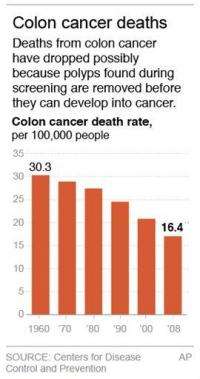
Deaths from colorectal cancer have been declining for more than two decades, mostly because of screening including colonoscopies and other tests, the organization says. People of average risk of colon cancer ages 50 to 75 should get screened, but only about half in the U.S. do.
A government-appointed panel of experts recommends one of three methods: annual stool blood tests; a sigmoidoscopy (scope exam of the lower bowel) every five years, plus stool tests every three years; or a colonoscopy once a decade.
In a colonoscopy, a thin, flexible tube with a tiny camera is guided through the large intestine. Growths can be snipped off and checked for cancer. Patients are sedated, but many dread the test because it requires patients to eat a modified diet and drink solutions the day before to clear out the bowel. It usually costs more than $1,000, compared with a $20 stool test.
Researchers at Sloan-Kettering previously showed that removing polyps during colonoscopy can prevent colon cancer from developing, but it was not clear whether it saved lives.
The new study followed 2,602 patients who had precancerous growths removed during colonoscopies for an average of 15 years. Their risk of dying from colon cancer was 53 percent lower than what would be expected among a similar group in the general population - 12 patients followed in the study died, versus 25 estimated deaths in the general population.
The study was not a randomized trial that's the gold standard in medical research. But Robert Smith, director of screening at the American Cancer Society, said it's the first direct evidence that removing polyps can reduce the risk of colon cancer death.
"There's no question that these are findings that we can take to the bank," said Smith, who had no role in the research.
The National Cancer Institute and several cancer organizations paid for the study.
Government and private cancer groups also funded the second study in the journal, led by researchers in Spain. About 53,000 participants were given a colonoscopy or a stool blood test. Both tests found similar numbers of colon cancer cases - about 30 in each group.
However, colonoscopies found advanced growths in twice as many people - 514 versus 231 of those given the stool test. Colonoscopy also found 10 times more people with less serious growths than the stool test did.
Neither test proved very appealing - only a quarter of patients offered a colonoscopy had one. Similarly, only a third agreed to the offered stool test.
The Spanish study is continuing and similar research in the U.S. and Norway that began recently is looking at the long-term impacts of colonoscopy.
Stephen Raquet, of Mount Kisco, N.Y., finds the test reassuring even if the preparation is unpleasant. He had his first colonoscopy 13 years ago at age 41, earlier than usual because of a family history of colon cancer.
The sudden death of his 45-year-old sister from the disease prompted Raquet to get checked out. He had a precancerous growth removed at Memorial Sloan-Kettering in 1999, and has had the test every three years since.
During his last appointment four months ago, doctors said he can come back in five years.
"It's given me peace of mind," said the 54-year-old business executive.
More information: Guidelines: http://www.uspreventiveservicestaskforce.org/uspstf/uspscolo.htm
©2012 The Associated Press. All rights reserved. This material may not be published, broadcast, rewritten or redistributed.


