Curry spice component may help slow prostate tumor growth
February 10, 2012 in Cancer
Curry spice component may help slow prostate tumor growth

Enlarge

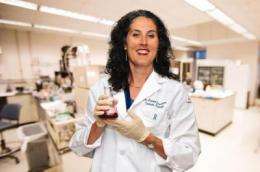
A team led by Karen Knudsen, Ph.D., a professor of cancer biology, urology and radiation oncology at Thomas Jefferson University, found that curcumin, an active component of the Indian curry spice turmeric, may help slow down tumor growth in castration-resistant prostate cancer patients on androgen deprivation therapy. Credit: TJUH

Curcumin, an active component of the Indian curry spice turmeric, may help slow down tumor growth in castration-resistant prostate cancer patients on androgen deprivation therapy (ADT), a study from researchers at Jefferson's Kimmel Cancer Center suggests.

Reporting in a recent issue of , Karen Knudsen, Ph.D., a Professor of , Urology and at Thomas Jefferson University, and colleagues observed in a pre-clinical study that curcumin suppresses two known activators, p300 and CPB (or CREB1-binding protein), which have been shown to work against ADT.

ADT aims to inhibit the —an important male hormone in the development and progression of prostate cancer—in patients. But a major mechanism of therapeutic failure and progression to advanced disease is inappropriate reactivation of this receptor. Sophisticated tumor cells, with the help of p300 and CPB, sometimes bypass the therapy.

Thus, development of novel targets that act in concert with the therapy would be of benefit to patients with castration-resistant prostate cancer.

For the study, prostate cancer cells were subjected to hormone deprivation in the presence and absence of curcumin with "physiologically attainable' doses. (Previous studies, which found similar results, included doses that were not realistic.)

Curcumin augments the results of ADT, and reduced cell number compared to ADT alone, the researchers found. Moreover, the spice was found to be a potent inhibitor of both cell cycle and survival in prostate cancer cells.

To help support their findings, the researchers also investigated curcumin in mice, which were castrated to mimic ADT. They were randomized into two cohorts: curcumin and control. Tumor growth and mass were significantly reduced in the mice with curcumin, the researchers report.

These data demonstrate for the first time that curcumin not only hampers the transition of ADT-sensitive disease to castration-resistance, but is also effective in blocking the growth of established castrate-resistant prostate tumors.

"This study sets the stage for further development of curcumin as a novel agent to target androgen receptor signaling," said Dr. Knudsen. "It also has implications beyond since p300 and CBP are important in other malignancies, like breast cancer. In tumors where these play an important function, curcumin may prove to be a promising therapeutic agent."

Provided by Thomas Jefferson University search and more info website

4.4 /5 (9 votes)  

Rank 4.4 /5 (9 votes)
Relevant PhysicsForums posts
  • Potential Breakthrough in Seizure Control
    createdMay 26, 2012
  • Popping/Cracked sternum.
    createdMay 25, 2012
  • Which Mental Illness Encompasses This Problem?
    createdMay 25, 2012
  • A question about drug tolerance
    createdMay 23, 2012
  • Poor nutrition leading to overeating?
    createdMay 23, 2012
  • Math and dyslexia?
    createdMay 21, 2012
  • More from Physics Forums - Medical Sciences

More news stories

Skp2 activates cancer-promoting, glucose-processing Akt

HER2 and its epidermal growth factor receptor cousins mobilize a specialized protein to activate a major player in cancer development and sugar metabolism, scientists report in the May 25 issue of Cell.

Cancer created May 25, 2012 | popularity not rated yet | comments 0 | with audio podcast

Pancreatectomy OK without downstaging from therapy

(HealthDay) -- Pancreatectomy improves median survival in pancreatic cancer patients even when presurgical neoadjuvant therapy does not lead to radiographic downstaging of tumors, according to a study published ...

Cancer created May 25, 2012 | popularity not rated yet | comments 0

Common therapies for basal cell carcinoma offer similar survival

(HealthDay) -- For patients with superficial basal cell carcinoma (sBCC), treatment with imiquimod or photodynamic therapy (PDT) results in similar long-term tumor-free survival, according to a review published ...

Cancer created May 25, 2012 | popularity not rated yet | comments 0

Cancer may require simpler genetic mutations than previously thought

Chromosomal deletions in DNA often involve just one of two gene copies inherited from either parent. But scientists haven't known how a deletion in one gene from one parent, called a "hemizygous" deletion, can contribute ...

Cancer created May 25, 2012 | popularity not rated yet | comments 0 | with audio podcast

New prostate cancer screening guidelines face a tough sell, study suggests

(Medical Xpress) -- Recent recommendations from the U.S. Preventive Services Task Force (USPSTF) advising elimination of routine prostate-specific antigen (PSA) screening for prostate cancer in healthy men are likely to encounter ...

Cancer created May 25, 2012 | popularity not rated yet | comments 2


T cells 'hunt' parasites like animal predators seek prey, study shows

By pairing an intimate knowledge of immune-system function with a deep understanding of statistical physics, a cross-disciplinary team at the University of Pennsylvania has arrived at a surprising finding: T cells use a movement ...

Same gene that stunts infants' growth also makes them grow too big: research

UCLA geneticists have identified the mutation responsible for IMAGe* syndrome, a rare disorder that stunts infants' growth. The twist? The mutation occurs on the same gene that causes Beckwith-Wiedemann syndrome, which makes ...

Almost half of new vets seek disability

(AP) -- America's newest veterans are filing for disability benefits at a historic rate, claiming to be the most medically and mentally troubled generation of former troops the nation has ever seen.

Color-changing contact lenses to help diabetics (w/ Video)

For the millions of Americans with diabetes, the inconvenient and often painful method of testing blood sugar levels is a way of life. But research and innovative product design by scientists at The University of Akron may ...

Missouri opts for untested drug for executions

(AP) -- The same anesthetic that caused the overdose death of pop star Michael Jackson is now the drug of choice for executions in Missouri, causing a stir among critics who question how the state can guarantee ...

Thioridazine kills cancer stem cells in human while avoiding toxic side-effects of conventional cancer treatments

A team of scientists at McMaster University has discovered a drug, thioridazine, successfully kills cancer stem cells in the human while avoiding the toxic side-effects of conventional cancer treatments.