Brain-imaging differences evident at 6 months in infants who develop autism
February 17, 2012 in Autism spectrum disorders
Brain-imaging differences evident at 6 months in infants who develop autism

Enlarge

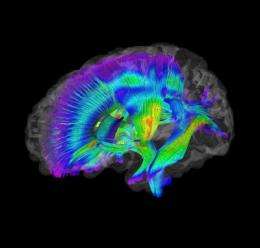
This is an image of white matter pathways extracted from diffusion tensor imaging data for infants at-risk for autism. Warmer colors represent higher fractional anisotropy. Credit: Image created by Jason Wolff, Ph.D.

A new study led by the University of North Carolina at Chapel Hill found significant differences in brain development starting at age 6 months in high-risk infants who later develop autism, compared to high-risk infants who did not develop autism.

"It's a promising finding," said Jason J. Wolff, PhD, lead author of the study and a postdoctoral fellow at UNC's Carolina Institute for Developmental Disabilities (CIDD). "At this point, it's a preliminary albeit great first step towards thinking about developing a biomarker for risk in advance of our current ability to diagnose autism."

The study also suggests, Wolff said, that autism does not appear suddenly in young children, but instead develops over time during infancy. This raises the possibility "that we may be able to interrupt that process with targeted intervention," he said.

Joseph Piven, MD, director of the CIDD, is senior author of the study.

The study was published online on Friday, Feb. 17 at AJP in Advance, a section of the website of the American Journal of Psychiatry. Its results are the latest from the ongoing Infant Brain Imaging Study (IBIS) Network, which is funded by the National Institutes of Health and headquartered at UNC. Piven received an NIH Autism Centers of Excellence (ACE) program network award for the IBIS Network in 2007. ACE networks consist of researchers at many facilities in locations throughout the country, all of whom work together on a single research question.

Participants in the study were 92 infants who all have older siblings with autism and thus are considered to be at high risk for autism themselves. All had diffusion tensor imaging – which is a type of magnetic resonance imaging (MRI) – at 6 months and behavioral assessments at 24 months. Most also had additional brain imaging scans at either or both 12 and 24 months.

At 24 months, 28 infants (30 percent) met criteria for autism spectrum disorders while 64 infants (70 percent) did not. The two groups differed in white matter fiber tract development – pathways that connect brain regions – as measured by fractional anisotropy (FA). FA measures white matter organization and development, based on the movement of water molecules through brain tissue.

This study examined 15 separate fiber tracts, and found significant differences in FA trajectories in 12 of the 15 tracts between infants who did develop autism versus infants who did not. Infants who later developed autism had elevated FA at six months but then experienced slower change over time. By 24 months of age, infants with autism had lower FA values than infants without autism.

"This evidence, which implicates multiple fiber pathways, suggests that autism is a whole-brain phenomenon not isolated to any particular brain region," Wolff said.

Journal reference: American Journal of Psychiatry search and more info website

Provided by University of North Carolina School of Medicine

4.8 /5 (4 votes)  

Rank 4.8 /5 (4 votes)
Relevant PhysicsForums posts
  • magnetic field from stream of protons
    created4 hours ago
  • Force on a particle constrained to move on the surface of a sphere
    created4 hours ago
  • Force in a magnetic coupling
    created14 hours ago
  • Sign of scalar product in electric potential integral?
    created21 hours ago
  • Heat engines: how can we yield work?
    created22 hours ago
  • Work done by us on the spring
    createdMay 25, 2012
  • More from Physics Forums - Classical Physics

More news stories

Autism often not diagnosed until age 5 or older: U.S. report

(HealthDay) -- Even though autism symptoms typically emerge before age 3, most children with autism are diagnosed when they're 5 or older, a new snapshot of autism in America shows.

Autism spectrum disorders created May 24, 2012 | popularity not rated yet | comments 0

Study shows that fever during pregnancy more than doubles the risk of autism or developmental delay

A team of UC Davis researchers has found that mothers who had fevers during their pregnancies were more than twice as likely to have a child with autism or developmental delay than were mothers of typically developing children, ...

Autism spectrum disorders created May 23, 2012 | popularity 5 / 5 (1) | comments 0

Oxytocin improves brain function in children with autism

(Medical Xpress) -- Preliminary results from an ongoing, large-scale study by Yale School of Medicine researchers shows that oxytocin — a naturally occurring substance produced in the brain and throughout ...

Autism spectrum disorders created May 21, 2012 | popularity 5 / 5 (1) | comments 0

French autistic kids mostly get psychotherapy

(AP) -- In most developed countries, children with autism are usually sent to school where they get special education classes. But in France, they are more often sent to a psychiatrist where they get talk ...

Autism spectrum disorders created May 18, 2012 | popularity not rated yet | comments 0

New study shows simple task at six months of age may predict risk of autism

A new prospective study of six-month-old infants at high genetic risk for autism identified weak head and neck control as a red flag for autism spectrum disorder (ASD) and language and/or social developmental delays. Researchers ...

Autism spectrum disorders created May 17, 2012 | popularity not rated yet | comments 0 | with audio podcast


Keep food safety in mind this memorial day weekend

(HealthDay) -- Picnics, parades and cookouts are as much a part of Memorial Day weekend as tributes to the United States' war veterans.

Travel to high altitudes tied to Crohn's, colitis flare-ups

(HealthDay) -- People with inflammatory bowel disease, which includes Crohn's disease and colitis, may be at increased risk for flare-ups when they fly or travel to high altitudes for skiing or mountain climbing, ...

Family history of Alzheimer's affects functional connectivity

(HealthDay) -- Cognitively normal individuals with a family history of late-onset Alzheimer's disease (AD) may display lower resting state functional connectivity in the default mode network (DMN) of the brain, ...

Transvaginal mesh op restores pelvic organ prolapse at price

(HealthDay) -- Transvaginal mesh (TVM) procedures are effective for anatomical restoration of pelvic organ prolapse (POP), but patients report a worsening of sexual function following surgery, according to ...

Of mice and mental models: Neuroscientific implications of risk-optimized behavior in the mouse

(Medical Xpress) -- Regardless of an organism’s biological complexity, every encephalized animal continuously makes under-informed behavioral choices that can have serious consequences. Despite its ubiquity, ...

Weight struggles? Blame new neurons in your hypothalamus

New nerve cells formed in a select part of the brain could hold considerable sway over how much you eat and consequently weigh, new animal research by Johns Hopkins scientists suggests in a study published in the May issue ...