'Explorers,' who embrace the uncertainty of choices, use specific part of cortex
February 8, 2012 in Neuroscience
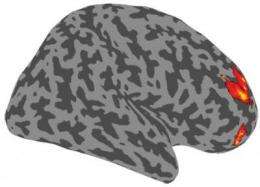
"Explorers," whose decision-making style embraces the possibilities of uncertainty, use specific parts (red) of the right rostrolateral prefrontal cortex to make calculations based on relative uncertainty. Credit: Badre-Frank Lab/Brown University
Life shrouds most choices in mystery. Some people inch toward a comfortable enough spot and stick close to that rewarding status quo. Out to dinner, they order the usual. Others consider their options systematically or randomly. But many choose to grapple with the uncertainty head on. "Explorers" order the special because they aren't sure they'll like it. It's a strategy of maximizing rewards by discovering whether as yet unexplored options might yield better returns. In a new study, Brown University researchers show that such explorers use a specific part of their brain to calculate the relative uncertainty of their choices, while non-explorers do not.
The study, published in the journal Neuron, newly exposes an aspect of the brain's architecture for producing decisions and learning, said co-author David Badre, assistant professor of cognitive, linguistic, and psychological sciences at Brown. There was no consensus that a precise area of the prefrontal cortex, in this case the right rostrolateral prefrontal cortex, would be so clearly associated with a specific operation, such as performing the requisite uncertainty comparison for supporting a decision-making strategy.
"There has long been a debate about the functional organization of the frontal cortex," Badre said. "There has been a notion that the frontal lobe lacks specialization when exercising cognitive control, that it's undifferentiated. This study provides evidence that there is a kind of organization. This is an example of how higher-order functions such as decision-making may relate to the frontal lobe's more general functional architecture."
Stop the clock
To spot explorer behavior among their 15 participants, Badre and Michael Frank, associate professor of cognitive, linguistic, and psychological sciences, slid them into an MRI scanner and presented them with a game to play. Participants had to stop the sweeping hand of a virtual clock to win points in different rounds. They were told that they could maximize their rewards by responding quickly in some rounds, and slowly in others. The trick is they did not know round-to-round which response prevailed, and the number of points they could win was highly variable. They therefore had to employ a strategy to discover how to maximize their rewards among uncertain options, keeping track of the current expected value of fast and slow responses in each round.
While the MRI scanner tracked the blood flow in the brains of the subjects a proxy for neural activity the game's software tracked their response times in each round. The computer then fed the game's data into mathematical models devised to determine whether participants adapted their response times by taking relative uncertainty into account or adapted in another manner.
Over dozens of rounds a clear pattern emerged. Regardless of which version of the model they used, the researchers found that about half the subjects were engaging in exploratory behavior based on uncertainty: Their choices of response times correlated strongly with the choices that had the greatest outcome uncertainty.
Badre, Frank, and their team then looked at the MRI scans, reasoning that if decision-making is based on relative uncertainty, then the subjects' brains must somehow represent this uncertainty. Sure enough, as relative uncertainty between choice options increased, so did activation in the right rostrolateral prefrontal cortex. This effect was substantially stronger in the explorers than the nonexplorers.
The result is the first to show that this region of the brain keeps track of relative uncertainty to guide exploration, but is consistent with previous studies that have shown an association between the right rostrolateral prefrontal cortex and relative comparisons. It also provides a potential explanation for Frank's previous findings that explorers were more likely to have a variation in a gene called COMT that affects dopamine levels in the prefrontal cortex.
From cortex to choice
Frank said researchers still don't know why some people employ the explorer strategy while others do not, but they might not be so different. According to one hypothesis, they all have an aversion to uncertainty and ambiguity.
"The difference could be that some people are averse to ambiguity in the time point where they make a single decision and other people are averse to ambiguity about their strategy over the long run," Frank said.
In other words, explorers may seek to reduce uncertainty by confronting it, rather than avoiding it.
Badre said that while the study has no direct clinical implications, the findings may still inform efforts to understand a broad set of disorders that affect frontal lobe function.
"There are a lot of diseases and disorders that affect the frontal lobes," Badre said. "They affect the ability to live independently, to carry out the day and make good decisions that get you where you want to go. The more we know about the specificity of these systems, the better that you can diagnose and suggest treatments."
Provided by
Brown University
-
Evidence appears to show how and where frontal lobe works
Mar 02, 2009 |
not rated yet |
0
-
Neural mechanisms of abstract learning
Apr 28, 2010 |
not rated yet |
0
-
Uncertainty can be more stressful than clear negative feedback
Nov 20, 2008 |
not rated yet |
0
-
People Use Separate Brain Mechanisms to Make Ambiguous and Risky Choices
Mar 02, 2006 |
not rated yet |
0
-
Gene variations can be barometer of behavior, choices
Jul 20, 2009 |
not rated yet |
0
-
Motion perception revisited: High Phi effect challenges established motion perception assumptions
Apr 23, 2013 |
3 / 5 (2) |
2
-
Anything you can do I can do better: Neuromolecular foundations of the superiority illusion (Update)
Apr 02, 2013 |
4.5 / 5 (11) |
5
-
The visual system as economist: Neural resource allocation in visual adaptation
Mar 30, 2013 |
5 / 5 (2) |
9
-
Separate lives: Neuronal and organismal lifespans decoupled
Mar 27, 2013 |
4.9 / 5 (8) |
0
-
Sizing things up: The evolutionary neurobiology of scale invariance
Feb 28, 2013 |
4.8 / 5 (10) |
14
-
How can there be a term called "intestinal metaplasia" of stomach
1 hour ago
-
Pressure-volume curve: Elastic Recoil Pressure don't make sense
May 18, 2013
-
If you became brain-dead, would you want them to pull the plug?
May 17, 2013
-
MRI bill question
May 15, 2013
-
Ratio of Hydrogen of Oxygen in Dessicated Animal Protein
May 13, 2013
-
Alcohol and acetaminophen
May 13, 2013
- More from Physics Forums - Medical Sciences
More news stories
Clouds in the head
Many brain researchers cannot see the forest for the trees. When they use electrodes to record the activity patterns of individual neurons, the patterns often appear chaotic and difficult to interpret.
Neuroscience
32 minutes ago |
not rated yet |
0
New theory offers clues to vital 'repair and maintenance' role of sleep
(Medical Xpress)—We spend about a third of our life asleep, but why we need to do so remains a mystery. In a recent publication, researchers at University of Surrey and University College London suggest a new hypothesis, ...
Neuroscience
2 hours ago |
not rated yet |
0
Study puts Huntington's disease trials on TRACK
(Medical Xpress)—A three-year multinational study has tracked and detailed the progression of Huntington's disease (HD), predicting clinical decline in people carrying the HD gene more than 10 years before ...
Neuroscience
2 hours ago |
not rated yet |
0
Leading researchers report on the elusive search for biomarkers in Huntington's disease
While Huntington's disease (HD) is currently incurable, the HD research community anticipates that new disease-modifying therapies in development may slow or minimize disease progression. The success of HD research depends ...
Neuroscience
14 hours ago |
5 / 5 (1) |
0
Study shows premature birth interrupts vital brain development processes leading to reduced cognitive abilities
Researchers from King's College London have for the first time used a novel form of MRI to identify crucial developmental processes in the brain that are vulnerable to the effects of premature birth. This new study, published ...
Neuroscience
17 hours ago |
5 / 5 (1) |
0
|
Sugar injections for knee arthritis may ease pain
(HealthDay)—Injections of a sugar solution appear to help relieve knee pain and stiffness related to osteoarthritis, a new study suggests.
Anti-CD47 antibody may offer new route to successful cancer vaccination
(Medical Xpress)—Scientists at the School of Medicine have shown that their previously identified therapeutic approach to fight cancer via immune cells called macrophages also prompts the disease-fighting killer T cells ...
Evaluating a new way to open clogged arteries
Over the past few decades, scientists have developed many devices that can reopen clogged arteries, including angioplasty balloons and metallic stents. While generally effective, each of these treatments ...
Losing weight may ease chronic heartburn
(HealthDay)—Obese and overweight men and women who suffer from heartburn often report relief when they lose weight, a new study shows.
Primary care docs should play role in kids' dental health, experts say
(HealthDay)—When it comes to the care of your children's teeth, dentists aren't the only experts who can help.
Study identifies superior hypertension treatment, efficacy between sexes
(Medical Xpress)—In a recent subgroup analysis of the largest blood pressure treatment trial in history, University of Alabama at Birmingham (UAB) researchers found that women and men react the same to ...
Feb 09, 2012
Rank: not rated yet
As I see it, the likelihood of finding genetically caused mapping in the prefrontal cortex depends on the extent to which seemingly abstract features of the world can actually correlate exactly with discrete reactions and behaviours intrinsic to the human animal. "Comparative uncertainty" is abstract is it not? So what feature/s of our animal self can embody and represent uncertainty? My guess is a grouping of fear, anger, curiosity, and self-assertion [this last item used to be called "spirit"].