Gene mutation discovery sparks hope for effective endometriosis screening
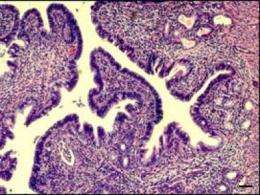
This is an example of the more aggressive endometriosis seen in women with the KRAS gene variant. Credit: Dr. Hugh S. Taylor, Yale School of Medicine
Researchers at Yale School of Medicine have, for the first time, described the genetic basis of endometriosis, a condition affecting millions of women that is marked by chronic pelvic pain and infertility. The researchers' discovery of a new gene mutation provides hope for new screening methods.
Published in the Feb. 3 early online issue of EMBO Molecular Medicine, the study explored an inherited mutation located in part of the KRAS gene, which leads to abnormal endometrial growth and endometrial risk. In endometriosis, uterine tissue grows in other parts of the body, such as the abdominal cavity, ovaries, vagina, and cervix. The condition is often hereditary and is found in 5%-15% of women of reproductive age, affecting over 70 million women worldwide.
Although the disorder has been studied for many years, its exact cause and how it develops remained unclear. It was previously shown that activating the KRAS gene caused mice to develop endometriosis. However, no mutations in this gene have been identified in women with endometriosis.
Led by senior author Hugh S. Taylor, M.D., professor and chief of the Division of Reproductive Endocrinology and Infertility in the Department of Obstetrics, Gynecology & Reproductive Sciences, the authors studied 132 women with endometriosis and evaluated them for a newly identified mutation in the region of the KRAS gene responsible for regulation. This mutation was previously linked to an increased risk of lung and ovarian cancer by study co-author Joanne Weidhaas, M.D., assistant professor of therapeutic radiology.
"We found that 31% of the women with endometriosis in the study carried this mutation, compared to only 5.8% of the general population," said Taylor. "The presence of this mutation was also linked to higher KRAS protein levels and associated with an increased capacity for these cells to spread. It also may explain the higher risk of ovarian cancer in women who have had endometriosis."
The Yale team is the first to identify a cause of this common and previously little understood disease. "This mutation potentially represents a new therapeutic target for endometriosis as well as a basis of potential screening methods to determine who is at risk for developing endometriosis," said Taylor.
More information: EMBO Molecular Medicine, DOI:10.1002/emmm.201100200
Provided by
Yale University
-
Reproductive disorder linked to increased risk of inflammatory bowel disease
Dec 20, 2011 |
not rated yet |
0
-
Endometriosis increases the risk of certain cancers
Jul 02, 2007 |
not rated yet |
0
-
Progress made in understanding causes and treatment of endometriosis
Jan 16, 2009 |
not rated yet |
0
-
Scientists identify possible cause of endometriosis
Aug 05, 2008 |
not rated yet |
0
-
Strong period pain and excess weight in childhood increases risk of endometriosis
Mar 11, 2010 |
not rated yet |
0
-
Motion perception revisited: High Phi effect challenges established motion perception assumptions
Apr 23, 2013 |
3 / 5 (2) |
2
-
Anything you can do I can do better: Neuromolecular foundations of the superiority illusion (Update)
Apr 02, 2013 |
4.5 / 5 (11) |
5
-
The visual system as economist: Neural resource allocation in visual adaptation
Mar 30, 2013 |
5 / 5 (2) |
9
-
Separate lives: Neuronal and organismal lifespans decoupled
Mar 27, 2013 |
4.9 / 5 (8) |
0
-
Sizing things up: The evolutionary neurobiology of scale invariance
Feb 28, 2013 |
4.8 / 5 (10) |
14
-
Classical and Quantum Mechanics via Lie algebras
Apr 15, 2011
- More from Physics Forums - Independent Research
More news stories
Researchers develop model for better testing, targeting of malignant peripheral nerve sheath tumors
University of Minnesota Medical School researchers from the Masonic Cancer Center, University of Minnesota, in partnership with the University's Brain Tumor Program, have developed a new mouse model of malignant peripheral ...
Genetics
10 hours ago |
5 / 5 (1) |
0
|
Researchers identify new circadian clock component
Northwestern University scientists have shown a gene involved in neurodegenerative disease also plays a critical role in the proper function of the circadian clock.
Genetics
May 16, 2013 |
3 / 5 (1) |
1
|
Returning genetic incidental findings without patient consent violates basic rights, experts say
Informed consent is the backbone of patient care. Genetic testing has long required patient consent and patients have had a "right not to know" the results. However, as 21st century medicine now begins to use the tools of ...
Genetics
May 16, 2013 |
5 / 5 (1) |
3
|
Ethicists provide framework supporting new recommendations on reporting incidental findings in gene sequencing
In a paper published in Science Express, a group of experts led by bioethicists in the Center for Medical Ethics and Health Policy at Baylor College of Medicine provide a framework for the new American College of Medical Geneti ...
Genetics
May 16, 2013 |
not rated yet |
0
Experts urge caution over use of new genetic sequencing techniques
The use of genome-wide analysis (GWA), where the entirety of an individual's DNA is examined to look for the genomic mutations or variants which can cause health problems is a massively useful technology for diagnosing disease. ...
Genetics
May 16, 2013 |
not rated yet |
0
Genetic predictors of postpartum depression uncovered
Johns Hopkins researchers say they have discovered specific chemical alterations in two genes that, when present during pregnancy, reliably predict whether a woman will develop postpartum depression.
Child maltreatment increases risk of adult obesity
Children who have suffered maltreatment are 36% more likely to be obese in adulthood compared to non-maltreated children, according to a new study by King's College London. The authors estimate that the prevention or effective ...
After a decade, global AIDS program looks ahead
(AP)—The decade-old law that transformed the battle against HIV and AIDS in developing countries is at a crossroads. The dream of future generations freed from the epidemic is running up against an era ...
New immune system discovered
(Medical Xpress)—A research team, led by Jeremy Barr, a biology post-doctoral fellow, unveils a new immune system that protects humans and animals from infection.
Early-life traffic-related air pollution exposure linked to hyperactivity
Early-life exposure to traffic-related air pollution was significantly associated with higher hyperactivity scores at age 7, according to new research from the University of Cincinnati (UC) and Cincinnati Children's Hospital ...
The compound in the Mediterranean diet that makes cancer cells 'mortal'
New research suggests that a compound abundant in the Mediterranean diet takes away cancer cells' "superpower" to escape death. By altering a very specific step in gene regulation, this compound essentially re-educates cancer ...