Researchers discover new HIV vaccine-related tool
February 23, 2012 in HIV & AIDS
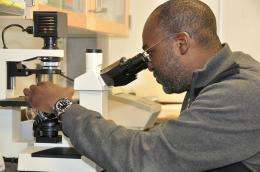
SFU health scientist Ralph Pantophlet takes a close up look at a bacterium that he and his colleagues have discovered could help our immune system eliminate HIV.
(Medical Xpress) -- A new discovery involving two Simon Fraser University scientists could lead to a little known and benign bacterium becoming a vital new tool in the development of a vaccine against human immunodeficiency virus (HIV).
Ralph Pantophlet, a Faculty of Health Sciences assistant professor, and Kate Auyeung, his senior research assistant and lab manager at SFU, and scientists in Italy have made a breakthrough discovery about Rhizobium radiobacter.
The journal Chemistry & Biology has just published their research in its Feb. 24 issue.
The research team has discovered this harmless bacterium has on its surface sugar molecules that resemble those on the surface of HIV.
This resemblance gives scientists a basis for developing a preventative vaccine, putting our immune system on guard against HIV.
HIVs sugar molecules act as a cloaking device, preventing our immune system from detecting the virus until it has created several variant generations of itself.
By the time our immune systems recognition has kicked in, weeks have elapsed, and HIV is several steps ahead of our bodys efforts to eliminate it.
Pantophlet and his colleagues believe the sugar molecules on Rhizobium radiobacter could be used to trigger our immune system to immediately recognize those on HIV, prompting more immediate awareness of the virus invasion.
The irony of our discovery is not lost on us, says Pantophlet. Weve found that a harmless species of a bacteria family that can cause tumours in the roots of legume plants could become a vital tool in the fight against one of the deadliest infectious diseases.
Before Rhizobium radiobacter can become the basis of an anti-HIV vaccine, the scientists need to find a protein to which they can attach the bacteriums sugar molecules. The protein is needed to properly trigger our immune systems development of antibodies to the sugar molecules. Such antibodies would then recognize and target HIVs sugar molecules because they resemble those on the bacterium.
This method of triggering antibodies development has led to the invention of successful sugar-based vaccines against diseases such as meningitis and childhood pneumonia.
Two known proteins, tetanus toxoid and CRM197, a nontoxic recombinant variant of diphtheria toxin, are commonly used to develop these kinds of vaccines, explains Pantophlet. So a lot of the groundwork is there for us to be able to have a vaccine that could be tested in a lab first and then in clinical trials later on.
Pantophlet and his colleagues are seeking grant funding from the Canadian Institutes for Health Research to continue their research.
If they get the grant, they hope to attach Rhizobium radiobacters sugar molecules to a protein and create vaccine candidates for testing within the next one to two years.
More information: www.cell.com/chemi… biology/home
Provided by Simon Fraser University
-
External capsule protects gum disease-causing bacteria from immune response
Nov 17, 2011 |
not rated yet |
0
-
Tuberculosis researchers discover potential new target for treatments
Nov 21, 2011 |
not rated yet |
0
-
Recognizing blood poisoning quickly
Dec 02, 2011 |
not rated yet |
0
-
Equine herpesvirus study to unravel how virus unlocks immune system 'gate'
Jan 19, 2012 |
not rated yet |
0
-
New tool enhances view of muscles
Jan 23, 2012 |
not rated yet |
0
-
Motion perception revisited: High Phi effect challenges established motion perception assumptions
Apr 23, 2013 |
3 / 5 (2) |
2
-
Anything you can do I can do better: Neuromolecular foundations of the superiority illusion (Update)
Apr 02, 2013 |
4.5 / 5 (11) |
5
-
The visual system as economist: Neural resource allocation in visual adaptation
Mar 30, 2013 |
5 / 5 (2) |
9
-
Separate lives: Neuronal and organismal lifespans decoupled
Mar 27, 2013 |
4.9 / 5 (8) |
0
-
Sizing things up: The evolutionary neurobiology of scale invariance
Feb 28, 2013 |
4.8 / 5 (10) |
14
-
Classical and Quantum Mechanics via Lie algebras
Apr 15, 2011
- More from Physics Forums - Independent Research
More news stories
Engineered cytomegalovirus protects monkeys from HIV equivalent
(Medical Xpress)—A new study by researchers in the US has shown that an ancient virus can be modified to help in the fight against the simian immunodeficiency virus SIV, which is the equivalent in monkeys ...
HIV & AIDS
1 hour ago |
not rated yet |
0
|
New microsphere-based methods for detecting HIV antibodies
Detection of HIV antibodies is used to diagnose HIV infection and monitor trials of experimental HIV/AIDS vaccines. New, more sensitive detection systems being developed use microspheres to capture HIV antibodies ...
HIV & AIDS
17 hours ago |
5 / 5 (1) |
0
Fecal microbiota tx feasible for recurrent C. difficile in HIV
(HealthDay)—For HIV-infected individuals with recurrent Clostridium difficile infection, fecal microbiota therapy is feasible, according to a letter published in the May 21 issue of the Annals of Intern ...
HIV & AIDS
May 22, 2013 |
not rated yet |
0
Canada lifts ban on gay men donating blood
Canadian health authorities lifted Wednesday what was effectively a ban on gay men giving blood, announcing new rules making men who have not had sex with men in the past five years eligible.
HIV & AIDS
May 22, 2013 |
not rated yet |
1
AIDS scientists optimistic of AIDS cure, for some
Top AIDS scientists were optimistic Wednesday of finding a cure for the disease that has claimed 30 million lives—but said it might not work for all people.
HIV & AIDS
May 22, 2013 |
not rated yet |
0
Saudi to send animal samples to US in coronavirus probe
Saudi Arabia said Friday it would send samples taken from animals possibly infected with a deadly SARS-like virus to the United States for testing in a bid to find the source of disease.
New neuron formation could increase capacity for new learning, at the expense of old memories
New research presented today shows that formation of new neurons in the hippocampus - a brain region known for its importance in learning and remembering - could cause forgetting of old memories by causing a reorganization ...
Are there atheists in foxholes? Study says they're the minority
Ernie Pyle – an iconic war correspondent in World War II – reportedly said "There are no atheists in foxholes." A new joint study between two brothers at Cornell and Virginia Wesleyan found that only ...
Scientists put bowel cancer under the microscope
Researchers from London's Kingston University have begun a two-year study which could help prolong the lives of people with colorectal tumours.
Help at hand for people with schizophrenia
How can healthy people who hear voices help schizophrenics? Finding the answer for this is at the centre of research conducted at the University of Bergen.
Do doctors understand the individualisation of treatments?
The individualisation of drug treatments to support patients to self-manage their conditions is a concept that sits at the heart of policy, but a recent study in BMJ Open shows that there is no concrete defini ...