Study of Alzheimer's-related protein in healthy adults may shed light on earliest signs of disease
February 1, 2012 in Neuroscience
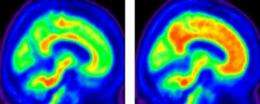
These are positron emission tomography scans of the brains of healthy adults showing low (left) and high (right) levels of beta-amyloid protein. Credit: Image courtesy of the Center for Vital Longevity, The University of Texas at Dallas
Researchers from the Center for Vital Longevity at the University of Texas at Dallas and UT Southwestern Medical Center have completed a large-scale neuroimaging study of healthy adults from age 30 to 90 that measured beta-amyloid proteina substance whose toxic buildup in the brain is a diagnostic marker for Alzheimer's disease.
The findings, published in the February 1, 2012 online issue of Neurology, the medical journal of the American Academy of Neurology, mark a crucial step toward being able to predict who may be at risk for developing Alzheimer's disease long before symptoms appear.
Relatively few studies have looked at levels of beta-amyloid in healthy living adults, as until recently, beta-amyloid levels could only be measured at autopsy. Few, if any, studies have looked at beta-amyloid levels in middle-aged and younger adults. Many investigators now believe that the beginning stages of Alzheimer's disease can precede symptoms of dementia by a decade or more, so data on middle-aged adults is critically important to understanding the transition from a healthy brain to a diseased brain.
In the new study, researchers measured levels of beta-amyloid protein in the brains of 137 cognitively healthy adults between the ages of 30 and 89 using an amyloid imaging agent. The researchers found that beta-amyloid levels increased with age across the entire age span and that about 20% of adults aged 60 and older had particularly high levels of beta-amyloid.
"We found that this high-amyloid group showed deficits in cognitive performance even though the individuals were well educated and scored normally on our standard tests of cognition," said Dr. Karen Rodrigue, a postdoctoral fellow at the Center for Vital Longevity and lead author of the study. On tests of processing speed, working memory, and reasoning abilitythree major aspects of cognitionhigher levels of beta-amyloid correlated with lower test scores.
That beta-amyloid burden has detectable effects on cognitive function even in adults with apparently good cognitive health underscores the need to better understand the recently proposed preclinical phase of Alzheimer's disease, which suggests that beta-amyloid deposits in healthy adults do not exert a strong effect on cognition for some time.
"Our findings suggest that subtle effects on cognition occur early," said principal investigator Dr. Denise Park, co-director of the Center for Vital Longevity and Distinguished University Chair in the School of Behavioral and Brain Sciences at UT Dallas. "These are important findings because imaging patients when they first show signs of very mild cognitive impairment could be essential to determining their risk of future disease."
Long-term follow-up studies led by Dr. Park as part of the Dallas Lifespan Brain Study, one of the nation's largest projects examining neural and cognitive aging across the entire adult lifespan, are already underway to help researchers determine whether high beta-amyloid burden in healthy people necessarily predetermines occurrence of Alzheimer's disease later in life.
"Knowing this information will help us determine at what stage potential interventions, once available, may be most critical and most effective," said Park. Many researchers believe that interventions to slow or halt the progression of Alzheimer's will be most effective during middle age, before irreparable damage to the brain is done. "Just as many adults take aspirin to lower their risk of heart disease or stroke, one day we may be able to help protect our brains and cognitive health by starting a treatment in our 40s or 50s," Park said.
Another of the study's interesting findings was that some people well into their 60s, 70s, and even 80s, had beta-amyloid levels as low or lower than people at middle age or younger.
"Another avenue of our future work will be to investigate what factors enable these individuals to maintain cognitive health well into old age, whether they be genetic factors, lifestyle factors, or environmental issues," said Park.
"Understanding how the brain and mind stay healthy and vital over the long term will help guide our efforts to delay or even prevent the devastation caused by diseases like Alzheimer's."
Provided by
University of Texas at Dallas
-
Study identifies chemical changes in brains of people at risk for Alzheimer's disease
Aug 24, 2011 |
not rated yet |
0
-
Malfunctioning protein a cause of Alzheimer's plaques
Jun 30, 2011 |
not rated yet |
0
-
Plasma beta-amyloid levels associated with cognitive decline
Aug 09, 2010 |
not rated yet |
0
-
Amyloid beta protein gets bum rap
Nov 09, 2009 |
not rated yet |
0
-
Lower biomarker levels, less education associated with greater cognitive decline
Jan 18, 2011 |
not rated yet |
0
-
Motion perception revisited: High Phi effect challenges established motion perception assumptions
Apr 23, 2013 |
3 / 5 (2) |
2
-
Anything you can do I can do better: Neuromolecular foundations of the superiority illusion (Update)
Apr 02, 2013 |
4.5 / 5 (11) |
5
-
The visual system as economist: Neural resource allocation in visual adaptation
Mar 30, 2013 |
5 / 5 (2) |
9
-
Separate lives: Neuronal and organismal lifespans decoupled
Mar 27, 2013 |
4.9 / 5 (8) |
0
-
Sizing things up: The evolutionary neurobiology of scale invariance
Feb 28, 2013 |
4.8 / 5 (10) |
14
-
How can there be a term called "intestinal metaplasia" of stomach
3 hours ago
-
Pressure-volume curve: Elastic Recoil Pressure don't make sense
May 18, 2013
-
If you became brain-dead, would you want them to pull the plug?
May 17, 2013
-
MRI bill question
May 15, 2013
-
Ratio of Hydrogen of Oxygen in Dessicated Animal Protein
May 13, 2013
-
Alcohol and acetaminophen
May 13, 2013
- More from Physics Forums - Medical Sciences
More news stories
Study shows where scene context happens in our brain
In a remote fishing community in Venezuela, a lone fisherman sits on a cliff overlooking the southern Caribbean Sea. This man –– the lookout –– is responsible for directing his comrades on the water, ...
Neuroscience
36 minutes ago |
not rated yet |
0
|
Clouds in the head
Many brain researchers cannot see the forest for the trees. When they use electrodes to record the activity patterns of individual neurons, the patterns often appear chaotic and difficult to interpret.
Neuroscience
2 hours ago |
not rated yet |
0
New theory offers clues to vital 'repair and maintenance' role of sleep
(Medical Xpress)—We spend about a third of our life asleep, but why we need to do so remains a mystery. In a recent publication, researchers at University of Surrey and University College London suggest a new hypothesis, ...
Neuroscience
3 hours ago |
not rated yet |
0
Study puts Huntington's disease trials on TRACK
(Medical Xpress)—A three-year multinational study has tracked and detailed the progression of Huntington's disease (HD), predicting clinical decline in people carrying the HD gene more than 10 years before ...
Neuroscience
4 hours ago |
not rated yet |
0
Leading researchers report on the elusive search for biomarkers in Huntington's disease
While Huntington's disease (HD) is currently incurable, the HD research community anticipates that new disease-modifying therapies in development may slow or minimize disease progression. The success of HD research depends ...
Neuroscience
16 hours ago |
5 / 5 (1) |
0
Monoclonal antibody appears effective and safe in asthma Phase IIa trial
A novel approach to obstructing the runaway inflammatory response implicated in some types of asthma has shown promise in a Phase IIa clinical trial, according to U. S. researchers.
New rice contamination reported in China
Authorities are investigating rice mills in southern China following tests that found almost half of the staple grain in one of the country's largest cities was contaminated with a toxic metal.
New tumour-killer shows great promise in suppressing cancers
Scientists from Nanyang Technological University (NTU) and Lund University, Sweden, have bioengineered a novel molecule which has been proven to successfully kill tumour cells.
Analgesics prescribed more heavily to women than to men, study finds
Regardless of pain, social class or age, a woman is more likely to be prescribed pain-relieving drugs. A study published in Gaceta Sanitaria (Spanish health scientific journal) affirms that this phenomenon is inf ...
New factor to control oncogene-induced senescence
An article published on the journal Nature describes the major role that Pyruvate dehydrogenase (PDH) —an enzyme of cellular energy metabolism— plays in the regulation of the cellular senescence induce ...
Exercise levels may predict hospitalizations in COPD population
Clinical measurement of physical activity appears to be an independent predictor of whether or not patients with chronic obstructive pulmonary disease (COPD) will end up being hospitalized, according to a new study conducted ...