When nerve meets muscle, biglycan seals the deal
February 14, 2012 in Neuroscience

When nerve meets muscle, biglycan seals the deal

Enlarge

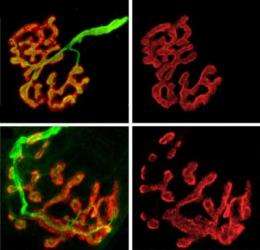
Segmented synapses Synaptic structures in mice engineered to lack the protein biglycan (bottom row) appear discontinuous compared to the synaptic structures in normal mice (top). Credit: Credit: Fallon Lab/Brown University

A protein that has shown early promise in preventing the loss of muscle function in mouse models of Duchenne muscular dystrophy, has been found in a new study to be a key player in the process of joining nerves to muscles.

The protein biglycan needs to be present to stabilize synapses at the neuromuscular junction after they have formed, according to research led by Brown University that appears in the Feb. 14, 2012, issue of the Journal of Neruoscience.

"What neuromuscular junctions do second-by-second is essential for our brain to control movement and they are also important for the long-term health of both muscle and motor neurons," said Justin Fallon, profesor of neuroscience at Brown University and the paper's senior author. "A treatment that sustains or supports the synapse could promote the health of and muscle."

In previous work, Fallon, a member of the Brown Institute for , has shown that in mice with the same genetic mutation as Duchenne patients, biglycan promotes the activity of another , utrophin, that can significantly reduce the muscle degradation that patients suffer. Utrophin essentially takes over for , which is the protein Duchenne patients cannot produce. In 2010 Brown licensed Fallon's biglycan intellectual property to the Providence startup company Tivorsan Pharmaceuticals, which is working toward human trials of biglycan.

Last month the Muscular Dystrophy Association, which helped support Fallon's new study, gave Tivorsan a $1 million grant.

Now Fallon's research group has found another important role for biglycan. In the new multi-institutional study, lead author Alison Amenta and a team of other scientists found that biglycan binds and helps activate and target a receptor enzyme called MuSK, which works like a foreman or master regulator over other proteins that build and stabilize the neuromuscular junction.

Mice engineered to lack biglycan developed normal junctions at first, but by five weeks after birth their synapses became much more likely to break into fragmented shadows of their former selves. In experiments the scientists saw that up to 80 percent of synapses in biglycan-lacking mice were unstable.

Biglycan-lacking mice also showed other structural defects including misaligned neurotransmitter receptors and extra folds near synapses.

"We think it is most likely that these folds are remnants of previous synaptic sites," that have since withered, the authors wrote in the paper.

Amenta, Fallon, and their team also found that in mice lacking biglycan, levels of MuSK at neuromuscular junction were reduced by a factor of more than 10. In another experiment, they found that recombinant biglycan could rescue the stability of synaptic structures in model cell culture system.

Relevance to motor neuron diseases

The findings help set the stage for testing biglycan as a potential therapy in animal models of motor neuron disease, Fallon said.

"As an extracellular protein that can be delivered systemically that acts to stabilize the , we propose that biglycan could be a protein therapeutic for motor neuron diseases such as spinal muscular atrophy and amyotrophic lateral sclerosis, or ALS," Fallon said.

Provided by Brown University search and more info website

5 /5 (3 votes)  

Filter


Move the slider to adjust rank threshold, so that you can hide some of the comments.


Display comments: newest first

Jeddy_Mctedder
Feb 14, 2012

Rank: not rated yet
this seems like a very big deal for developing potential 'smart' artificial limbs. i just don't see how eeg's are ever going to replace direct nerve output.

one day, they will figure out how to interface nerves unto digital chips in a manner that we observe nerves joined to muscle and we will do it by biologically manipulating the nerve to behave as if it were acting on the chip as if it were acting on the muslce. instead of the digital mechanical limb responding to a chip that is reading the output of your eeg, it will react to a chip that is reading the direct output of a neuron that is biologically wired to the chip as if the chip were a muscle.

Rank 5 /5 (3 votes)
Relevant PhysicsForums posts

More news stories

For combat veterans suffering from post-traumatic stress disorder, 'fear circuitry' in the brain never rests

Chronic trauma can inflict lasting damage to brain regions associated with fear and anxiety. Previous imaging studies of people with post-traumatic stress disorder, or PTSD, have shown that these brain regions can over-or ...

Neuroscience created 14 hours ago | popularity 5 / 5 (1) | comments 0 | with audio podcast

Temporal processing in the olfactory system

The neural machinery underlying our olfactory sense continues to be an enigma for neuroscience. A recent review in Neuron seeks to expand traditional ideas about how neurons in the olfactory bulb might encode information about ...

Neuroscience created May 17, 2013 | popularity not rated yet | comments 0 | with audio podcast report

Melon focus headband turns to Kickstarter for rollout plans

(Medical Xpress)—What if the quality of your work depends more on your focus on the piano keys or canvas or laptop than your musical or painting or computing skills? If target users can be convinced, they ...

Neuroscience created May 17, 2013 | popularity 3.7 / 5 (3) | comments 0 | with audio podcast weblog

Deep brain stimulation: A fix when the drugs don't work

Neurological disorders can have a devastating impact on the lives of sufferers and their families.

Neuroscience created May 17, 2013 | popularity 5 / 5 (1) | comments 0 | with audio podcast

Brain makes call on which ear is used for cell phone

If you're a left-brain thinker, chances are you use your right hand to hold your cell phone up to your right ear, according to a newly published study from Henry Ford Hospital in Detroit.

Neuroscience created May 16, 2013 | popularity 2 / 5 (2) | comments 0 | with audio podcast


New research identifies risks, interventions for children's GI health

An increasing number of U.S. children are experiencing gastrointestinal issues that require interventions to resolve, according to research presented at Digestive Disease Week (DDW).

US psychiatry gets makeover in new manual

The latest makeover to a massive psychiatric tome honored by some, reviled by others and even called the "Bible" of mental disorders is being released Saturday with a host of new changes.

New case of SARS-like virus in Saudi: ministry

A new case of the deadly coronavirus has been detected in Saudi Arabia where 15 people have already died after contracting it, the health ministry announced on Saturday on its Internet website.

AIDS science at 30: 'Cure' now part of lexicon

Big names in medicine are set to give an upbeat assessment of the war on AIDS on Tuesday, 30 years after French researchers identified the virus that causes the disease.

New colonoscope provides ground-breaking view of colon

A ground-breaking advance in colonoscopy technology signals the future of colorectal care, according to research presented today at Digestive Disease Week(DDW). Additional research focuses on optimizing the minimal withdrawal ...

Now we know why old scizophrenia medicine works on antibiotics-resistant bacteria

In 2008 researchers from the University of Southern Denmark showed that the drug thioridazine, which has previously been used to treat schizophrenia, is also a powerful weapon against antibiotic-resistant bacteria such as ...