Packard Children's has smallest child yet to get pacemaker
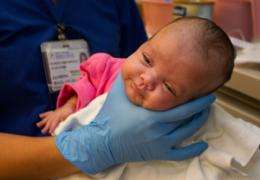
Jaya Maharaj was 15 minutes old when she was sent to surgery at Lucile Packard Children’s Hospital and given a pacemaker that saved her life. The tiny girl — born nine weeks early, weighing 3.5 pounds, with a heart slightly bigger than a walnut — had been diagnosed before birth with a severe heart defect. She is smaller than any pacemaker recipient ever reported in the medical literature.
Jaya’s surgery is remarkable not just because of her small size but because many fetuses with her condition, congenital heart block, do not survive pregnancy. Research has shown that 20 to 50 percent of patients diagnosed prenatally die in utero or in the first weeks after birth. Yet premature delivery to implant a pacemaker carries its own hazards. When Leanne Maharaj, Jaya’s mom, was first referred to Packard Children’s from her hometown of Hayward, Calif., at 28 weeks pregnant, her doctors weighed the conflicting risks.
“We knew that at any time the baby’s heart could give out,” said neonatologist Valerie Chock, MD, a member of the large, multidisciplinary team that planned Jaya’s birth and surgery. “We had to decide: At what point do we deliver to balance that risk against the risk of premature delivery?”
Congenital heart block develops if, during pregnancy, the mother’s immune system mistakenly attacks nerve fibers that transmit heartbeat signals through the fetal heart muscle. When this happens, the fetal heart rate becomes dangerously slow. Congestive heart failure can develop, in which fluid backs up around the heart and lungs, and the body can’t get oxygen needed for growth. Even worse, the heart’s different chambers may beat in an uncoordinated way, and the heart can stop.
“So much was in the balance,” said Yasser El-Sayed, MD, the Packard Children’s high-risk obstetrician who oversaw Leanne’s care during pregnancy. “We just had to take it day by day, week by week.”
The threat to their eagerly awaited first baby was painful for Leanne and her husband, Kamneel, who relied on their extended family and their Hindu religion to cope. “Praying every day gave us faith and hope that something would help,” Kamneel recalled.
Chock and El-Sayed worked with specialists in pediatric cardiology, cardiac electrophysiology, cardiac surgery, cardiovascular anesthesia, respiratory therapy and pharmacy to make sure every aspect of Jaya and Leanne’s complex case was addressed. Such collaborations are a regular occurrence in Packard Children’s Center for Fetal and Maternal Health, which coordinates care for high-risk pregnancies and has treated a few congenital heart block cases in the past.
The medical team checked Jaya twice a week before birth, monitoring her heart rate and growth, and looking for fluid around her heart and lungs. Leanne was given a steroid medication to minimize continued damage to Jaya’s heart. Because the baby was growing and not showing signs of heart failure, the team decided they could wait until 31 weeks’ gestation to deliver her.
Early on Nov. 22, Leanne was wheeled into an operating room where about 25 clinicians waited to perform her cesarean and stabilize the newborn. In the adjacent operating room, another team prepared for Jaya’s surgery.
The delivery went quickly. “When they took her out, she was crying, and my husband started crying,” Leanne remembered.
Several clinicians set to work on Jaya: checking her heart rate, putting in a breathing tube and intravenous catheters for surgery, checking her oxygen levels, and administering medication for her premature lungs. Jaya’s 3.5-pound size, healthy for such a premature baby, confirmed that her heart defect had not hampered her growth in the womb. But her heart was beating only 45 beats per minute — far below a typical newborn’s rate of 120 to 150 beats per minute, and below the threshold of 55 beats per minute at which immediate artificial pacing is considered essential. The team had to begin her heart surgery as soon as possible.
After the first flurry of activity, Leanne and Kamneel quickly greeted their baby. Then she was wheeled next door.
The surgeon, Katsuhide Maeda, MD, had planned to give Jaya temporary pacing wires that would connect her heart to a device outside her body that generated a heartbeat signal. This approach has been used in tiny preemies before. It allows for a quick initial surgery but has the disadvantage of requiring the patient to go through a second chest surgery a few weeks later to implant a permanent pacemaker.
In the operating room, Maeda revised his plan. “Jaya was in critical condition, but not so sick as to have needed chest compressions,” Maeda said. Though slow, Jaya’s heart rate was stable, so Maeda decided he could implant a permanent pacemaker and spare Jaya a second surgery a few weeks later.
Still, Maeda proceeded cautiously. “Her heart muscle was so fragile that I had to be extra careful about putting stitches in,” he said. “The heart muscle on such a small baby is easily torn; that’s why people usually prefer just putting in temporary pacing wires.”
With eight stitches total, Maeda connected two pacemaker leads to Jaya’s heart. He then implanted a pacemaker in her upper abdomen. The surgery was finished and Jaya’s heart rate had been raised to normal by the time she was two hours old.
After surgery, Jaya spent six weeks in the Neonatal Intensive Care Unit. With her heart pumping properly, she grew rapidly and was able to go home on Jan. 12. Her prognosis is excellent: Her pacemaker leads must be repositioned occasionally as she grows, and she will need new pacemaker batteries every five to seven years, but otherwise she will be able to lead a normal life.


