Turmeric-based drug effective on Alzheimer flies
February 14, 2012 in Medical research
Turmeric-based drug effective on Alzheimer flies

Enlarge

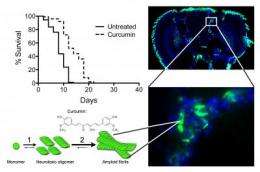
Above left are the survival curves for "Alzheimer flies" treated (dashed line) and those not treated with curcumin. The flies that were administered curcumin lived longer and were more active. The scientists identified an accelerated formation of amyloid plaque in the treated flies, which seemed to protect the nerve cells. On the right we see microscopic images of neurons (blue) and plaque (green) in the fruit fly's brain. The study strengthens the hypothesis that a curcumin-based drug can contribute to toxic fibrils being encapsulated (bottom left of the figure). Credit: Per Hammarström, Ina Caesar

Curcumin, a substance extracted from turmeric, prolongs life and enhances activity of fruit flies with a nervous disorder similar to Alzheimers. The study conducted at Linköping University, indicates that it is the initial stages of fibril formation and fragments of the amyloid fibrils that are most toxic to neurons.

Ina Caesar, as the lead author, has published the results of the study in the prestigious journal PLoS One.

For several years curcumin has been studied as a possible drug candidate to combat Alzheimer's disease, which is characterized by the accumulation of sticky amyloid-beta and Tau protein fibres. Linköping researchers wanted to investigate how the substance affected transgenic (), which developed evident Alzheimer's symptoms. The fruit fly is increasingly used as a model for neurodegenerative diseases.

Five groups of diseased flies with different genetic manipulations were administered curcumin. They lived up to 75 % longer and maintained their mobility longer than the sick flies that did not receive the substance.

However, the scientists saw no decrease of amyloid in the brain or eyes. Curcumin did not dissolve the amyloid plaque; on the contrary it accelerated the formation of fibres by reducing the amount of their precursor forms, known as oligomers.

–The results confirm our belief that it is the oligomers that are most harmful to the nerve cells, says Professor Per Hammarstrom, who led the study.

–We now see that small molecules in an animal model can influence the amyloid form. To our knowledge the encapsulation of oligomers is a new and exciting treatment strategy.

Several theories have been established about how oligomers can instigate the disease process. According to one hypothesis, they become trapped at synapses, inhibiting nerve impulse signals. Others claim that they cause cell death by puncturing the cell membrane.

is extracted from the root of herbaceous plant and has been used as medicine for thousands of years. More recently, it has been tested against pain, thrombosis and cancer.

More information: Curcumin promotes A-beta fibrillation and reduces neurotoxicity in transgenic Drosophila by Ina Caesar, Mary Johnson, K. Peter R. Nilsson, Stefan Thor and Per Hammarström. PLoS One 7(2), 13 February 2012

Journal reference: PLoS ONE search and more info website

Provided by Linkoping University

5 /5 (1 vote)  

Filter


Move the slider to adjust rank threshold, so that you can hide some of the comments.


Display comments: newest first

Birger
Feb 15, 2012

Rank: not rated yet
Very interesting news. Too bad it will take more than a decade for derived medicines to reach patients.
docterd
Feb 15, 2012

Rank: not rated yet
This is really insignificant news. The benefits of circumin have been known for quite some time. A more interesting story is Salk Scientist Dave Schubert who has used chemistry to rationally design a more potent form of circumin, known as CNB-001. CNB is not only more potent, but has been shown to be effective in mouse models of multiple neurological disorders.
Rank 5 /5 (1 vote)
Relevant PhysicsForums posts
  • Potential Breakthrough in Seizure Control
    created20 hours ago
  • Popping/Cracked sternum.
    createdMay 25, 2012
  • Which Mental Illness Encompasses This Problem?
    createdMay 25, 2012
  • A question about drug tolerance
    createdMay 23, 2012
  • Poor nutrition leading to overeating?
    createdMay 23, 2012
  • Math and dyslexia?
    createdMay 21, 2012
  • More from Physics Forums - Medical Sciences

More news stories

Implantable pain disk may help those with cancer

An estimated 3.5 million cancer patients around the globe are in severe pain from their disease, but many get no relief.

Medical research created May 25, 2012 | popularity 5 / 5 (1) | comments 0 | with audio podcast

Energy levels link sleep control mechanisms

Sleep, or lack of it, can determine level of cognitive performance which is linked with accidents as well as increased risk of serious health problems. Links between cell energy levels, gene transcription ...

Medical research created May 25, 2012 | popularity not rated yet | comments 0

Researchers identify key brain cell in antidepressant action

(Medical Xpress) -- Antidepressant medications such as Prozac have helped improve mood and lessen anxiety in millions of people with major depression. But scientists know surprisingly little about how these drugs work.

Medical research created May 25, 2012 | popularity 4.7 / 5 (3) | comments 0 | with audio podcast

Rockefeller scientists pioneer new method to determine mechanisms of drug action

(Medical Xpress) -- Knowing that a drug works is great. Knowing how it works is a luxury. And until now, determining a drug’s mechanism of action has been a tedious and difficult process for scientists.

Medical research created May 25, 2012 | popularity not rated yet | comments 0 | with audio podcast

Like curry? New biological role identified for compound used in ancient medicine

Scientists have just identified a new reason why some curry dishes, made with spices humans have used for thousands of years, might be good for you.

Medical research created May 25, 2012 | popularity 4.5 / 5 (12) | comments 2 | with audio podcast


Keep food safety in mind this memorial day weekend

(HealthDay) -- Picnics, parades and cookouts are as much a part of Memorial Day weekend as tributes to the United States' war veterans.

Travel to high altitudes tied to Crohn's, colitis flare-ups

(HealthDay) -- People with inflammatory bowel disease, which includes Crohn's disease and colitis, may be at increased risk for flare-ups when they fly or travel to high altitudes for skiing or mountain climbing, ...

Family history of Alzheimer's affects functional connectivity

(HealthDay) -- Cognitively normal individuals with a family history of late-onset Alzheimer's disease (AD) may display lower resting state functional connectivity in the default mode network (DMN) of the brain, ...

Transvaginal mesh op restores pelvic organ prolapse at price

(HealthDay) -- Transvaginal mesh (TVM) procedures are effective for anatomical restoration of pelvic organ prolapse (POP), but patients report a worsening of sexual function following surgery, according to ...

Of mice and mental models: Neuroscientific implications of risk-optimized behavior in the mouse

(Medical Xpress) -- Regardless of an organism’s biological complexity, every encephalized animal continuously makes under-informed behavioral choices that can have serious consequences. Despite its ubiquity, ...

Weight struggles? Blame new neurons in your hypothalamus

New nerve cells formed in a select part of the brain could hold considerable sway over how much you eat and consequently weigh, new animal research by Johns Hopkins scientists suggests in a study published in the May issue ...