New model show how the brain is organized to process odor information
March 19, 2012 in Neuroscience
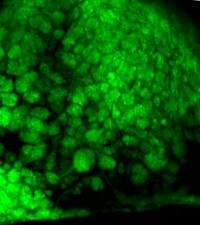
Glomeruli in the olfactory bulb (shown in green), the first waystation for incoming olfactory signals, play an important role in the processing and identification of smells. Credit: Courtesy of Limei Ma, Stowers Institute for Medical Research
Just like a road atlas faithfully maps real-word locations, our brain maps many aspects of our physical world: Sensory inputs from our fingers are mapped next to each other in the somatosensory cortex; the auditory system is organized by sound frequency; and the various tastes are signaled in different parts of the gustatory cortex.
The olfactory system was believed to map similarly, where groups of chemically related odorants - amines, ketones, or esters, for example - register with clusters of cells that are laid out next to each other.
When researchers at the Stowers Institute for Medical Research traced individual odor molecules' signal deep into the brain, they found evidence that this "chemotopic" hypothesis of olfaction is insufficient, paving the way for a new model of how the sense of smell works, and how it came about.
"When we mapped the individual chemical features of different odorants, they mapped all over the olfactory bulb, which processes incoming olfactory information," says Associate Investigator C. Ron Yu, PhD, who led the study published in this week's online edition of the Proceedings of the National Academy of Sciences. "From the animal's perspective that makes perfect sense. The chemical structure of an odor molecule is not what's important to them. They really just want to learn about their environment and associate olfactory information with food or other relevant information."
The brain receives information about odors from olfactory receptors, which are embedded in the membrane of sensory neurons in the nasal cavity. Any time an odor molecule interacts with a receptor, an electrical signal travels to so-called glomeruli in the olfactory bulb. Each glomerulus receives input from olfactory receptor neurons expressing only one type of olfactory receptor. The overall glomerular activation patterns within the olfactory bulb are thought to represent specific odors.
This video is not supported by your browser at this time.
Any time an odor molecule interacts with an olfactory receptor in the nasal cavity, an electrical signal travels to so-called glomeruli in the olfactory bulb. Each glomerulus receives input from olfactory receptor neurons expressing only one type of olfactory receptor. The overall glomerular activation patterns within the olfactory bulb are thought to represent specific odors. Credit: Courtesy of Limei Ma, Stowers Institute for Medical Research
"Chemotopy is a very attractive model," says Yu. But it had never been mapped accurately based on the earlier available technologies and recent experiments suggested that the chemotopic hypothesis breaks down at a fine level. To increase the resolution of the "olfactory map," Yu and his team generated a new line of transgenic mice with superb sensitivity and devised equipment that allowed them to deliver hundreds of odor stimuli to a single mouse.
When the Stowers researchers examined the activation pattern at the level of single glomeruli, they found that certain odors activated glomeruli within a distinct area of the olfactory bulb, while others signaled to glomeruli located all over the map. Odors from different classes intermingled, too, suggesting that the glomeruli have not evolved to only detect the chemical shapes of specific odorants.
This makes sense, as there are hundreds of thousands of odors, says Limei Ma, PhD, a research specialist at Stowers and first author on the new study. "Many of them could be really novel to the organism, something they never encountered before," she says. "The system must have the capability to recognize and encode anything."
So if glomeruli didn't have a fidelity to certain molecular shapes, as the chemotopic hypothesis had suggested, what did unite them? The team was led to a "tunotopic" hypothesis of the olfactory system. Individual olfactory receptors are "tuned" during evolution not to one particular kind of odorant, but to a variety of molecules. In combination, these receptors can then respond to those millions of smells. Glomeruli with similar tuning properties tend to be near each other. From a computing standpoint, this arrangement helps to enhance contrast among similar odors, explains Ma.
"The evolution of these receptors is not dictated by the chemical structures that they recognize," says Yu. "Most of our receptors have descended from a few common ancestral genes. Initially, they are more likely tuned to similar odors. When receptors accumulate mutations, it adds to their repertoire of natural odors they recognize."
Imagine a roomful of musicians. In chemotopy, the musicians are clustered according to their instruments and never play with other instruments. The team's tunotopic hypothesis is closer to an actual symphony: Different instruments overlap to create many more different sounds than the individual ones could.
Yu and his team think, further, that the tunotopic hypothesis may help us understand visual, auditory, and somatosensory processing as well. In the case of olfaction, tunotopy allows the animal to better distinguish among the nuances of odors. That precision, from an evolutionary perspective, would come in handy as the animal sorted through its environment.
It also helps us adapt to a constantly changing world.
"When you have a new chemical synthesized, like new perfumes and food flavors, you don't have to create new brain regions to react to it," says Ma. "What you do is use the existing receptors to sense all these chemicals and then tell your brain whether this is novel, whether it's similar, or whether it's something really strange."
Provided by Stowers Institute for Medical Research
-
Neural mapping paints a haphazard picture of odor receptors
Feb 03, 2009 |
not rated yet |
0
-
Olfactory bulb size may change as sense of smell changes
Jun 16, 2008 |
not rated yet |
0
-
Sensory wiring for smells varies among individuals
Mar 30, 2011 |
not rated yet |
0
-
How fast can a rat smell?
Apr 08, 2008 |
not rated yet |
0
-
Researchers unlock new secret to how smells are detected
Mar 25, 2011 |
not rated yet |
0
-
Motion perception revisited: High Phi effect challenges established motion perception assumptions
Apr 23, 2013 |
3 / 5 (2) |
2
-
Anything you can do I can do better: Neuromolecular foundations of the superiority illusion (Update)
Apr 02, 2013 |
4.5 / 5 (11) |
5
-
The visual system as economist: Neural resource allocation in visual adaptation
Mar 30, 2013 |
5 / 5 (2) |
9
-
Separate lives: Neuronal and organismal lifespans decoupled
Mar 27, 2013 |
4.9 / 5 (8) |
0
-
Sizing things up: The evolutionary neurobiology of scale invariance
Feb 28, 2013 |
4.8 / 5 (10) |
14
-
Pressure-volume curve: Elastic Recoil Pressure don't make sense
6 hours ago
-
If you became brain-dead, would you want them to pull the plug?
23 hours ago
-
MRI bill question
May 15, 2013
-
Ratio of Hydrogen of Oxygen in Dessicated Animal Protein
May 13, 2013
-
Alcohol and acetaminophen
May 13, 2013
-
Marie Curie's leukemia
May 13, 2013
- More from Physics Forums - Medical Sciences
More news stories
For combat veterans suffering from post-traumatic stress disorder, 'fear circuitry' in the brain never rests
Chronic trauma can inflict lasting damage to brain regions associated with fear and anxiety. Previous imaging studies of people with post-traumatic stress disorder, or PTSD, have shown that these brain regions can over-or ...
Neuroscience
9 hours ago |
not rated yet |
0
|
Temporal processing in the olfactory system
The neural machinery underlying our olfactory sense continues to be an enigma for neuroscience. A recent review in Neuron seeks to expand traditional ideas about how neurons in the olfactory bulb might encode information about ...
Neuroscience
20 hours ago |
not rated yet |
0
|
Melon focus headband turns to Kickstarter for rollout plans
(Medical Xpress)—What if the quality of your work depends more on your focus on the piano keys or canvas or laptop than your musical or painting or computing skills? If target users can be convinced, they ...
Neuroscience
20 hours ago |
3.7 / 5 (3) |
0
|
Deep brain stimulation: A fix when the drugs don't work
Neurological disorders can have a devastating impact on the lives of sufferers and their families.
Neuroscience
May 17, 2013 |
5 / 5 (1) |
0
|
Brain makes call on which ear is used for cell phone
If you're a left-brain thinker, chances are you use your right hand to hold your cell phone up to your right ear, according to a newly published study from Henry Ford Hospital in Detroit.
Neuroscience
May 16, 2013 |
2 / 5 (2) |
0
|
New research identifies risks, interventions for children's GI health
An increasing number of U.S. children are experiencing gastrointestinal issues that require interventions to resolve, according to research presented at Digestive Disease Week (DDW).
AIDS science at 30: 'Cure' now part of lexicon
Big names in medicine are set to give an upbeat assessment of the war on AIDS on Tuesday, 30 years after French researchers identified the virus that causes the disease.
Now we know why old scizophrenia medicine works on antibiotics-resistant bacteria
In 2008 researchers from the University of Southern Denmark showed that the drug thioridazine, which has previously been used to treat schizophrenia, is also a powerful weapon against antibiotic-resistant bacteria such as ...
Individuals who drink heavily and smoke may show 'early aging' of the brain
Treatment for alcohol use disorders works best if the patient actively understands and incorporates the interventions provided in the clinic. Multiple factors can influence both the type and degree of neurocognitive abnormalities ...
College women exceed NIAAA drinking guidelines more frequently than college men
In order to avoid harms associated with alcohol consumption, in 2009 the National Institute on Alcohol Abuse and Alcoholism issued guidelines that define low-risk drinking. These guidelines differ for men and women: no more ...
Study identifies new approach to improving treatment for MS and other conditions
(Medical Xpress)—Working with lab mice models of multiple sclerosis (MS), UC Davis scientists have detected a novel molecular target for the design of drugs that could be safer and more effective than current FDA-approved ...
Mar 20, 2012
Rank: not rated yet
What is the "tunotopy" hypothesis???
There is Fourier (analysis) to explain literally everything that goes on with and within the human auditory process - from the ears to the molecular/cellar processes in the ears and brain.
Sorry, Yu. You are going to retract that statement.
That's like saying:
"The evolution of auditory receptors are not dictated by the sounds that they recognize." says Yu.
You are wrong. You are wrong. You are wrong.
Retract that statement. The last advice you will ever hear before you embark on a path of no return.
Mar 20, 2012
Rank: not rated yet
Mar 25, 2012
Rank: not rated yet
Mar 25, 2012
Rank: not rated yet
Mar 27, 2012
Rank: not rated yet