Implant to replace defective venous valve
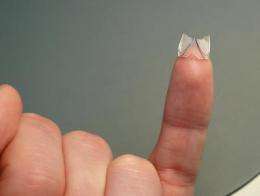
The finished venous valve is highly durable. Credit: Helmholtz-Institute of Biomedical Engineering of RWTH Aachen
If heart valves don't close properly, they are replaced. Conventional treatment of venous valve failure, however, has up to now always and exclusively been via medication. In future, an implant will assume the function of damaged valves -- and a new dispensing tool means these prostheses can be made using an automated process.
It's one of the most commonly occurring medical conditions chronic venous in-sufficiency (CVI). Almost ten million German citizens suffer from weak veins that require treatment, with twice as many women being affected as men. The cause of this widespread condition is restricted functioning of the venous valves in the legs. If the venous valve is no longer able to close properly, blood will observe the laws of gravity in between heartbeats and flow down to collect in the legs. This leads to edemas, and can cause open ulcers in particularly severe cases. CVI is usually treated with anti-inflammatory drugs and diuretics; as yet there is no globally available venous valve implant that can be used to treat the illness. This is something that researchers from the Fraunhofer Institute for Manufacturing Engineering and Automation IPA in Stuttgart are setting out to change: In close collaboration with four industrial partners and Helmholtz-Institute for Biomedical Engineering of RWTH Aachen University, they have developed an automated production facility that can make venous valve prostheses from polycarbonate-urethane (PCU), a plastic. The project was sponsored by the German Federal Ministry of Economics and Technology BMWI.
The centerpiece of the facility is a 3D droplet dispensing tool which enables the researchers to precisely apply a particular polymer onto freeform surfaces and at the same time combine various grades of polymer hardness, called Shore hardnesses. "3D droplet dispensing technology is an additive procedure that allows three-dimensional geometries to be created layer by layer using a polymer", explains Dr. Oliver Schwarz, group manager at the IPA. The scientists use PCU because it is particularly strong and flexible, while another useful property of the material is that it is easy to sew into surrounding tissue. PCU structures can be made in very thin layers, which is ideal when replacing wafer-thin atrioventricular valves. "By using PCU in combination with our 3D dispensing kinematics, we can achieve seamless transitions within the material between six different grades of elasticity and hardness without any breaking points whatsoever. This technique mirrors the design of highly stressed structures in nature. It can't be done using injection molding", says Schwarz.
But how does the PCU become a venous valve prosthesis? Initially, the polymers are dissolved in a solvent and deposited onto a venous valve prosthetic mold one droplet at a time, using the dispensing tool. The system is accurate to within 25 micrometers, and can deliver up to 100 droplets per second, each with a volume of 2 to 60 nanoliters. A six-axis kinematic system positions the piezo feeder precisely above the mold. Once it is fully coated with droplets, the mold is bathed in a warm stream of nitrogen. This causes the solvent to evaporate, leaving the polymer behind. Further layers are applied by repeating the dispensing process, and in the end the polymer prosthesis can simply be peeled from the mold. Doctors can take the finished replacement valves and implant them into the veins of the leg via a catheter passed through the skin.
The production facility comprises numerous other components besides the dispenser. The IPA experts are responsible for, amongst other things, the filling and monitoring system, the drying facilities, the entire clean-room box and the control mechanism for the six-axis kinematic system. "We have successfully managed to re-program the Beckhoff control system normally used with milling machines in such a way that it can now be used with additive processes," Schwarz is happy to report. The solution they have come up with will soon see the researcher and his team in a position to produce thin-walled, highly durable implants such as heart valves or intervertebral disks.
The IPA scientists will be presenting a prototype of their 3D droplet dispenser at the MEDTEC Europe 2012 trade fair from March 13 15 in Stuttgart (Hall 6, Booth 6211).
Provided by
Fraunhofer-Gesellschaft
-
Prosthetic vein valve designed to direct blood flow shows promising pre-clinical results
Sep 15, 2008 |
not rated yet |
0
-
New design for mechanical heart valves
Nov 22, 2011 |
not rated yet |
0
-
Story of lymphatic system expands to include chapter on valve formation
Nov 14, 2011 |
not rated yet |
0
-
FDA OKs heart valve made from human tissue
Feb 07, 2008 |
not rated yet |
0
-
Mitral valve repair with bypass surgery may improve heart function
Feb 29, 2012 |
not rated yet |
0
-
Motion perception revisited: High Phi effect challenges established motion perception assumptions
Apr 23, 2013 |
3 / 5 (2) |
2
-
Anything you can do I can do better: Neuromolecular foundations of the superiority illusion (Update)
Apr 02, 2013 |
4.5 / 5 (11) |
5
-
The visual system as economist: Neural resource allocation in visual adaptation
Mar 30, 2013 |
5 / 5 (2) |
9
-
Separate lives: Neuronal and organismal lifespans decoupled
Mar 27, 2013 |
4.9 / 5 (8) |
0
-
Sizing things up: The evolutionary neurobiology of scale invariance
Feb 28, 2013 |
4.8 / 5 (10) |
14
-
Classical and Quantum Mechanics via Lie algebras
Apr 15, 2011
- More from Physics Forums - Independent Research
More news stories
ACP issues recommendations for management of high blood glucose in hospitalized patients
High blood glucose is associated with poor outcomes in hospitalized patients, and use of intensive insulin therapy (IIT) to control hyperglycemia is a common practice in hospitals. But the recent evidence does not show a ...
Other
6 hours ago |
not rated yet |
0
Future doctors unaware of their obesity bias
Two out of five medical students have an unconscious bias against obese people, according to a new study by researchers at Wake Forest Baptist Medical Center. The study is published online ahead of print in the Journal of ...
Other
12 hours ago |
not rated yet |
0
Plastic realistic: Medical students to use plastinated human bodies for anatomy learning
Nanyang Technological University's (NTU) new medical school will be pioneering the use of plastinated bodies for medical education in Singapore.
Other
21 hours ago |
not rated yet |
0
Survey points out deficiencies in addictions training for medical residents
A 2012 survey of internal medicine residents at Massachusetts General Hospital (MGH) – one of the nation's leading teaching hospitals – found that more than half rated the training they had received in addiction and other ...
Other
May 22, 2013 |
5 / 5 (1) |
0
Early use of tracheostomy for mechanically ventilated patients not associated with improved survival
For critically ill patients receiving mechanical ventilation, early tracheostomy (within the first 4 days after admission) was not associated with an improvement in the risk of death within 30 days compared to patients who ...
Other
May 21, 2013 |
not rated yet |
0
Obesity weighs down on top soda guzzler Mexico
Artemio Martinez balanced his corpulent frame on a stool in a Mexico City street taco stand, downing a sweet soda and eating a final pork-filled corn tortilla.
Controlling mood through the motions of mitochondria
(Medical Xpress)—Regulating the distribution of power in neurons is done by a system that makes the national electric grid look simple by comparison. Each neuron has several thousand mitochondria confined ...
Hormone replacement therapy—clarity at last
The British Menopause Society and Women's Health Concern have today released updated guidelines on Hormone Replacement Therapy (HRT) to provide clarity around the role of HRT, the benefits and the risks. The new guidelines ...
Motion quotient: IQ predicted by ability to filter motion (w/ video)
A brief visual task can predict IQ, according to a new study. This surprisingly simple exercise measures the brain's unconscious ability to filter out visual movement. The study shows that individuals whose ...
Multiple research teams unable to confirm high-profile Alzheimer's study
Teams of highly respected Alzheimer's researchers failed to replicate what appeared to be breakthrough results for the treatment of this brain disease when they were published last year in the journal Science.
Scientists discover molecule triggers sensation of itch
Scientists at the National Institutes of Health report they have discovered in mouse studies that a small molecule released in the spinal cord triggers a process that is later experienced in the brain as ...