'Impossible' problem solved after non-invasive brain stimulation
March 29, 2012 in Neuroscience

'Impossible' problem solved after non-invasive brain stimulation

Enlarge

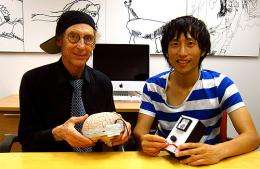
(L-R) Professor Allan Snyder and Richard Chi found brain stimulation helped people solve a puzzle.

(Medical Xpress) -- Brain stimulation can markedly improve people's ability to solve highly complex problems, a recent University of Sydney study suggests.

The findings by Professor Allan Snyder and Richard Chi, from the University of Sydney, are published in Neuroscience Letters.

"The results suggest non-invasive could assist people in solving tasks that appear straightforward but are inherently difficult," said Professor Snyder.

Our minds have evolved to solve certain problems effortlessly, yet we struggle to solve others that appear simple but require us to apply an unfamiliar , to 'think outside the box'.

'Impossible' problem solved after non-invasive brain stimulation

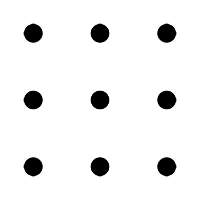
The famous 'nine dots puzzle'. Can you join them using only four straight lines without taking your pen off the page?

"As an example we have taken the famous nine dots problem, where you are asked to join all the dots with four straight lines without taking the pen off the page," Professor Snyder said.

"Surprisingly, investigations over the last century show that almost no one can do this."

Now the researchers have shown that more than 40 percent of the people they tested were able to solve the nine dots problem after receiving 10 minutes of safe, non-invasive brain stimulation.

Specifically the left anterior temporal lobe of the brain is inhibited while simultaneously the right anterior temporal lobe is excited, employing a technique known as transcranial direct current stimulation.

Using the same procedure the researchers have previously reported success in amplifying insight and .

Chi and Snyder suggest that their unique brain stimulation could ultimately enable people to "escape the tricks our minds impose on us," as Professor Snyder describes it, and solve tasks that appear deceptively simple.

Provided by University of Sydney

4.7 /5 (30 votes)  

Filter


Move the slider to adjust rank threshold, so that you can hide some of the comments.


Display comments: newest first

antialias_physorg
Mar 29, 2012

Rank: 5 / 5 (1)
The famous 'nine dots puzzle'. Can you join them using only four straight lines without taking your pen off the page?

Depends on how big your page is. If it's just as big as the figure then: no

Unless:
- you're allowed to roll the page into a tube. Then you can do it with one line under the assumption that the points have non-zero extent

- if the points are of zero size you can still do it with one line (or one point to be exact) if you're allowed to fold the paper.

Specifically the left anterior temporal lobe of the brain is inhibited while simultaneously the right anterior temporal lobe is excited, employing a technique known as transcranial direct current stimulation.

Don't screw with your mind. When all is said and done it's the only thing that makes you: you.
It's also the one thing in your body you don't want to mess with beyond repair. I'll believe that this short term stimulation is harmless...but using this 8 hours a day at the workplace? I have my doubts.
speakermagnet
Mar 29, 2012

Rank: 5 / 5 (1)
I agree that artificially modifying the operation of your brain could lead to undesired effects. In fact, I think Professor Snyder may have dipped into the stimulator a few too many times based on the way he is wearing his hat!
Magus
Mar 29, 2012

Rank: 5 / 5 (1)
They are joined with white-space no lines required. Or draw beyond the outside dots as Wikipedia suggests. I would say I knew this one, but this is the internet and I have no way of proving that to someone reading this. Now that I said that though, you might believe me even though I've add no real reason to believe I could do it on my own.

*-*-*-
|\ /
* * *
| X
* * *
|/
SteveL
Mar 29, 2012

Rank: 5 / 5 (1)
Your all making it too hard. Take another look at the rules of the puzzle, and change the way you think about what lines are. (hint hint)

It's really simple and can can be done a couple of ways if you look at the flexibility that is provided in the rules. (But I did have to think about it a few minutes to see the solutions).
Zorlont3
Mar 29, 2012

Rank: 5 / 5 (1)
To spoil it for anyone that thinks I am correct. My conclusion.

Draw a line across the bottom row, KEEP your pen on the line...and back-trace to the center of the line. Draw a line up the center row, creating your SECOND line. Retrace backwards to the center point, and draw a line SIDE TO SIDE through the center horizontal row. Finally, (Key here is keeping your pen touching the paper.) Move your pen to the top row, and cross it out. That is 4 lines.

You don't need "brain" stimulation" to think outside the box. You just need to approach the WHOLE problem. The actual problem, and the rules/laws of solving it.
powerup1
Mar 29, 2012

Rank: 5 / 5 (1)
Some people are missing the point of this article. It is not about solving this particular puzzle, but it is about being able to get their mind to work in a new way. If more people are able to problem solve in a more effective manner, the world can only be better because of it.
gwrede
Mar 29, 2012

Rank: 5 / 5 (1)
What if the bad guys (insert your favorite here, or the other party) get this news? Maybe the world won't turn so much better.
Neurons_At_Work
Mar 30, 2012

Rank: 5 / 5 (1)
This is pretty good. (hint: The lines don't have to end or make a direction change AT a dot.)
Sinister1811
Mar 30, 2012

Rank: not rated yet
Sounds like something I need, whenever I'm stuck on college homework or whatever. This thing should be made publicly available.
DaFranker
Mar 30, 2012

Rank: 5 / 5 (1)
@Sinister1811:

No, it really shouldn't. No one has a clear and adequately 'certain' idea of the actual mechanisms and effects of this treatment are, and also no information about what effects this might lead to on the long term, with repeated exposure or with continuous extended exposure.

They're basically doing something analoguous to mixing completely unknown chemicals together in a saferoom and looking at whether it bubbles, without gaining clear information about the composition of the chemicals either before or after the reaction - if there is a reaction at all.
James Fugedy
Mar 30, 2012

Rank: not rated yet
I have used tDCS for the relief of treatment-resistant chronic pain, migraine and depression for the last 5 years. There are over 600 published scientific articles on tDCS (abstracts available at pubmed, the NIH search engine). The science behind tDCS is elegantly simple. Neurons underlying the electrodes can be facilitated or inhibited, depending on polarity. Effect depends on electrode location. Because of the efficacy, ease of use, limited duration of effect, low cost and lack of side effects, tDCS will have many beneficial applications. Even now, tDCS demonstrates benefit for stroke, autism, epilepsy, as well as, enhancing memory, reducing craving and improving motor function.
Tausch
Apr 01, 2012

Rank: not rated yet
Hmm. Artificially induced brain stimulation.
Natural induced brain stimulation:
Have your left hand play the melody and the right hand play the other clef signatures. Criss cross your hands - another option.

Pretend you are blind. Find the answer braille-logically.
Just kidding...here a link - surprised that AP didn't throw this in the commentary mix - under the assumption his German is better than his English.
http://en.wikiped...g_effect
Tausch
Apr 01, 2012

Rank: not rated yet
Addendum:

Yeah. Firing together, wires together.
http://en.wikiped...g_effect

Wikipedia excerpt:
An incorrect solution to the extinction problem indicated the presence of the Einstellung effect. :)


Maybe. Unless you told me you were getting old. ;)
SubmarineRider618
Apr 04, 2012

Rank: not rated yet
The solution to this challenge is not difficult to find - what ipresses me about it is how wonderfully (and punfully, in a way), the solution illustrates the principle of "thinking outside the box." Yes, that's a hint, too.
(SPOILER ALERT -
SPOILER ALERT - Begin with a full diagonal line, but don't stop when you reach the third point in the diagonal - that's a bigger clue.)
SubmarineRider618
Apr 04, 2012

Rank: not rated yet
OH - and to lable as "safe" anything that distorts the normal brain function for hours at a time - even for so pure a motive as to solve a puzzle whose answer probably won't even end world hunger - well, that's a bit of loose thinking, eh wot?
postfuture
Apr 05, 2012

Rank: not rated yet
The famous 'nine dots puzzle'. Can you join them using only four straight lines without taking your pen off the page? - I cannot understand the rules. The solution is seems obvious, but may be I do not understand the problem. E.g. they did not say if you cannot repeat and go back on the same line. If they mean that have to be 4 lines at the end? Or? Also should all lines that you make have to be straight, or only 4 lines that connect dots? Are all lines have to be inside of the square or not? Also the question about angles. Seems there can be many solutions depends on what they want.
Rank 4.7 /5 (30 votes)
Related Stories
Relevant PhysicsForums posts

More news stories

For combat veterans suffering from post-traumatic stress disorder, 'fear circuitry' in the brain never rests

Chronic trauma can inflict lasting damage to brain regions associated with fear and anxiety. Previous imaging studies of people with post-traumatic stress disorder, or PTSD, have shown that these brain regions can over-or ...

Neuroscience created 22 hours ago | popularity 5 / 5 (1) | comments 0 | with audio podcast

Temporal processing in the olfactory system

The neural machinery underlying our olfactory sense continues to be an enigma for neuroscience. A recent review in Neuron seeks to expand traditional ideas about how neurons in the olfactory bulb might encode information about ...

Neuroscience created May 17, 2013 | popularity not rated yet | comments 0 | with audio podcast report

Melon focus headband turns to Kickstarter for rollout plans

(Medical Xpress)—What if the quality of your work depends more on your focus on the piano keys or canvas or laptop than your musical or painting or computing skills? If target users can be convinced, they ...

Neuroscience created May 17, 2013 | popularity 3.7 / 5 (3) | comments 0 | with audio podcast weblog

Deep brain stimulation: A fix when the drugs don't work

Neurological disorders can have a devastating impact on the lives of sufferers and their families.

Neuroscience created May 17, 2013 | popularity 5 / 5 (1) | comments 0 | with audio podcast

Brain makes call on which ear is used for cell phone

If you're a left-brain thinker, chances are you use your right hand to hold your cell phone up to your right ear, according to a newly published study from Henry Ford Hospital in Detroit.

Neuroscience created May 16, 2013 | popularity 2 / 5 (2) | comments 0 | with audio podcast


New research identifies risks, interventions for children's GI health

An increasing number of U.S. children are experiencing gastrointestinal issues that require interventions to resolve, according to research presented at Digestive Disease Week (DDW).

US psychiatry gets makeover in new manual

The latest makeover to a massive psychiatric tome honored by some, reviled by others and even called the "Bible" of mental disorders is being released Saturday with a host of new changes.

New case of SARS-like virus in Saudi: ministry

A new case of the deadly coronavirus has been detected in Saudi Arabia where 15 people have already died after contracting it, the health ministry announced on Saturday on its Internet website.

AIDS science at 30: 'Cure' now part of lexicon

Big names in medicine are set to give an upbeat assessment of the war on AIDS on Tuesday, 30 years after French researchers identified the virus that causes the disease.

New colonoscope provides ground-breaking view of colon

A ground-breaking advance in colonoscopy technology signals the future of colorectal care, according to research presented today at Digestive Disease Week(DDW). Additional research focuses on optimizing the minimal withdrawal ...

Body clocks of depressed people altered at cell level, researchers show

Every cell in our bodies runs on a 24-hour clock, tuned to the night-day, light-dark cycles that have ruled us since the dawn of humanity. The brain acts as timekeeper, keeping the cellular clock in sync ...