Patients with rare diseases to get DNA sequenced at no charge
March 1, 2012 By Michael C. Purdy in Genetics
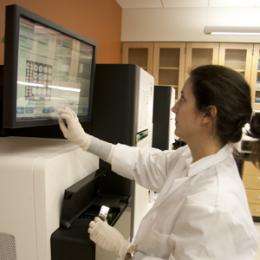
Research technician Maggie O’Guinn prepares a DNA sequencer at Washington University’s Genomic and Pathology Services. Its scientists are reaching out to patient advocacy groups and offering to sequence the DNA of 99 patients with rare diseases. Credit: MICHAEL C. PURDY
Rare genetic diseases, long overlooked because they affect relatively few people, are getting new attention. Scientists at Washington University School of Medicine in St. Louis are reaching out to patient advocacy groups and offering to decode the DNA of 99 patients with rare diseases to help find the genetic alterations responsible for their illnesses.
The patients DNA will be sequenced at the universitys Genomics and Pathology Services (GPS) at no cost to patients or the advocacy groups. The new effort is known as the Rare99X Clinical Exome Challenge.
The genomics revolution provides many of the tools that may unlock the secrets of rare diseases, says Jimmy Lin, PhD, research instructor in pathology and immunology. We are excited to form partnerships with patient advocacy groups to apply these technologies to advance clinical understanding of these diseases.
Collectively, an estimated 7,000 rare diseases affect some 25 million Americans. They range from Huntingtons disease, a neurodegenerative disorder diagnosed in adulthood, to Neimann-Pick, a metabolic disorder which can occur in infancy.
In recent years, advances in technology have made DNA sequencing cheaper, faster and more accurate. For patients with rare diseases, scientists now can use that technology to find the genetic error or errors that most likely caused their illness.
Many rare diseases are thought to be caused by genetic variations in the small portion of the DNA that codes for proteins, collectively known as the exome. This is the part of the DNA that will be sequenced.
By early last year, exome sequencing had already helped researchers identify the genetic causes for 39 rare diseases. Scientists think this is only the beginning.
Identifying and validating gene alterations linked to disease is now enabled by the advent of new sequencing methods that allow for highly sensitive analysis of the patients genetic makeup, says Karen Seibert, PhD, director of GPS and research professor of pathology and immunology.
GPS will begin accepting proposals for exome sequencing from patient advocacy groups on Feb. 29, which has been designated as Rare Disease Day. Final selection of the projects will occur this summer. A panel of genetics experts will review the proposals to help GPS leaders choose the projects most likely to improve care of patients with rare diseases.
Lin is the founder of the Rare Genomics Institute, a nonprofit that designs personalized research studies for rare disease patients, connects them with the latest technology and top researchers and helps secure funding with an online platform. The institutes mission is to make gene sequencing and other advanced techniques accessible to patients with rare diseases. The institute is preparing online training sessions and other activities to help advocacy organizations create their proposals for the Rare99X Clinical Exome Challenge.
In addition to providing exome sequencing for rare disorders, Seibert notes that GPS offers clinical genetic tests for patients with more common diseases like cancer or heart disease. Mutations underlying those diseases can help physicians determine the best treatment options for patients.
Exome sequencing can help identify genetic differences that affect the chances that a treatment will succeed or fail, Seibert says. The information from clinical genetic tests are expected to play an important role in the characterization of an individuals disease the first step in identifying approaches to successful treatment.
More information: For more information, go to raregenomics.org/rare99x .
Provided by
Washington University School of Medicine in St. Louis
-
Major breakthrough will revolutionize the screening and treatment of genetic diseases
Jun 10, 2010 |
not rated yet |
0
-
Next generation sequencing establishes genetic link between two rare diseases
Jul 29, 2010 |
not rated yet |
0
-
For the first time, scientists discover causative gene of a rare disorder by exome sequencing
Nov 17, 2009 |
not rated yet |
0
-
Researchers identify gene that causes rare dementing illness
Nov 24, 2011 |
not rated yet |
0
-
BGI develops first monkey exome sequencing platform for biomedical research
Oct 11, 2011 |
not rated yet |
0
-
Motion perception revisited: High Phi effect challenges established motion perception assumptions
Apr 23, 2013 |
3 / 5 (2) |
2
-
Anything you can do I can do better: Neuromolecular foundations of the superiority illusion (Update)
Apr 02, 2013 |
4.5 / 5 (11) |
5
-
The visual system as economist: Neural resource allocation in visual adaptation
Mar 30, 2013 |
5 / 5 (2) |
9
-
Separate lives: Neuronal and organismal lifespans decoupled
Mar 27, 2013 |
4.9 / 5 (8) |
0
-
Sizing things up: The evolutionary neurobiology of scale invariance
Feb 28, 2013 |
4.8 / 5 (10) |
14
-
Classical and Quantum Mechanics via Lie algebras
Apr 15, 2011
- More from Physics Forums - Independent Research
More news stories
Researchers identify first drug targets in childhood genetic tumor disorder
Two mutations central to the development of infantile myofibromatosis (IM)—a disorder characterized by multiple tumors involving the skin, bone, and soft tissue—may provide new therapeutic targets, according to researchers ...
Genetics
11 hours ago |
3 / 5 (2) |
0
|
Patenting the human genome
Can human genes be patented? That was the question posed by Alan J. Snyder, vice president and associate provost for research and graduate studies at Lehigh, and Lee Kaplan, scientific director of cellular and molecular genetics ...
Genetics
18 hours ago |
4 / 5 (1) |
0
Researchers complete largest genetic sequencing study of human disease
Researchers from Queen Mary, University of London have led the largest sequencing study of human disease to date, investigating the genetic basis of six autoimmune diseases.
Genetics
May 22, 2013 |
4.5 / 5 (4) |
0
|
Researchers develop model for better testing, targeting of malignant peripheral nerve sheath tumors
University of Minnesota Medical School researchers from the Masonic Cancer Center, University of Minnesota, in partnership with the University's Brain Tumor Program, have developed a new mouse model of malignant peripheral ...
Genetics
May 20, 2013 |
5 / 5 (1) |
0
|
Researchers identify new circadian clock component
Northwestern University scientists have shown a gene involved in neurodegenerative disease also plays a critical role in the proper function of the circadian clock.
Genetics
May 16, 2013 |
3 / 5 (1) |
1
|
Engineered cytomegalovirus protects monkeys from HIV equivalent
(Medical Xpress)—A new study by researchers in the US has shown that an ancient virus can be modified to help in the fight against the simian immunodeficiency virus SIV, which is the equivalent in monkeys ...
Hormone levels may provide key to understanding psychological disorders in women
Women at a particular stage in their monthly menstrual cycle may be more vulnerable to some of the psychological side-effects associated with stressful experiences, according to a study from UCL.
Going live: Immune cell activation in multiple sclerosis
Biological processes are generally based on events at the molecular and cellular level. To understand what happens in the course of infections, diseases or normal bodily functions, scientists would need to ...
Help at hand for people with schizophrenia
How can healthy people who hear voices help schizophrenics? Finding the answer for this is at the centre of research conducted at the University of Bergen.
Alzheimer's disease, the soft target of the euthanasia debate
(Medical Xpress)—The way Alzheimer's disease is portrayed by advocacy groups and the media is having undue influence on the euthanasia debate, according to a Deakin University nursing ethics professor.
Depression raises diabetics' risk of severe low blood sugar episodes
(Medical Xpress)—Patients with diabetes who are depressed are much more likely to develop episodes of dangerously low blood sugars, or hypoglycemia, than are those who are not depressed, a new study has ...
Mar 01, 2012
Rank: not rated yet