Scripps Research discoveries lead to newly approved drug for infant respiratory distress syndrome
March 7, 2012 in Diseases, Conditions, Syndromes
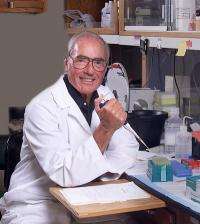
Scripps Research Institute professor emeritus Charles Cochrane, M.D., led work that laid the foundation for the new drug Surfaxin, now approved in the United States for the treatment of infant respiratory distress syndrome. Credit: Courtesy of The Scripps Research Institute.
Scientific advances at The Scripps Research Institute have led to a new drug Surfaxin (lucinactant), approved today by the U.S. Food and Drug Administration (FDA) to treat infant respiratory distress syndrome.
"I am excited that our scientific findings will help save lives," said Charles Cochrane, MD, professor emeritus at Scripps Research. "Many years of work in our basic research laboratory at The Scripps Research Institute made this landmark development possible."
Respiratory distress syndrome (also known as neonatal respiratory distress syndrome) is a life-threatening condition affecting pre-term infants. The more premature an infant is, the more likely he or she is to suffer from it and die.
The condition occurs when infants are born prior to the time when natural surfactant is made in their lungs. Surfactant is a liquid that coats the inside of the lungs, helping to keep the air sacs open and making normal breathing possible. Without enough surfactant, the lungs collapse and the body can be starved of oxygen.
In addition to mechanical ventilation, current treatments for pre-term infants involve using surfactants derived from chopped cow or pig lungs. However, animal-derived surfactants are expensive, contain material that can be injurious to the lungs, and cannot be produced in quantities sufficient to treat pre-term infants worldwide. In addition, animal-derived surfactants can only be used once since they cause an immune reaction; in contrast, the new synthetic surfactant is not immunogenic.
The Cochrane lab first created a synthetic version of surfactant in the 1990s, mimicking a natural peptide known as Surfactant Protein B; the inventors of the technology are Cochrane and Susan Revak. After this formative work at Scripps Research, the therapy was developed by Discovery Labs of Warrington, PA, which oversaw the three phases of clinical trials required by the FDA. These clinic trials provided data on the drug's success.
Provided by
The Scripps Research Institute
-
Scientists show gene mutation may cause immature lungs in newborns
Nov 24, 2008 |
not rated yet |
0
-
Findings suggest optimal oxygen dose for preterm infants
Jun 02, 2010 |
not rated yet |
0
-
Study breathes new life into fight against primary killer of premature infants
Oct 18, 2011 |
not rated yet |
0
-
Higher oxygen levels improve preterm survival, increase risk for eye condition
May 16, 2010 |
not rated yet |
0
-
New treatment could reduce chronic lung disease in premature babies
Apr 29, 2008 |
not rated yet |
0
-
Motion perception revisited: High Phi effect challenges established motion perception assumptions
Apr 23, 2013 |
3 / 5 (2) |
2
-
Anything you can do I can do better: Neuromolecular foundations of the superiority illusion (Update)
Apr 02, 2013 |
4.5 / 5 (11) |
5
-
The visual system as economist: Neural resource allocation in visual adaptation
Mar 30, 2013 |
5 / 5 (2) |
9
-
Separate lives: Neuronal and organismal lifespans decoupled
Mar 27, 2013 |
4.9 / 5 (8) |
0
-
Sizing things up: The evolutionary neurobiology of scale invariance
Feb 28, 2013 |
4.8 / 5 (10) |
14
-
Classical and Quantum Mechanics via Lie algebras
Apr 15, 2011
- More from Physics Forums - Independent Research
More news stories
Researchers find genetic risk factor for pulmonary fibrosis
A paper recently published in the New England Journal of Medicine and co-written by physicians and scientists at the University of Colorado School of Medicine finds that an important genetic risk factor for pulmonary fibros ...
Diseases, Conditions, Syndromes
11 hours ago |
not rated yet |
0
Biomarkers discovered for inflammatory bowel disease
Using the Department of Defense Serum Repository (DoDSR), University of Cincinnati (UC) researchers have identified a number of biomarkers for inflammatory bowel disease (IBD), which could help with earlier diagnosis and ...
Diseases, Conditions, Syndromes
11 hours ago |
5 / 5 (1) |
0
CDC says high number of public pools contain microbes
(HealthDay)—Three-quarters of public schools in the metro Atlanta area contain microbes, including bacteria indicating the presence of fecal matter, according to research published in the May 17 issue of ...
Diseases, Conditions, Syndromes
12 hours ago |
not rated yet |
0
Study examines outbreak of spinal infections in Michigan
(HealthDay)—Factors such as increased case finding may explain why Michigan had half of the total spinal infections associated with contaminated methylprednisolone acetate in the recent fungal meningitis ...
Diseases, Conditions, Syndromes
12 hours ago |
not rated yet |
0
World not ready for mass flu outbreak, WHO says
The world is unprepared for a massive virus outbreak, the deputy chief of the World Health Organization warned Tuesday, amid fears that H7N9 bird flu striking China could morph into a form that spreads easily among people.
Diseases, Conditions, Syndromes
13 hours ago |
not rated yet |
0
Study says empathy plays a key role in moral judgments
Is it permissible to harm one to save many? Those who tend to say "yes" when faced with this classic dilemma are likely to be deficient in a specific kind of empathy, according to a report published in the scientific journal ...
Phthalates: Study links chemicals widely found in plastics, processed food to elevated blood pressure in children, teens
Plastic additives known as phthalates (pronounced THAL-ates) are odorless, colorless and just about everywhere: They turn up in flooring, plastic cups, beach balls, plastic wrap, intravenous tubing and—according to the ...
If you can remember it, you can remember it wrong
(Medical Xpress)—Native peoples in regions where cameras are uncommon sometimes react with caution when their picture is taken. The fear that something must have been stolen from them to create the photo ...
B vitamins could delay dementia
(Medical Xpress)—Despite spending billions of dollars on research and development, drug companies have been unable to come up with effective treatments for dementia and Alzheimer's Disease (AD). Now, A. ...
Insight into the dazzling impact of insulin in cells
Australian scientists have charted the path of insulin action in cells in precise detail like never before. This provides a comprehensive blueprint for understanding what goes wrong in diabetes.
New sleeping pill poised to hit US markets
An experimental sleeping pill from US drug company Merck is effective at helping people fall and stay asleep, according to reviewers at the US Food and Drug Administration, which could soon approve the new drug.