Novel therapy for Crohn's disease discovered
March 19, 2012 in Inflammatory disorders
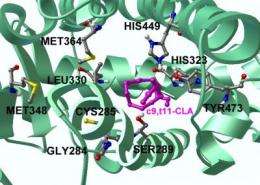
This image represents a CLA molecule. Credit: Virginia Tech
The Nutritional Immunology and Molecular Medicine Laboratory (NIMML) research team at Virginia Tech has discovered important new information on the efficacy of conjugated linoleic acid (CLA) in treating Crohn's disease, a form of inflammatory bowel disease (IBD). CLA is a naturally occurring acid found in meat and dairy products known for its anti-cancer and immune modulatory properties.
In collaboration with the Division of Gastroenterology and Hepathology at University of North Carolina School of Medicine and the Wake Forest Medical Center, researchers found that Crohn's patients who took supplementary CLA showed noticeable improvement. "In our recent open label study of CLA as a supplement in study subjects with mild to moderate CD there was a marked improvement in disease activity and quality of life in 50% of the subjects. CLA was well tolerated by all of the study subjects. These findings are very encouraging and will need to be verified in a randomized controlled trial," said Professor Kim L. Isaacs, a Professor of Gastroenterology at the University of North Carolina at Chapel Hill.
The two main manifestations of IBDCrohn's and ulcerative colitisafflict over 1.4 million people in the United States. Symptoms include abdominal cramping, fever, fatigue, loss of appetite, skin and mouth ulcers, and diarrhea or constipation. In addition, the risk of developing colorectal cancer increases by about one percent yearly in IBD patients. Currently, there is no cure for Crohn's disease and the exact causes of it aren't fully understood.
CLA affords those afflicted with mild to moderate IBD an effective treatment without the unwanted side effects of many synthetic drugs. "Furthermore, we have demonstrated that probiotic bacteria can produce CLA locally and suppress colitis. Therefore, CLA can be administered directly in capsules or indirectly through CLA-producing probiotic bacteria," said Dr. Raquel Hontecillas, an Assistant Professor of Immunology at NIMML.
NIMML strives to develop safer and more effective therapies for human chronic inflammatory diseases from Nature's own medicine cabinet. To achieve this, NIMML uses advanced computational modeling in addition to mechanistic and clinical experimentation. "The validation of the anti-inflammatory actions of CLA in the gut is in line with our goal because CLA is a natural fatty acid found in milk and ruminant products. The fully integrated bioinformatics, nutrition and immunology experimentation capabilities of NIMML enable the acceleration of translational biomedical research from computational and mathematical modeling into the clinic. CLA is an example of an anti-inflammatory compound in a pipeline of naturally occurring and synthetic compounds (e.g., abscisic acid, eleostearic acid, terephthalanilides) with tremendous therapeutic and prophylactic potential as anti-inflammatories," said Dr. Josep Bassaganya-Riera, a Professor of Immunology, principal investigator of this human clinical trial, and the Director of the NIMML and the Center for Modeling Immunity to Enteric Pathogens.
These findings, reported in the most recent edition of Clinical Nutrition, were awarded the American College of Gastroenterology Presidential Poster of distinction for human clinical trials.
More information: Bassaganya-Riera, J., R. Hontecillas, W.T. Horne, M. Sandridge, H. Herfarth, R. Bloomfeld, and K. Isaacs (2012) Conjugated linoleic modulates immune responses in patients with Mild to Moderately active Crohn's disease. Clinical Nutrition. In Press.
Provided by
Virginia Tech
-
Gut bacteria can manufacture defences against cancer and inflammatory bowel disease
Feb 06, 2009 |
not rated yet |
0
-
Foods high in conjugated linoleic acids can enrich breast milk
Jul 28, 2008 |
not rated yet |
0
-
Designer probiotics could reduce obesity
Dec 23, 2010 |
not rated yet |
0
-
Weight-Loss Supplement Shows Good And Bad Traits
Jan 30, 2007 |
not rated yet |
0
-
Promising probiotic treatment for inflammatory bowel disease
Jan 20, 2010 |
not rated yet |
0
-
Motion perception revisited: High Phi effect challenges established motion perception assumptions
Apr 23, 2013 |
3 / 5 (2) |
2
-
Anything you can do I can do better: Neuromolecular foundations of the superiority illusion (Update)
Apr 02, 2013 |
4.5 / 5 (11) |
5
-
The visual system as economist: Neural resource allocation in visual adaptation
Mar 30, 2013 |
5 / 5 (2) |
9
-
Separate lives: Neuronal and organismal lifespans decoupled
Mar 27, 2013 |
4.9 / 5 (8) |
0
-
Sizing things up: The evolutionary neurobiology of scale invariance
Feb 28, 2013 |
4.8 / 5 (10) |
14
-
Assumptions of Griffith's fracture theory
8 hours ago
-
Current leading voltage or vice versa concept
10 hours ago
-
Angular Frequency of AC voltage
13 hours ago
-
Modeling Rigid Body - Unsure about Euler angles and angular velocity
13 hours ago
-
Function for a bullet's path
15 hours ago
-
Elementary questions relating to Newton's laws of motion
16 hours ago
- More from Physics Forums - Classical Physics
More news stories
Asthma symptoms impair sleep quality and school performance in children
The negative effects of poorly controlled asthma symptoms on sleep quality and academic performance in urban schoolchildren has been confirmed in a new study.
Inflammatory disorders
1 hour ago |
not rated yet |
0
Inflammatory bowel disease raises risk of melanoma
Patients with inflammatory bowel disease (IBD) are at higher risk of melanoma, a form of skin cancer, report researchers at Mayo Clinic. Researchers found that IBD is associated with a 37 percent greater risk for the disease. ...
Inflammatory disorders
May 20, 2013 |
4 / 5 (1) |
0
A new 'on' signal for inflammation
(Medical Xpress)—Inflammation is an important response in the body - it helps you to kill off invaders such bacteria that could cause a harmful infection. But if it's chronic or uncontrolled, inflammation can also cause ...
Inflammatory disorders
May 14, 2013 |
not rated yet |
0
|
New research reveals swimming beneficial for young people with asthma
New research by medical students working in the Breathe Well Centre of Research Excellence at the UTAS School of Medicine has revealed swimming has health benefits for young people with asthma, with no adverse effects on ...
Inflammatory disorders
May 10, 2013 |
not rated yet |
0
Nearly 5 million asthmatics could benefit from antifungal therapy
An estimated 4,837,000 asthmatics with allergic bronchopulmonary aspergillosis (ABPA) could benefit substantially from antifungal treatment, say researchers from The University of Manchester and the University of Toronto.
Inflammatory disorders
May 08, 2013 |
not rated yet |
0
If you can remember it, you can remember it wrong
(Medical Xpress)—Native peoples in regions where cameras are uncommon sometimes react with caution when their picture is taken. The fear that something must have been stolen from them to create the photo ...
Study shows where scene context happens in our brain
In a remote fishing community in Venezuela, a lone fisherman sits on a cliff overlooking the southern Caribbean Sea. This man –– the lookout –– is responsible for directing his comrades on the water, ...
Monoclonal antibody appears effective and safe in asthma Phase IIa trial
A novel approach to obstructing the runaway inflammatory response implicated in some types of asthma has shown promise in a Phase IIa clinical trial, according to U. S. researchers.
New rice contamination reported in China
Authorities are investigating rice mills in southern China following tests that found almost half of the staple grain in one of the country's largest cities was contaminated with a toxic metal.
Delayed transfer to the ICU increases risk of death in hospital patients
Delayed transfer to the intensive care unit (ICU) in hospitalized patients significantly increases the risk of dying in the hospital, according to a new study from researchers in Chicago.
New immune system discovered
(Medical Xpress)—A research team, led by Jeremy Barr, a biology post-doctoral fellow, unveils a new immune system that protects humans and animals from infection.