First US case since FDA-approval, new magnetic device for heartburn

April 11, 2012 By Jackie Carr in Cardiology

First U.S. case since FDA-Approval, new magnetic device for heartburn

Enlarge

On Monday, April 9, 2012, Santiago Horgan, MD, chief of minimally invasive surgery at UC San Diego Health System implanted the new FDA-approved LINX device in a 29-year old patient suffering from gastroesophageal reflux disease (GERD), a chronic digestive disease that can lead to severe inflammation, stricture, Barrett’s esophagus and esophageal cancer.

“The multi-center clinical trial results clearly showed that the magnetic device is highly effective in treating GERD and the painful burning that results from this progressive condition,” said Horgan, an international expert in treating esophageal disease. “Unlike drugs that suppress stomach acids, this flexible device corrects the anatomy and immediately addresses the actual source of reflux.”

The LINX system is composed of a series of titanium beads, each with a magnetic core, that are connected to form a ring shape. It is implanted at the lower esophageal sphincter (LES), a circular band of muscle that closes the last few centimeters of the esophagus and prevents the backward flow of stomach contents.
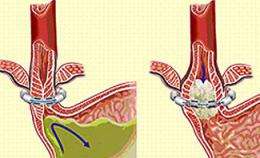
First U.S. case since FDA-Approval, new magnetic device for heartburn
Enlarge

The LINX device is designed to prevent acid reflux but allow for digestion.

“This device has changed my life,” said Gina Brickell, one of the first recipients of the LINX device. “I suffered from GERD for years. Now I can eat what I want, when I want, and where I want.”

The FDA approved the LINX Reflux Management System in March 2012. Horgan and his surgical team have implanted more than 20 of the devices during the clinical trial phase, representing the most surgeries in the second phase of procedures that led to approval.

The LINX device is an option for patients who do not respond to dietary and lifestyle measures. The device can be placed during a 20-30 minute minimally invasive surgery. Patients may leave the hospital the same day after brief observation.

Magnetic Resonance Imaging (MRI) tests are prohibited if you have received the LINX Reflux Management System.

The LINX Reflux Management System is manufactured by Torax Medical Inc. in St. Paul, Minn.

More information: To learn more about eligibility for the LINX device at UC San Diego Health System, please call 619-471-0447.

Provided by University of California - San Diego search and more info website

not rated yet  

Rank not rated yet
Relevant PhysicsForums posts

More news stories

Registry confirms TAVI efficacy and safety in Asian patients

Transcatheter aortic valve implantation (TAVI) is effective and safe in Asian patients, according to early experience based on first results from a multicentre Asian registry reported at EuroPCR 2013.

Cardiology created 7 hours ago | popularity not rated yet | comments 0

Diagnostic coronary angiography: Functional flow reserve changes decisions in 25 percent of cases

Routinely measuring fractional flow reserve (FFR) using pressure wire assessment during coronary angiography for diagnosis of chest pain leads to significant changes in the management of one in four patients, according to ...

Cardiology created 10 hours ago | popularity not rated yet | comments 0

Feasibility trial reports deployment of new device for TAVI in aortic insufficiency

A new investigational device - the Helio System (TF-FA) - being developed for use with the Sapien XT Transcatheter Heart Valve was successfully deployed in all four patients in a small, first-in-human feasibility study of ...

Cardiology created 11 hours ago | popularity not rated yet | comments 0

Cardiac study used as source for new guidelines on treating people undergoing coronary artery bypass surgery

Cardiac research from the University of Alberta had serious impact as a source for the American College of Cardiology and the American Heart Association's new guidelines on how to treat patients undergoing coronary artery ...

Cardiology created 11 hours ago | popularity not rated yet | comments 0

Dual-source cardiac CT IDs CAD in hard-to-image patients

(HealthDay)—In patients who have previously been considered difficult to image, dual-source cardiac (DSC) computed tomography (CT) can identify clinically significant coronary artery disease, according ...

Cardiology created May 23, 2013 | popularity not rated yet | comments 0


Researchers identify first drug targets in childhood genetic tumor disorder

Two mutations central to the development of infantile myofibromatosis (IM)—a disorder characterized by multiple tumors involving the skin, bone, and soft tissue—may provide new therapeutic targets, according to researchers ...

Engineered cytomegalovirus protects monkeys from HIV equivalent

(Medical Xpress)—A new study by researchers in the US has shown that an ancient virus can be modified to help in the fight against the simian immunodeficiency virus SIV, which is the equivalent in monkeys ...

Hormone levels may provide key to understanding psychological disorders in women

Women at a particular stage in their monthly menstrual cycle may be more vulnerable to some of the psychological side-effects associated with stressful experiences, according to a study from UCL.

Driving and hands-free talking lead to spike in errors, study shows

Talking on a hands-free device while behind the wheel can lead to a sharp increase in errors that could imperil other drivers on the road, according to new research from the University of Alberta.

Going live: Immune cell activation in multiple sclerosis

Biological processes are generally based on events at the molecular and cellular level. To understand what happens in the course of infections, diseases or normal bodily functions, scientists would need to ...

Pollen count apps for smartphones are nothing to sneeze at

Kate O'Reilly's spring allergy survival kit includes the usual stuff - nasal sprays, allergy pills and a box of tissues. This season, she's added a new weapon to her line of defense: an app on her smartphone.