Clinical trial measures impact of food on anti-cancer drug effects
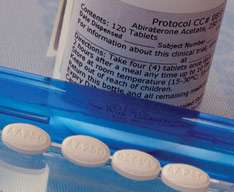
(Medical Xpress) -- An unusual clinical trial based at the University of Chicago Medicine is seeking to determine whether a drug approved for patients with advanced prostate cancer might be safer and just as effective if taken at a much lower dose with food instead of at the full dose on an empty stomach.
The results of the trial could affect future dosage recommendations, potentially saving patients who take the drug thousands of dollars a month.
Abiraterone acetate (trade named Zytiga) has a greater positive food effect--an increase in the mount absorbed when taken with food--than any other marketed drug that is labeled to be taken on an empty stomach. Five times as much of the drug is taken up with a low-fat meal as on an empty stomach, and up to 10 times as much with a high-fat meal. Yet patients are told not to eat for two hours before and for one hour after taking their pills. As a result, taking Zytiga as directed means the amount of the drug absorbed by the body to fight cancer is decreased by 80 to 90 percent.
"This clinical trial is designed to assess the risks and benefits of taking this effective but costly drug with food," said Russell Szmulewitz, MD, assistant professor of medicine at the University of Chicago Medicine and director of the study. "Taking one pill with a meal, rather than four pills on a empty stomach, is much more convenient for patients, so it may improve compliance. It would also reduce the cost."
The savings to patients and their insurance companies from taking lower doses of the drug would be significant. The drug costs $5,000 a month. "By taking one-fourth of the dose with a low-fat breakfast," Szmulewitz said, "patients may be able to get the full medical benefit and save about $3,750 per month."
The convenience would appeal to patients. Many dislike having to fast for hours before and after taking their medication, which can upset an empty stomach. Since patients with advanced prostate cancer tend to be older, most take multiple medications for additional health issues, fitting each medication into a complicated daily routine. Many patients who take Zytiga wake up during the night, for example, to take the medicine, then go back to sleep, allowing them to eat soon after they wake up.
Abiraterone acetate was approved in 2011 for the treatment of metastatic prostate cancer that did not respond to standard chemotherapy. An estimated 30,000 men in the United States will die of advanced castration-resistant prostate cancer this year; the majority could benefit from this drug, which works by blocking production of male hormones anywhere within the body. Spending for the brand Zytiga is predicted to exceed $1 billion a year in the United States by 2015.
Although a large clinical trial showed that Zytiga reduced pain and extended the life of patients with advanced prostate cancer by nearly four months, the London-based National Institute for Health and Clinical Excellence, which counsels the British National Health System, advised it not to cover the drug because of the expense.
There is also an overdose risk if a patient takes the standard 1,000 mg after fasting, then gets hungry and eats a meal. Taking the full dose with food could boost blood levels of Zytiga up to 10 times the intended dose.
In this clinical trial, one-half of the study participants will take the standard 1,000 mg dose of Zytiga--four pills each morning while fasting. The other half will take one 250 mg pill each morning with a low-fat breakfast. All trial participants also will take prednisone, a steroid that helps prevent common side effects of Zytiga such as high blood pressure, low potassium levels and fluid accumulation.
The researchers hope to enroll about 30 people in the trial at the University of Chicago Medicine and an additional 40 patients at a network of trial sites. The study is funded by the University of Chicago Medicine and not by the maker of Zytiga, Johnson & Johnson. The drug must be purchased by patients who enroll in the trial, ideally with the assistance of health insurance.
Patients who are already taking Zytiga for prostate cancer should not "conduct such experiments on their own," cautions co-investigator Mark Ratain, MD, the Leon O. Jacobson professor of medicine and director of the Center for Personalized Therapeutics at the University of Chicago Medicine. The drug has not been carefully studied when taken with food. Careful monitoring of drug levels in the blood and its ability to stop or slow the growth of the cancer are central to the study.
"We do not yet know how well the drug will be absorbed or how it will impact the patient and his disease when delivered in this way," Ratain said. "We know only what happens when it is taken on an empty stomach. In that setting, most of it gets flushed away at considerable expense."


