Group finds facial expressions not as universal as thought
April 17, 2012
by Bob Yirka
in Psychology & Psychiatry
Image: University of Glasgow
(Medical Xpress) -- For most of history, people have assumed that facial expressions are generally universal; a smile by someone of any cultural group generally is an expression of happiness or pleasure, for example. This whole line of thinking was backed up by Charles Darwin who proposed that all humans have six basic facial expressions, which correspond to six general types of emotions: anger, sadness, happiness, fear, disgust and surprise. Unfortunately, new research by a team looking into whether this common assumption is true has found, as they discuss in their paper published in the Proceedings of the National Academy of Sciences, that such perceptions are likely distorted by the fact that most studies on the subject dont look at the differences between cultures, and that when subjected to study, don't appear to hold up under scrutiny.
After perusing available literature on the subject, the team began to suspect that something was amiss. Virtually every study they encountered focused on the various facial features people present during different emotional states, rather than comparing such expressions between cultures. Thus to find out if there are differences between cultures the team had to conduct an experiment of their own.
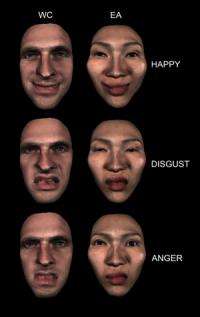
Rather than conduct an expensive and time consuming comparative survey, the team instead built a simple computer application that was capable of displaying animated faces on a computer screen capable of showing up to 4800 different facial expressions. For their experiment, they created one group of faces that looked western, and another that looked Asian. Then, they had volunteers look at the faces and offer their opinions of what the facial expressions meant.
To no ones surprise, when the volunteers were westerners looking at expressions on faces of either culture, they tended to follow along with Darwins assumptions. But when the volunteers were non-westernized Asians, their view of what the expressions represented tended to be slightly different from those of westerners, particularly when looking at faces that were supposed to represent fear, surprise anger or disgust. This, the researchers say, is likely due to cultural based connections between emotions such as shame, guilt or pride which can result in people putting on a different face than would those from other cultures. In Asian cultures, they say, more use is made of subtle widening or narrowing of the eyes, for example.
While the team did find that general facial expressions such as those of people smiling or laughing appear to be universal, they note that others are not so clear cut and that the underlying assumption that facial expressions are universal is simply not true.
More information: Facial expressions of emotion are not culturally universal, PNAS, Published online before print April 16, 2012, doi: 10.1073/pnas.1200155109
Abstract
Since Darwins seminal works, the universality of facial expressions of emotion has remained one of the longest standing debates in the biological and social sciences. Briefly stated, the universality hypothesis claims that all humans communicate six basic internal emotional states (happy, surprise, fear, disgust, anger, and sad) using the same facial movements by virtue of their biological and evolutionary origins [Susskind JM, et al. (2008) Nat Neurosci 11:843850]. Here, we refute this assumed universality. Using a unique computer graphics platform that combines generative grammars [Chomsky N (1965) MIT Press, Cambridge, MA] with visual perception, we accessed the minds eye of 30 Western and Eastern culture individuals and reconstructed their mental representations of the six basic facial expressions of emotion. Cross-cultural comparisons of the mental representations challenge universality on two separate counts. First, whereas Westerners represent each of the six basic emotions with a distinct set of facial movements common to the group, Easterners do not. Second, Easterners represent emotional intensity with distinctive dynamic eye activity. By refuting the long-standing universality hypothesis, our data highlight the powerful influence of culture on shaping basic behaviors once considered biologically hardwired. Consequently, our data open a unique naturenurture debate across broad fields from evolutionary psychology and social neuroscience to social networking via digital avatars.
Journal reference:
Proceedings of the National Academy of Sciences
© 2012 Medical Xpress
-
Perception of facial expressions differs across cultures
Sep 01, 2011 |
not rated yet |
0
-
Facial expressions show language barriers too
Aug 13, 2009 |
not rated yet |
0
-
Brain takes just 200 milliseconds to interpret facial expressions
May 26, 2009 |
not rated yet |
0
-
Men have a stronger reaction to seeing other men's emotions compared with women's
Dec 07, 2011 |
not rated yet |
0
-
Recognition of facial expressions is not universal
Jan 26, 2010 |
not rated yet |
0
-
Motion perception revisited: High Phi effect challenges established motion perception assumptions
Apr 23, 2013 |
3 / 5 (2) |
2
-
Anything you can do I can do better: Neuromolecular foundations of the superiority illusion (Update)
Apr 02, 2013 |
4.5 / 5 (11) |
5
-
The visual system as economist: Neural resource allocation in visual adaptation
Mar 30, 2013 |
5 / 5 (2) |
9
-
Separate lives: Neuronal and organismal lifespans decoupled
Mar 27, 2013 |
4.9 / 5 (8) |
0
-
Sizing things up: The evolutionary neurobiology of scale invariance
Feb 28, 2013 |
4.8 / 5 (10) |
14
-
How can there be villous adenoma in colon, if there are no villi there
3 hours ago
-
How can there be a term called "intestinal metaplasia" of stomach
May 21, 2013
-
Pressure-volume curve: Elastic Recoil Pressure don't make sense
May 18, 2013
-
If you became brain-dead, would you want them to pull the plug?
May 17, 2013
-
MRI bill question
May 15, 2013
-
Ratio of Hydrogen of Oxygen in Dessicated Animal Protein
May 13, 2013
- More from Physics Forums - Medical Sciences
More news stories
American, Nepalese kids a world apart on social duties
(Medical Xpress)—Preschoolers universally recognize that one's choices are not always free – that our decisions may be constrained by social obligations to be nice to others or follow rules set by parents ...
Psychology & Psychiatry
2 hours ago |
not rated yet |
0
Ethicists' behavior not more moral, study finds
(Medical Xpress)—Do ethicists engage in better moral behavior than other professors? The answer is no. Nor are they more likely than nonethicists to act according to values they espouse, according to researchers from the ...
Psychology & Psychiatry
3 hours ago |
5 / 5 (1) |
0
Study says empathy plays a key role in moral judgments
Is it permissible to harm one to save many? Those who tend to say "yes" when faced with this classic dilemma are likely to be deficient in a specific kind of empathy, according to a report published in the scientific journal ...
Psychology & Psychiatry
6 hours ago |
not rated yet |
0
|
Weather worries can threaten a child's mental health
(HealthDay)—The monstrous tornado that devastated Moore, Okla., on Monday, killing dozens of adults and children, is a stunning example of violent weather that can affect a child's mental well-being.
Psychology & Psychiatry
19 hours ago |
not rated yet |
0
Teens exposed to schoolmate's death by suicide much more likely to consider or attempt suicide
Youth who had a schoolmate die by suicide are significantly more likely to consider or attempt suicide, according to a study in published in CMAJ (Canadian Medical Association Journal). This effect can last 2 years or mo ...
Psychology & Psychiatry
22 hours ago |
not rated yet |
0
Study finds new pneumococcal vaccine appears to be as safe as previously used vaccine
The new 13-valent pneumococcal conjugate vaccine (PCV13) appears to be as safe as the previous version used prior to 2010, the 7-valent pneumococcal conjugate vaccine (PCV7), according to a Kaiser Permanente study published ...
Addiction to unhealthy foods could help explain the global obesity epidemic
Research presented today shows that high-fructose corn syrup can cause behavioural reactions in rats similar to those produced by drugs of abuse such as cocaine. These results, presented by addiction expert Francesco Leri, ...
A molecular explanation for age-related fertility decline in women
(Medical Xpress)—Scientists supported by the National Institutes of Health have a new theory as to why a woman's fertility declines after her mid-30s. They also suggest an approach that might help slow ...
If you can remember it, you can remember it wrong
(Medical Xpress)—Native peoples in regions where cameras are uncommon sometimes react with caution when their picture is taken. The fear that something must have been stolen from them to create the photo ...
Phthalates: Study links chemicals widely found in plastics, processed food to elevated blood pressure in children, teens
Plastic additives known as phthalates (pronounced THAL-ates) are odorless, colorless and just about everywhere: They turn up in flooring, plastic cups, beach balls, plastic wrap, intravenous tubing and—according to the ...
Medical researchers discover new ways to target, develop and design drugs to prevent and treat viral infection
Researchers at the University of Alberta have discovered a new drug target, developed a new drug and identified a new way to design drugs—all of which could be a winning combination in the battle against viruses.