Microchip success for bionic eye
April 3, 2012 in Ophthalmology

Microchip success for bionic eye

Enlarge

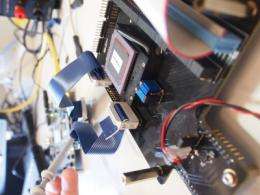
Microchip for the bionic eye

(Medical Xpress) -- Research to restore sight to the clinically blind has reached a critical stage, with testing underway of the prototype microchips that will power the bionic eye.

Electrical engineers from the Monash Vision Group (MVG) have begun trailling the , with early laboratory tests proving positive, and pre-clinical assessment due to begin shortly.

The Director of MVG, Professor Arthur Lowery said the positive result meant the project was on track to deliver a direct-to-brain bionic ready for patient tests in 2014.

The device will consist of a mounted into a pair of glasses, which acts as the retina; a pocket processor, which takes the electronic information from the camera and converts it into signals enabling the brain to build up a visual construct; and cortical implants of several tiles which will be the portal for the stimulation of the .

“The aim for this vision prosthetic is to be at least equivalent to a seeing-eye dog or a white cane. While it would initially complement existing aids such as these, we believe the device eventually will replace them, and as the technology is further refined, become sufficiently sensitive to discriminate large print,” Professor Lowery said.

“The microchips we are testing will be implanted directly on the surface of a patient’s visual cortex, located at the back of the brain. It’s estimated that each patient will receive a grid of up to 14 eight-by-eight millimetre tiles,” Professor Lowery said.

Each tile comprises a four-by-four millimeter microchip with some 500,000 transistors and 45 hair-thin electrodes. When fully operational, these tiles will receive low-resolution, black-and-white images from an external digital processing unit connected to a high-resolution camera.

Dr. Jean-Michel Redouté, MVG’s Program Leader, Implantable Electronics, said one of the project’s main challenges was harnessing and powering this array of electrically-charged devices in the brain.

“Achieving acceptable vision requires far more electrode capacity than the amount required to power a bionic ear. While the bionic ear requires approximately 15 electrodes, we’ll need at least 600 to produce useful vision for patients,” Dr. Redouté said.

Over 50,000 people in Australia are considered clinically blind. The number exceeds 160 million globally .

The MVG was established in April 2010, with an $8 million grant from the Australian Research Council. The MVG accommodates more than 20 leaders in physiology, neurosurgery, ophthalmology, electrical and electronic engineering, mechanical and materials engineering, mathematics and immunology.

Provided by Monash University search and more info website

4.4 /5 (9 votes)  

Rank 4.4 /5 (9 votes)
Related Stories
Relevant PhysicsForums posts

More news stories

New study pinpoints biochemical mechanism underlying fibrosis following glaucoma surgery

The most common cause of failure after glaucoma surgery is scarring at the surgical site, so researchers are actively looking for ways to minimize or prevent scar formation. Previous work had suggested that vascular endothelial ...

Ophthalmology created 16 hours ago | popularity not rated yet | comments 0 | with audio podcast

Early screenings key to diagnosing glaucoma

New research is emphasizing the importance of regular screenings for glaucoma, a disease that deteriorates the optic nerve over time and is a leading cause of irreversible blindness worldwide. The onset of glaucoma is associated ...

Ophthalmology created 20 hours ago | popularity not rated yet | comments 0 | with audio podcast

University partners with Sony to find cure for 'lazy eye'

The University of Nottingham and Nottingham University Hospitals NHS Trust, have been working with Sony Computer Entertainment Europe (SCEE) to develop special 3-D glasses and games to help treat children ...

Ophthalmology created May 08, 2013 | popularity not rated yet | comments 0

First corneal transplant with pre-loaded donor tissue performed at Mass. Eye and Ear

The first successful cornea transplant with donor endothelial tissue preloaded by an eye bank has been performed at Massachusetts Eye and Ear in Boston, Mass. Roberto Pineda II, M.D., Director of the Refractive Surgery Service ...

Ophthalmology created May 07, 2013 | popularity 5 / 5 (1) | comments 0

Study provides clarity on supplements for protection against blinding eye disease

Adding omega-3 fatty acids did not improve a combination of nutritional supplements commonly recommended for treating age-related macular degeneration (AMD), a major cause of vision loss among older Americans, ...

Ophthalmology created May 06, 2013 | popularity 3 / 5 (2) | comments 0 | with audio podcast


AIDS science at 30: 'Cure' now part of lexicon

Big names in medicine are set to give an upbeat assessment of the war on AIDS on Tuesday, 30 years after French researchers identified the virus that causes the disease.

For combat veterans suffering from post-traumatic stress disorder, 'fear circuitry' in the brain never rests

Chronic trauma can inflict lasting damage to brain regions associated with fear and anxiety. Previous imaging studies of people with post-traumatic stress disorder, or PTSD, have shown that these brain regions can over-or ...

Temporal processing in the olfactory system

The neural machinery underlying our olfactory sense continues to be an enigma for neuroscience. A recent review in Neuron seeks to expand traditional ideas about how neurons in the olfactory bulb might encode information about ...

Melon focus headband turns to Kickstarter for rollout plans

(Medical Xpress)—What if the quality of your work depends more on your focus on the piano keys or canvas or laptop than your musical or painting or computing skills? If target users can be convinced, they ...

Now we know why old scizophrenia medicine works on antibiotics-resistant bacteria

In 2008 researchers from the University of Southern Denmark showed that the drug thioridazine, which has previously been used to treat schizophrenia, is also a powerful weapon against antibiotic-resistant bacteria such as ...

Study identifies new approach to improving treatment for MS and other conditions

(Medical Xpress)—Working with lab mice models of multiple sclerosis (MS), UC Davis scientists have detected a novel molecular target for the design of drugs that could be safer and more effective than current FDA-approved ...