Online tool helps those with BRCA mutations understand options
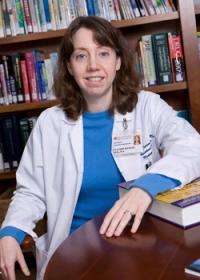
(Medical Xpress) -- At age 47, Melanie Lemons has already had her ovaries removed. With a few clicks of her computer’s mouse, she can see her estimated chance of survival if she has her breasts removed as well.
Women like Lemons — who have a high risk for developing breast and ovarian cancers — used to face their heart-wrenching decisions without much of a road map. Now, with information at her fingertips from a tool developed by School of Medicine researchers, she can wrestle with the tough choices on her own terms.
“I go back to it regularly,” Lemons said, “just to remind myself what the numbers are and to play with them — because I can change all the variables.”
Launched earlier this year, the online, interactive tool allows women with known mutations in the BRCA1 or BRCA2 genes, which put them at high risk for cancer, to see what their chances of survival would be after taking different preventive measures at different ages. The tool, which can be found on the Stanford Cancer Institute website at brcatool.stanford.edu/, already receives around 1,000 visits per month. High-risk cancer patients are praising it as an empowering way to help cope with and plan for preventive treatments.
“We wanted to create something simple that would lay out the numbers in a straightforward fashion,” said co-developer Allison Kurian, MD, an assistant professor of oncology and of health research and policy at the Stanford School of Medicine who was the lead author of a paper describing the online tool in the Feb. 10 issue of Journal of Clinical Oncology. “We hope that this leads to an informed dialogue between doctors and patients.”
Kurian and colleagues designed the tool for women with BRCA1 and BRCA2 mutations, which cripple a gene that normally helps protect DNA. Those who carry the mutation have a 40 to 60 percent chance of developing ovarian and/or breast cancer. Usually, carriers learn their status only after a family member turns up with cancer.
That’s exactly how Lemons discovered her mutation. After her oldest sister was diagnosed with breast cancer and found to carry the BRCA2 mutation, Lemons, along with her two other sisters and their mother, went for screening. They all had it too.
“There’s only about a 12 percent chance that the entire family would be positive,” said Lemons, who lives in San Luis Obispo, Calif. “But my sister basically gave us a crystal ball by doing the genetic testing.”
Since the discovery, Lemons decided to have a preventive surgery to remove her ovaries — prophylactic oophorectomy — thus nearly eliminating her risk for ovarian cancer and significantly reducing her chance of developing breast cancer. Her twin sister and mother have undergone prophylactic mastectomies, which removes breast tissue. Lemons is now debating the breast surgery for herself.
Using the online tool, she can compare her options. She starts by selecting from a drop-down menu that she has a BRCA2 mutation rather than BRCA1, then clicks on her age range. Lemons then can select her current cancer-screening regimen — an MRI or mammogram every six months — and can see the array of possible outcomes.
“The tool shows the chances of developing cancer and surviving the disease,” said associate professor of radiology Sylvia Plevritis, PhD, who developed the tool’s underlying mathematical model of cancer progression using mounds of published clinical data, and senior author of the recent publication. “It lets women put their risks in perspective.”
For now, the decision tool predicts that Lemons has a 59 percent chance of getting to age 70 without a hint of cancer, a 21 percent chance of getting breast cancer and surviving, and a 3 percent chance of the worst-case scenario. For comparison, the tool also shows what her chances of survival would be if she had done nothing or if she wasn’t a BRCA2 mutation carrier.
“It’s been really helpful in just wrapping my mind around what my chances and my choices are,” Lemons said. “But, it was surprising to me that I still have such a high risk of getting breast cancer.”
If she gets a mastectomy by age 50, her chance of dodging cancer jumps to 73 percent, with an 8 percent chance of getting and surviving breast cancer, and only a 1 percent chance of not surviving. If she puts the operation off, her chances would change again.
“It’s something that takes some time to process and think about with the different scenarios,” Kurian said. She hopes that patients will use the tool on their own terms, just as Lemons has been doing, and talk over options and decisions with their doctor when they’re ready.
“I’ll probably go down the route of a mastectomy,” Lemons said. “I just need to come to grips and do it. Basically, that’s what this tool has allowed me to do — just to come to that decision on my own with the information. It helps you feel a little bit more in control of something you have absolutely no control over.”
In addition to Kurian and Plevritis, other Stanford scientists involved in developing the tool include graduate student Diego Munoz, research assistant Elizabeth Schackmann and program manager of Stanford’s cancer genetics program Meredith Mills.
This work was supported by the National Institutes of Health, the Robert Wood Johnson Foundation and a Stanford Cancer Institute developmental research award.
The medical school’s departments of Medicine, of Health Research and Policy and of Radiology also supported this work.


