April 10, 2012 report
Researchers find head turning resets cocktail party effect
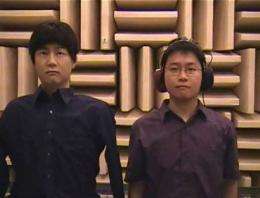
(Medical Xpress) -- Anyone who has ever been to a cocktail party knows how difficult it can be to hear and follow conversations due to a host of distracting noises. Some might have even noticed that if they focus on a person talking, that after a few seconds, it seems to become easier to follow what they are saying. That’s the basis for what researchers call, the “cocktail party effect.” But how and why it works, and sometimes doesn’t is still poorly understood. To find out more, a team of Japanese researchers from NTT Communication Science Laboratories conducted a series of experiments and found, as they report in their paper published in the Proceedings of National Academy of Sciences, that something as innocuous as moving one’s head can upset the cocktail party effect, forcing the listener to once again focus and wait for the clearing-up to kick in again.
The first experiment consisted of asking volunteers to sit across from an electronic speaker that emitted tones selected by the researchers. Two different kinds of tones were played intermittently, making it difficult to focus on either one. But as with conversation at a cocktail party, listeners soon were able to differentiate between the two and to follow either.
Next, the researchers sat volunteers alone in a room with headphones on. In another room they sat a robot (that could be seen by the volunteer) with microphones in its ear canals. Then, the same types of tones as before were sounded and were picked up by the microphones in the robot and relayed to the human volunteer. In this setup, the researchers could monitor and measure the cocktail party effect while changing several parameters. They could for instance, ask the volunteer to turn his or her head just out of the blue to see how it impacted their ability to follow the tones. Or they could ask that it only be done when the robot did so, or have the robot mimic the head movements of the volunteer, or they could vary the source of the sound, or add other variables such as distracting lights.
After running through all possible scenarios, the researchers found that the cocktail party effect is very fleeting, and that something as simple as a turning of the head, then turning back can cause the clarity that was just there to disappear, forcing the listener to find it again by focusing. Interestingly they also found that other changes in the environment do not. For instance, if the listener switched focus for just an instant when distracted by blinking lights, it didn’t force the brain to begin sifting through the tones again, it held on and kept the ability to differentiate the tones.
The researchers also found that losing the stream of sounds and then refocusing on it didn’t appear to change the volunteers’ ability to get the gist of the entire stream, possibly explaining how people are able to follow a conversation stream at a cocktail party even if they lose the clear thread occasionally.
More information: Effects of self-motion on auditory scene analysis, PNAS, Published online before print April 9, 2012, doi: 10.1073/pnas.1112852109
Abstract
Auditory scene analysis requires the listener to parse the incoming flow of acoustic information into perceptual “streams,” such as sentences from a single talker in the midst of background noise. Behavioral and neural data show that the formation of streams is not instantaneous; rather, streaming builds up over time and can be reset by sudden changes in the acoustics of the scene. Here, we investigated the effect of changes induced by voluntary head motion on streaming. We used a telepresence robot in a virtual reality setup to disentangle all potential consequences of head motion: changes in acoustic cues at the ears, changes in apparent source location, and changes in motor or attentional processes. The results showed that self-motion influenced streaming in at least two ways. Right after the onset of movement, self-motion always induced some resetting of perceptual organization to one stream, even when the acoustic scene itself had not changed. Then, after the motion, the prevalent organization was rapidly biased by the binaural cues discovered through motion. Auditory scene analysis thus appears to be a dynamic process that is affected by the active sensing of the environment.
© 2012 Phys.Org


