Single-neuron observations mark steps in Alzheimer's disease
April 20, 2012 in Alzheimer's disease & dementia

Single-neuron observations mark steps in Alzheimer's disease

Enlarge

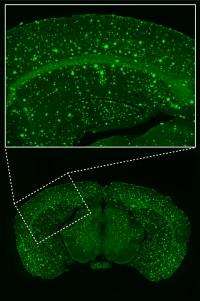
These are microscopic images of a brain section (bottom: overview. top: enlarged view of the visual cortex), obtained from an APP23xPS45 Alzheimer mouse, in which the beta-amyloid plaques are labeled with Thioflavin-S. Credit: Konnerth lab, TU Muenchen

Studying a mouse model of Alzheimer's disease, neuroscientists at the Technische Universitaet Muenchen have observed correlations between increases in both soluble and plaque-forming beta-amyloid – a protein implicated in the disease process – and dysfunctional developments on several levels: individual cortical neurons, neuronal circuits, sensory cognition, and behavior. Their results, published in Nature Communications, show that these changes progress in parallel and that, together, they reveal distinct stages in Alzheimer's disease with a specific order in time.

In addition to its well known, devastating effects on memory and learning, Alzheimer's disease can also impair a person's sense of smell or vision. Typically these changes in sensory cognition only show themselves behaviorally when the disease is more advanced. A new study sheds light on what is happening in the brain throughout the disease process, specifically with respect to the part of the cerebral cortex responsible for integrating visual information. A team led by Prof. Arthur Konnerth, a Carl von Linde Senior Fellow of the TUM Institute for Advanced Study, has observed Alzheimer's-related changes in the visual cortex at the single-cell level.
Single-neuron observations mark steps in Alzheimer's disease
Enlarge

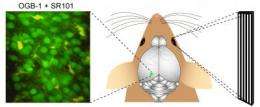
This schematic illustration shows the experimental arrangement for in vivo two-photon calcium imaging of stimulation-evoked neuronal activity in anesthetized mice. At left, in vivo two-photon image of the visual cortex. The neurons are stained with the calcium indicator dye Oregon Green BAPTA-1 (green, OGB-1) and the astrocytes with Sulforhodamine 101 (yellow, SR101). Right, visual stimuli were projected on a screen placed in front of the eye of the mouse. Credit: Konnerth lab, TU Muenchen

Using a technique called two-photon calcium imaging, the researchers recorded both spontaneous and stimulated signaling activity in cortical of living mice: transgenic mice carrying mutations that cause Alzheimer's disease in humans, and wild-type mice as a control group. By observing how neuronal signaling responded to a special kind of vision test – in which a simple grating pattern of light and dark bars moves in front of the mouse's eye – the scientists could characterize the visual circuit as being more or less "tuned" to specific orientations and directions of movement.

Konnerth explains, "Like many Alzheimer's patients, the diseased mice have impairments in their ability to discriminate visual objects. Our results provide important new insights on the cause that may underlie the impaired behavior, by identifying in the visual cortex a fraction of neurons with a strongly disturbed function." And within this group, the researchers discovered, there are two subsets of neurons – both dysfunctional, but in completely different ways. One subset, thought to be the first neurons to degenerate, showed no activity at all; the other showed a pathologically high level of activity, rendering these neurons incapable of properly sensing objects in the mouse's environment. "While around half of the neurons in the visual cortex were disturbed in one way or the other, roughly half responded normally," notes Christine Grienberger, a doctoral candidate in Konnerth's institute and first author of this paper. "That could have significant implications for future research in the field of Alzheimer's disease, as our findings raise the question of whether future work only needs to target this population of neurons that are disturbed in their function."
Single-neuron observations mark steps in Alzheimer's disease
Enlarge

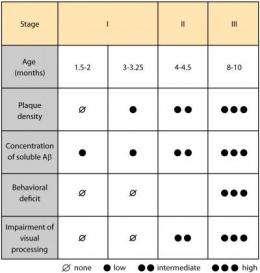
This is a table illustrating the staged decline of the cortical circuit function on the level of the beta-amyloid load, the behavioral deficits and the visual processing. Credit: Konnerth lab, TU Muenchen

The in vivo single-neuron experiments were carried out for three age groups, corresponding to different stages of this progressive, degenerative disease. The results were correlated with other measurements, including soluble beta-amyloid levels and the density of beta-amyloid plaques in the brain tissue. The researchers' findings show for the first time a progressive decline of function in cortical circuits. "An important conclusion from this study," Konnerth says, "is that the Alzheimer's disease-related changes on all levels – including behavior, cortical circuit dysfunction, and the density of amyloid plaques in diseased brains – progress in parallel in a distinct temporal order. In the future, the identification of such stages in patients may help researchers pinpoint stage-specific and effective therapies, with reduced levels of side effects."

More information: Nature Communications, April 10, 2012. DOI: 10.1038/ncomms1783

Journal reference: Nature Communications search and more info website

Provided by Technische Universitaet Muenchen

not rated yet  

Rank not rated yet
Relevant PhysicsForums posts
  • The idea behind a reverse shock
    created2 hours ago
  • Guass's Law for a charge distribution
    created2 hours ago
  • Noise dependence
    created3 hours ago
  • siphon and bernouli theorum
    created5 hours ago
  • Hot gas expansion rate into outer space
    created5 hours ago
  • Magnetic field lines through copper
    created10 hours ago
  • More from Physics Forums - Classical Physics

More news stories

A new strategy required in the search for Alzheimer's drugs?

In the search for medication against Alzheimer's disease, scientists have focused – among other factors – on drugs that can break down Amyloid beta (A-beta). After all, it is the accumulation of A-beta that causes the ...

Alzheimer's disease & dementia created May 24, 2013 | popularity not rated yet | comments 0

Alzheimer's disease, the soft target of the euthanasia debate

(Medical Xpress)—The way Alzheimer's disease is portrayed by advocacy groups and the media is having undue influence on the euthanasia debate, according to a Deakin University nursing ethics professor.

Alzheimer's disease & dementia created May 24, 2013 | popularity not rated yet | comments 2

Scientists discover cinnamon compounds' potential ability to prevent Alzheimer's

Cinnamon: Can the red-brown spice with the unmistakable fragrance and variety of uses offer an important benefit? The common baking spice might hold the key to delaying the onset of –– or warding off ...

Alzheimer's disease & dementia created May 23, 2013 | popularity 5 / 5 (5) | comments 0 | with audio podcast

Drug reverses Alzheimer's disease deficits in mice, research confirms

An anti-cancer drug reverses memory deficits in an Alzheimer's disease mouse model, University of Pittsburgh Graduate School of Public Health researchers confirm in the journal Science.

Alzheimer's disease & dementia created May 23, 2013 | popularity not rated yet | comments 0 | with audio podcast

Multiple research teams unable to confirm high-profile Alzheimer's study

Teams of highly respected Alzheimer's researchers failed to replicate what appeared to be breakthrough results for the treatment of this brain disease when they were published last year in the journal Science.

Alzheimer's disease & dementia created May 23, 2013 | popularity 3 / 5 (2) | comments 3 | with audio podcast


Seniors more likely to crash when driving with pet, study finds

(HealthDay)—Animals make great companions for senior citizens, but elderly people who always drive with a pet in the car are far more likely to crash than those who never drive with a pet, researchers have ...

First drug to improve heart failure mortality in over a decade

Coenzyme Q10 decreases all cause mortality by half, according to the results of a multicentre randomised double blind trial presented today at Heart Failure 2013 congress. It is the first drug to improve heart failure mortality ...

Heart failure accelerates male 'menopause'

Heart failure accelerates the aging process and brings on early andropausal syndrome (AS), according to research presented today at the Heart Failure Congress 2013. AS, also referred to as male 'menopause', was four times ...

Death highest in heart failure patients admitted in January, on Friday, and overnight

Mortality and length of stay are highest in heart failure patients admitted in January, on Friday, and overnight, according to research presented today at the Heart Failure Congress 2013. The analysis of nearly 1 million ...

Feds fight morning-after pill age ruling in NY

(AP)—Department of Justice lawyers have again asked a federal appeals court in New York to delay lifting age restrictions and prescription requirements on an emergency contraceptive popularly known as the morning-after ...

New immune system discovered

(Medical Xpress)—A research team, led by Jeremy Barr, a biology post-doctoral fellow, unveils a new immune system that protects humans and animals from infection.