Born to run barefoot? Some end up getting injured
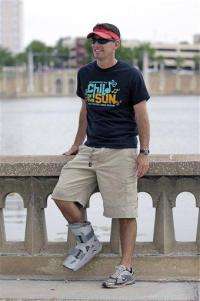
(AP) -- Swept by the barefoot running craze, ultramarathoner Ryan Carter ditched his sneakers for footwear that mimics the experience of striding unshod.
The first time he tried it two years ago, he ran a third of a mile on grass. Within three weeks of switching over, he was clocking six miles on the road.
During a training run with a friend along a picturesque bike path near downtown Minneapolis, Carter suddenly stopped, unable to take another step. His right foot seared in pain.
"It was as though someone had taken a hammer and hit me with it," he recalled.
Carter convinced his friend to run on without him. He hobbled home and rested his foot. When the throbbing became unbearable days later, he went to the doctor. The diagnosis: a stress fracture.
As more avid runners and casual athletes experiment with barefoot running, doctors say they are treating injuries ranging from pulled calf muscles to Achilles tendinitis to metatarsal stress fractures, mainly in people who ramped up too fast. In serious cases, they are laid up for several months.
Many converts were inspired by Christopher McDougall's 2009 best-seller "Born To Run," widely credited with sparking the barefoot running trend in the Western world. The book focuses on an Indian tribe in Mexico whose members run long distances without pain in little more than sandals.
While the ranks of people running barefoot or in "barefoot running shoes" have grown in recent years, they still represent the minority of runners. Some devotees swear they are less prone to injuries after kicking off their athletic shoes though there's no evidence that barefoot runners suffer fewer problems.
In some cases, foot specialists are noticing injuries arising from the switch to barefoot, which uses different muscles. Shod runners tend to have a longer stride and land on their heel compared with barefoot runners, who are more likely to have a shorter stride and land on the midfoot or forefoot. Injuries can occur when people transition too fast and put too much pressure on their calf and foot muscles, or don't shorten their stride and end up landing on their heel with no padding.
Podiatrist Paul Langer used to see one or two barefoot running injuries a month at his Twin Cities Orthopedics practice in Minneapolis. Now he treats between three and four a week.
"Most just jumped in a little too enthusiastically," said Langer, an experienced runner and triathlete who trains in his barefoot running shoes part of the week.
Bob Baravarian, chief of podiatry at the UCLA Medical Center in Santa Monica, Calif., said he's seen "a fair number" of heel injuries and stress fractures among first-timers who are not used to the different forces of a forefoot strike.
"All of a sudden, the strain going through your foot is multiplied manifold" and problems occur when people don't ease into it, he said.
Running injuries are quite common. Between 30 to 70 percent of runners suffer from repetitive stress injuries every year and experts can't agree on how to prevent them. Some runners with chronic problems have seized on barefoot running as an antidote, claiming it's more natural. Others have gone so far as to demonize sneakers for their injuries.
Pre-human ancestors have walked and run in bare feet for millions of years often on rough surfaces, yet researchers surprisingly know very little about the science of barefoot running. The modern running shoe with its cushioned heel and stiff sole was not invented until the 1970s. And in parts of Africa and other places today, running barefoot is still a lifestyle.
The surging interest has researchers racing for answers. Does barefoot running result in fewer injuries? What kinds of runners will benefit most from switching over? What types of injuries do transitioning barefoot runners suffer and how to prevent them?
While some runners completely lose the shoes, others opt for minimal coverage. The oxymoron "barefoot running shoes" is like a glove for the feet designed to protect from glass and other hazards on the ground. Superlight minimalist shoes are a cross between barefoot shoes and traditional sneakers - there's little to no arch support and they're lower profile.
Greg Farris decided to try barefoot running to ease the pain on the outside of his knee, a problem commonly known as runner's knee. He was initially shoeless - running minutes at a time and gently building up. After three months, he switched to barefoot running shoes after developing calluses.
Halfway through a 5K run in January, he felt his right foot go numb, but he pushed on and finished the race. He saw a doctor and got a steroid shot, but the pain would not quit. He went to see another doctor, who took an X-ray and told him he had a stress fracture.
Farris was in a foot cast for three months. He recently started running again - in sneakers.
"I don't think my body is made to do it," he said, referring to barefoot running.
Experts say people can successfully lose the laces. The key is to break in slowly. Start by walking around barefoot. Run no more than a quarter mile to a mile every other day in the first week. Gradually increase the distance. Stop if bones or joints hurt. It can take months to make the change.
"Don't go helter skelter at the beginning," said Dr. Jeffrey Ross, an associate clinical professor of medicine at Baylor College of Medicine and chief of the Diabetic Foot Clinic at Ben Taub General Hospital in Houston.
A year and a half ago, Ross saw a steady stream - between three and six barefoot runners a week - with various aches and pain. It has since leveled off to about one a month.
Ross doesn't know why. It's possible that fewer people are trying it or those baring their feet are doing a better job adapting to the new running style.
There's one group foot experts say should avoid barefoot running: People with decreased sensation in their feet, a problem common among diabetics, since they won't be able to know when they get injured.
Harvard evolutionary biologist Daniel Lieberman runs a lab devoted to studying the effects of running form on injury rates. He thinks form matters more than footwear or lack of - don't overstride, have good posture and land gently.
In a 2010 study examining different running gaits, Lieberman and colleagues found that striking the ground heel first sends a shock up through the body while barefoot runners tend to have a more springy step. Even so, more research is needed into whether barefoot running helps avoid injury.
"The long and the short of it is that we know very little about how to help all runners - barefoot and shod - prevent getting injured. Barefoot running is no panacea. Shoes aren't either," said Lieberman, who runs barefoot except during the New England winters.
Carter, the ultramarathoner, blames himself for his injury. Before he shed his shoes, he never had a problem that kept him off his feet for two months.
In April, he ran his fourth 100-mile race - with shoes. Meanwhile, his pair of barefoot running shoes is collecting dust in the closet.
©2012 The Associated Press. All rights reserved. This material may not be published, broadcast, rewritten or redistributed.


